
Cryptocurrency markets operate around the clock, creating opportunities for traders but also making continuous market monitoring difficult to manage manually. Crypto trading bots address this challenge by automating predefined trading strategies, monitoring market conditions, and executing trades through connected exchange accounts.
However, developing a reliable crypto trading bot requires more than implementing buy and sell logic. The system needs to process market data quickly, connect securely with cryptocurrency exchanges, manage trading strategies, handle API failures, protect sensitive credentials, and provide users with sufficient visibility into automated activity. The underlying architecture also needs to remain stable when market activity and transaction volumes increase.
For businesses planning to build an automated crypto trading platform, choosing the right technology partner can therefore have a direct impact on the reliability and scalability of the product.
This article highlights the top crypto trading bot development companies that can be considered by startups, crypto businesses, exchanges, and organizations planning to build customized automated trading solutions.
What is a Crypto Trading Bot?
A crypto trading bot is a software application that automatically executes cryptocurrency trading strategies based on predefined rules, market data, or algorithmic signals.
Instead of requiring a trader to manually monitor markets and place every order, a bot can continuously evaluate configured conditions and interact with supported cryptocurrency exchanges through APIs.
Depending on the product's objectives, a crypto trading bot can support capabilities such as:
- Automated buy and sell orders
- Technical indicator-based strategies
- Arbitrage trading
- Portfolio rebalancing
- Grid trading
- Market monitoring and alerts
- Risk and position management
- Backtesting of trading strategies
- Multiple exchange integrations
- Trading performance analytics
Crypto trading bots can be developed for individual traders, crypto investment platforms, trading firms, exchanges, or businesses offering automated trading products to their customers.
Because these systems can interact directly with financial markets and exchange accounts, reliability, security, data accuracy, and careful handling of API credentials are essential considerations when selecting a crypto trading bot development company.
Why Invest in Crypto Trading Bot Development in 2026?
The cryptocurrency market operates continuously, unlike traditional markets that follow defined trading sessions. This creates a natural use case for automation because manually tracking market conditions throughout the day and night is difficult for individual traders and businesses alike.
Automated trading platforms can also help users apply predefined strategies consistently instead of making every trading decision manually. Depending on the strategy, automation can monitor price movements, identify predefined market conditions, and execute orders according to configured rules.
For businesses, a custom trading bot can also become the foundation of a broader crypto product rather than simply functioning as an isolated automation tool.
Some of the key opportunities driving crypto trading bot development include:
- 24/7 Market Monitoring: Automated systems can continuously monitor supported markets without requiring users to remain active throughout the day.
- Strategy Automation: Trading rules can be encoded into software so that predefined strategies can be executed consistently.
- Multi-Exchange Trading: Businesses can connect the platform with multiple exchanges and provide users with a centralized trading experience.
- Portfolio Automation: Bots can support portfolio rebalancing and other rule-based portfolio management workflows.
- Data-Driven Trading: Real-time market data, technical indicators, and analytics can be incorporated into automated strategies.
- Advanced Algorithmic Strategies: More sophisticated platforms can incorporate custom algorithms, backtesting, machine learning models, AI agents in trading, and other analytical components where appropriate.
How We Selected the Top Crypto Trading Bot Development Companies
Selecting a development partner for an automated crypto trading platform requires evaluating capabilities beyond conventional mobile or web development. We considered the following factors when structuring this list:
- Technical Expertise: We considered the company's capabilities across custom software development, backend engineering, mobile applications, APIs, artificial intelligence, blockchain, and other technologies relevant to automated trading platforms.
- Crypto And Blockchain Experience: Experience with cryptocurrency, blockchain, exchanges, wallets, decentralized applications, and related financial technology can be particularly valuable when developing trading automation.
- API And Integration Capabilities: Trading bots depend heavily on exchange APIs and external market data. Development teams need to understand authentication, order execution, real-time data feeds, error handling, and integration reliability.
- Security Considerations: Trading systems handle sensitive credentials and potentially valuable financial assets. Secure architecture, authentication, access controls, encryption, and careful API-key management are important considerations.
- Client Reviews And Reputation: Clutch ratings, review volumes, Google ratings where supplied, and other provided reputation indicators were considered when comparing companies.
- Development Cost: Hourly rates were reviewed alongside technical capabilities and market reputation rather than being treated as the sole indicator of value.
- Scalability And Product Engineering: A trading bot that works for a small number of users may require a very different architecture when supporting large numbers of users, exchanges, strategies, and concurrent orders. Scalability was therefore considered as part of the overall evaluation.
Top 7 Crypto Trading Bot Development Companies
The companies below bring different strengths to software, blockchain, fintech, and digital product development. Businesses should evaluate their specific trading strategy, exchange requirements, security model, target users, and regulatory considerations before selecting a development partner.
1. Citrusbug Technolabs
Citrusbug Technolabs develops custom software, mobile applications, artificial intelligence solutions, and digital products for startups and businesses. Its broad engineering capabilities provide a foundation for organizations looking to develop customized trading applications rather than relying entirely on generic automation platforms.
For crypto businesses, a custom trading bot can combine market-data processing, exchange APIs, automated strategy execution, user dashboards, notifications, and analytics within a single product. Citrusbug's experience across custom application development and AI can support projects where trading automation needs to be integrated with a broader fintech or crypto platform.
Why Choose Citrusbug Technolabs for Crypto Trading Bot Development?
- Custom crypto trading bot development
- Exchange API integration and automated trade execution
- AI-powered trading analytics and automation
- Trading dashboards, portfolio tracking, and reporting
Google Rating- 5.0
Clutch Rating- 4.7
Founded- 2013
Awards- Clutch Top-Rated listings, GoodFirms recognition, Upwork Top Agency listings
Hourly Rate- $25 - $49/hr
Location- Ahmedabad, Gujarat, India
Website- Citrusbug Technolabs
2. SoluLab
SoluLab develops blockchain, Web3, AI, and custom software solutions for businesses building products around emerging technologies. Its blockchain-focused capabilities make it relevant for organizations developing cryptocurrency applications and platforms that require decentralized technology alongside conventional software components.
Its experience across blockchain and Web3 technologies can be useful when a crypto trading product needs to interact with centralized exchanges, blockchain networks, wallets, market-data services, or other external systems.
Why Choose SoluLab for Crypto Trading Bot Development?
- Crypto and blockchain application development
- Exchange and API integrations
- Web3 and decentralized application development
- AI-powered cryptocurrency solutions
Google Rating- 3.9
Clutch Rating- 4.9
Founded- 2014
Awards- Clutch Top Developer recognitions, ISO / industry certifications
Hourly Rate- $25 - $49/hr
Location- Los Angeles, California, USA
Website- SoluLab
3. Antier Solutions
Antier Solutions works across blockchain, cryptocurrency, Web3, and custom software development. Its technology capabilities cover blockchain applications and cryptocurrency-focused solutions that can form part of a wider automated trading ecosystem.
A crypto trading platform may require exchange connectivity, wallet functionality, user management, transaction monitoring, analytics, and administrative controls in addition to the trading bot itself. Antier's blockchain-oriented capabilities can support projects that combine these components into a unified product.
Why Choose Antier Solutions for Crypto Trading Bot Development?
- Cryptocurrency trading platform development
- Blockchain and Web3 application development
- Exchange, wallet, and API integrations
- Trading dashboards and digital asset solutions
Google Rating- 4.3
Clutch Rating- 5.0
Founded- 011
Awards- Clutch recognitions
Hourly Rate- $25 - $49/hr
Location- Mohali, Punjab, India
Website- Antier Solutions
4. Technoloader Pvt Ltd.
Technoloader Pvt Ltd. provides blockchain and custom software development services for businesses building digital products around emerging technologies. Its capabilities include blockchain development, cryptocurrency solutions, mobile applications, and web platforms, giving it a relevant technical base for organizations exploring automated crypto trading products.
A trading bot may need to work with exchange APIs, real-time market feeds, user accounts, trading strategies, and analytical dashboards simultaneously. Blockchain expertise can also support projects where automated trading operates alongside wallets, digital assets, and other cryptocurrency functionality.
Why Choose Technoloader for Crypto Trading Bot Development?
- Crypto trading bot development
- Blockchain and cryptocurrency solutions
- Exchange API and wallet integrations
- Web and mobile trading applications
Google Rating- 4.4
Clutch Rating- 4.9
Founded- 2019
Hourly Rate- $25 - $49/hr
Location- Jaipur, Rajasthan, India
Website- Technoloader Pvt Ltd.
5. Suffescom Solutions Inc.
Suffescom Solutions Inc. develops custom applications and emerging technology solutions across blockchain, Web3, mobile, and web platforms. Its experience in cryptocurrency-oriented development makes it relevant for businesses seeking to build digital asset products with automated trading functionality.
Crypto trading systems can involve several interconnected components, including exchange connectivity, market-data processing, strategy configuration, portfolio monitoring, and analytics. Its experience across cryptocurrency and application development can support projects where automated trading is integrated into a broader crypto product.
Why Choose Suffescom Solutions for Crypto Trading Bot Development?
- Crypto trading bot development
- Blockchain and Web3 development
- Cryptocurrency exchange and API integrations
- Trading dashboards and portfolio applications
Google Rating- 4.7
Clutch Rating- 4.9
Founded- 2013
Awards- Clutch recognitions, DesignRush listings
Hourly Rate- $25 - $49/hr
Location- New York, NY, USA
Website- Suffescom Solutions Inc
6. Dappfort
Dappfort focuses on blockchain and decentralized application development for businesses interested in building products around Web3 technologies. Its technical capabilities make it relevant for cryptocurrency projects where automated trading is combined with decentralized applications, blockchain networks, or digital asset functionality.
Depending on the architecture, crypto trading platforms may need to interact with both centralized exchange infrastructure and blockchain networks. This creates engineering requirements around transactions, wallet connectivity, smart contracts, and blockchain data.
Why Choose Dappfort for Crypto Trading Bot Development?
- Blockchain-based trading applications
- Decentralized application development
- Smart contract and wallet integrations
- Web3 and cryptocurrency solutions
Google Rating- 5.0
Clutch Rating- 4.9
Founded- 2022
Hourly Rate- $25 - $49/hr
Location- Madurai, Tamil Nadu, India
Website- Dappfort
7. Bitdeal
Bitdeal provides blockchain and cryptocurrency development services for businesses exploring digital assets and Web3 products. Its service portfolio is centered around blockchain technology and cryptocurrency solutions, making it relevant to organizations considering automated trading as part of a larger crypto ecosystem.
For a trading bot, the development scope can extend beyond strategy execution. Businesses may need exchange integrations, wallet connections, trading dashboards, market-data feeds, administrative controls, and analytics depending on the intended product.
Why Choose Bitdeal for Crypto Trading Bot Development?
- Cryptocurrency trading platform development
- Crypto trading bot development
- Blockchain and wallet integrations
- Trading dashboards and analytics
Google Rating- 4.2
Clutch Rating- 5
Founded- 2015
Hourly Rate- $25 - $49/hr
Location- India
Website- Bitdeal
Key Features to Look for in a Crypto Trading Bot
A crypto trading bot should be designed around the trading strategy and operational requirements it is expected to support within a modern trading app. The exact functionality will vary between products, but several capabilities are particularly important when building an automated trading platform.
- Exchange API Integration: The bot should securely connect with supported cryptocurrency exchanges for market-data retrieval and order execution. Robust API handling is important because exchange connectivity directly affects the system's ability to operate reliably.
- Real-Time Market Data: Automated strategies depend on timely and accurate market information. The platform should be capable of processing relevant price, volume, order-book, and other market data according to the requirements of the trading strategy.
- Strategy Configuration: Users should be able to configure supported trading strategies and parameters without modifying the underlying application. Depending on the product, this may include indicators, entry and exit conditions, trading pairs, position sizes, and other configurable rules.
- Backtesting: Backtesting allows users or strategy developers to evaluate how a strategy would have performed against historical market data before deploying it in a live environment. This can help identify configuration issues and understand potential strategy behavior.
- Risk Management: Automated trading systems should include controls around position sizes, exposure, stop-loss conditions, maximum trading limits, and other risk parameters appropriate to the strategy.
- Portfolio Monitoring: A centralized dashboard can display open positions, balances, completed trades, performance metrics, and other relevant information so users can understand what the automated system is doing.
- Multi-Exchange Support: Supporting multiple exchanges can give users greater flexibility and can enable strategies that depend on price differences or liquidity across different platforms.
- Notifications And Alerts: Users should receive relevant notifications for completed orders, errors, strategy events, connectivity problems, or other conditions requiring attention.
- Secure Credential Management: Exchange API credentials must be handled carefully. The system should use appropriate encryption, access controls, secret management, and permission configurations to reduce the risk associated with compromised credentials.
- Logging And Monitoring: Detailed logs can help developers and operators understand order execution, API responses, errors, and system behavior. Monitoring is particularly important for automated systems that can operate continuously without direct human supervision.
The goal should not be to include every possible feature in the initial release. Businesses should first identify the strategies, exchanges, users, and workflows the bot needs to support, then build the architecture around those requirements.
How Much Does Crypto Trading Bot Development Cost?
The cost of developing a crypto trading bot depends on the trading strategies, number of exchange integrations, market-data requirements, security architecture, user interface, and automation capabilities included in the product.
A basic bot that supports a single exchange and a limited set of predefined strategies requires considerably less development effort than a multi-exchange platform with backtesting, portfolio management, advanced analytics, and several automated strategies.
A general estimate can look like this:
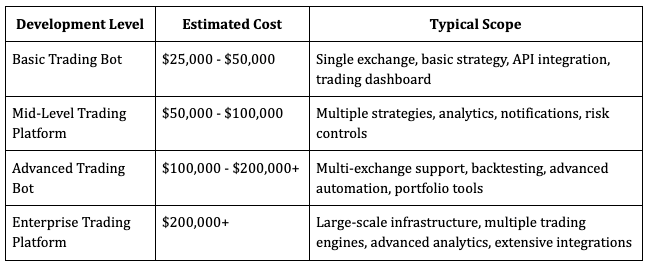
These figures are indicative rather than fixed project quotes. The final cost should be determined after defining the exchanges, trading strategies, supported assets, expected users, security requirements, and infrastructure.
Businesses should also account for ongoing expenses such as cloud infrastructure, exchange API services where applicable, monitoring, security updates, maintenance, and future feature development.
Crypto Trading Bot Development Process
Developing an automated trading system requires a structured approach because the application's trading logic, integrations, and security controls need to work together reliably.
1. Define Trading Requirements
The first stage involves identifying the target users, supported exchanges, cryptocurrencies, trading strategies, risk parameters, and overall business model. This creates the foundation for the product architecture and feature scope.
2. Design The Trading Architecture
Developers then define how market data will enter the system, how strategies will process that information, and how orders will be sent to connected exchanges. The architecture should also account for failures, latency, monitoring, and future scalability.
3. Develop Exchange Integrations
Exchange APIs are integrated to retrieve market information and execute supported trading operations. Authentication, permissions, rate limits, error handling, and connection recovery need to be addressed during this stage.
4. Build Trading Strategies
The selected trading strategies are converted into software logic. Depending on the product, this can include technical indicators, rule-based conditions, arbitrage logic, grid strategies, portfolio rebalancing, or custom algorithmic models.
5. Add Risk Controls
Risk management features are introduced to control exposure and prevent unintended trading behavior. Position limits, stop conditions, order restrictions, and other safeguards can be configured according to the strategy.
6. Implement Backtesting And Simulation
Where applicable, historical market data can be used to test strategies before they are deployed against live markets. Paper trading or simulation environments can provide an additional layer of testing without placing real orders.
7. Test The Platform
Testing should cover strategy logic, API integrations, order execution, authentication, failure scenarios, concurrent requests, security, and overall system performance. Particular attention should be given to situations where exchange connectivity or market-data availability changes unexpectedly.
8. Deploy And Monitor
Once the platform has been validated, it can be deployed to its production infrastructure. Continuous monitoring, logging, alerting, security updates, and performance analysis remain important after launch because the system may operate continuously.
Conclusion
Choosing among the crypto trading bot development companies requires more than comparing development rates or blockchain credentials. Automated trading platforms interact with live market infrastructure, making exchange integration, strategy reliability, security, risk controls, and system monitoring important parts of the development process.
The right crypto trading bot development company should be able to understand the trading strategy and translate it into a dependable technical architecture. Whether the objective is to create a simple automated trading tool, a multi-exchange platform, or a larger cryptocurrency ecosystem, the development approach should be based on the product's actual trading requirements.
The companies featured in this list offer different strengths across blockchain development, cryptocurrency solutions, custom software engineering, and digital product development. Before making a decision, compare their relevant experience, technical capabilities, pricing, security practices, and ability to support the platform after launch.
FAQs
What is a crypto trading bot?
A crypto trading bot is software that automatically monitors cryptocurrency markets and executes trades according to predefined strategies or rules. It typically connects to cryptocurrency exchanges through APIs.
How long does it take to develop a crypto trading bot?
A basic trading bot may take around three to four months to develop. More sophisticated platforms with multiple strategies, exchanges, backtesting, analytics, and advanced risk-management functionality can take six months or longer.
Can AI be used in crypto trading bots?
Yes. AI and machine learning can be incorporated for areas such as market-data analysis, pattern identification, anomaly detection, strategy research, and portfolio analytics. However, the suitability of AI depends on the trading strategy, available data, and risk-management framework.
What security measures should a crypto trading bot have?
A trading bot should use secure API-key management, encryption, authentication, access controls, logging, monitoring, and appropriate permission restrictions. API credentials should be configured with only the permissions required by the application.
Can a crypto trading bot support multiple exchanges?
Yes. A multi-exchange trading bot can connect with several supported exchanges and provide a centralized interface for market monitoring and trading. The implementation needs to account for differences in APIs, order types, rate limits, asset availability, and exchange-specific behavior.