
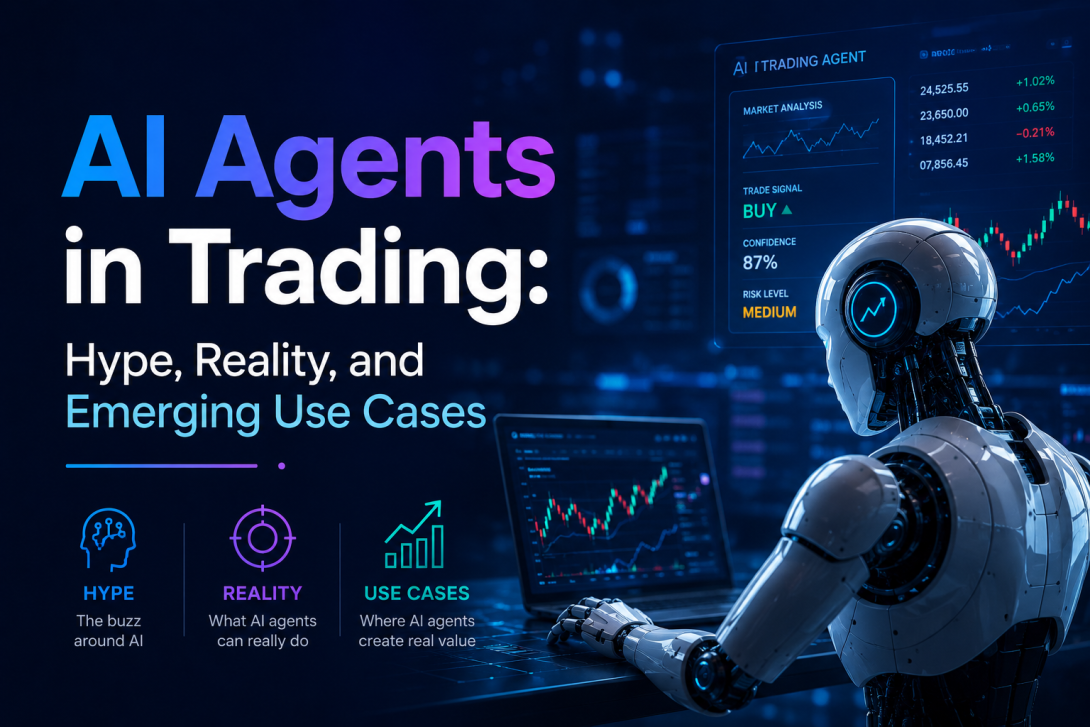
Artificial intelligence has become one of the most discussed technologies in the financial industry. From market prediction models to automated trading systems, AI is changing how trading platforms operate and how investors interact with financial markets. More recently, AI agents have attracted attention because they can perform tasks with greater autonomy than traditional automation tools.
Many companies promote AI agents as systems that can completely transform trading. While these technologies offer real advantages, they also have limitations. Successful implementation depends on good data, clear objectives, strong risk management, and regulatory compliance. AI agents should support traders and financial institutions rather than replace human judgment.
As online trading continues to grow, businesses are exploring practical ways to integrate AI agents into their platforms. Instead of focusing only on automated trading, organizations are using AI to improve customer support, market analysis, portfolio management, fraud detection, and operational efficiency.
This article explains what AI agents are, how they work in trading platforms, where they provide real value, and what businesses should consider before adopting them.
Understanding AI Agents in Trading
What Is an AI Agent?
An AI agent is a software system that can observe information, analyze data, make decisions based on predefined goals, and perform tasks with limited human intervention.
Unlike traditional software that follows fixed rules, AI agents can evaluate changing situations and adjust their actions based on new information.
In trading platforms, AI agents may monitor financial markets, analyze news, identify trading opportunities, manage alerts, or assist users with investment-related questions.
How AI Agents Differ From Traditional Trading Bots
Many people confuse AI agents with automated trading bots, but they are not the same.
Traditional trading bots usually execute trades based on fixed rules such as moving averages or price thresholds.
AI agents are designed to process multiple sources of information, evaluate different scenarios, and adapt their recommendations or actions based on changing market conditions.
Rather than following a single strategy, AI agents continuously learn from available data within the limits defined by their developers.
Why AI Agents Are Receiving So Much Attention
Growth of Digital Trading Platforms
The number of retail investors has increased significantly over the last few years.
More users now access financial markets through smartphones and online trading platforms instead of traditional brokerage services.
Industry reports discussing the online trading platform market size continue to show steady expansion as digital investing becomes more accessible across global markets.
As user numbers increase, trading platforms need technology that helps manage larger volumes of market data and customer interactions efficiently.
Advances in Artificial Intelligence
Recent improvements in machine learning, natural language processing, and large language models have expanded what AI systems can do.
AI agents can now process financial news, summarize research reports, answer customer questions, and identify market patterns much faster than earlier systems.
This progress has encouraged financial institutions to explore broader AI adoption.
How AI Agents Work in Trading Platforms
Collecting Information
AI agents begin by collecting data from multiple sources.
These sources may include:
- Live market prices
- Historical trading data
- Financial news
- Economic indicators
- Company reports
- User portfolio information
Combining multiple data sources provides a broader understanding of market conditions.
Processing and Analysis
After collecting data, AI agents analyze it using machine learning models and predefined business rules.
Depending on their purpose, they may:
- Detect unusual market activity
- Identify price trends
- Monitor investment portfolios
- Evaluate market sentiment
- Generate alerts
This analysis helps users receive relevant information more quickly.
Taking Action
Some AI agents only provide recommendations.
Others may perform approved actions such as:
- Sending notifications
- Creating reports
- Updating watchlists
- Scheduling portfolio reviews
- Triggering automated workflows
Organizations generally limit autonomous trading actions to maintain regulatory compliance and risk control.
Practical Use Cases for AI Agents
Market Research Assistance
Financial markets produce enormous amounts of information every day.
AI agents help traders summarize research reports, monitor company announcements, and identify important market developments.
Instead of reading hundreds of articles manually, investors receive concise summaries that support faster decision-making.
Portfolio Monitoring
Managing multiple investments can become difficult as portfolios grow.
AI agents continuously monitor portfolio performance and notify users about significant changes.
Examples include:
- Large price movements
- Portfolio imbalance
- Dividend announcements
- Earnings reports
- Risk exposure
These notifications help investors respond more quickly to changing conditions.
AI Agents for Customer Support
Improving User Experience
Customer support is another area where AI agents provide practical value.
Instead of answering only basic questions, modern AI agents can assist users with:
- Account navigation
- Order status
- Platform features
- Investment education
- Technical support
Human support teams remain available for more complex requests.
Providing Faster Responses
AI agents operate continuously without waiting for business hours.
Users receive immediate responses to common questions, improving customer satisfaction while reducing support workloads.
AI Agents in Risk Management
Detecting Unusual Trading Activity
Risk management is one of the most important responsibilities within financial platforms.
AI agents help monitor trading activity by identifying transactions that differ from normal user behavior.
Examples include:
- Unusual trading frequency
- Large unexpected transactions
- Suspicious login attempts
- Rapid account changes
Early detection allows financial institutions to investigate potential issues before they become larger problems.
Supporting Compliance Teams
AI agents also assist compliance teams by organizing large amounts of transaction data and identifying activities that may require further review.
These capabilities improve operational efficiency without replacing human oversight.
AI Agents and Personalized Investing
Delivering Relevant Information
Every investor has different financial goals.
Some focus on long-term investing, while others actively trade throughout the day.
AI agents analyze user preferences and provide personalized information based on investment behavior.
Examples include:
- Customized watchlists
- Educational content
- Portfolio summaries
- Market updates
- Investment reminders
Personalization improves engagement while helping users access information that matches their interests.
Supporting New Investors
Many users entering financial markets have limited investment experience.
AI agents can explain financial concepts, describe platform features, and guide users through common investment processes.
This makes trading platforms more accessible to beginners.
Building Scalable AI Trading Platforms
Cloud Infrastructure
AI agents require substantial computing resources for data processing and model execution.
Cloud infrastructure provides scalability while allowing businesses to expand platform capacity as user numbers grow.
Flexible Software Architecture
Modern trading platforms should support future AI capabilities without requiring complete system redesigns.
Organizations such as Citrusbug develop trading stock app solutions using scalable architectures that support AI integration, real-time analytics, secure trading operations, and future platform expansion.
Challenges of Using AI Agents in Trading
Data Quality Directly Affects Performance
An AI agent is only as effective as the data it receives. If market data is incomplete, delayed, or inaccurate, the recommendations generated by the system may also be unreliable.
Trading platforms should establish strong data validation processes before AI models begin analyzing information. Reliable data sources and continuous monitoring improve the quality of AI-driven insights.
Financial Markets Change Constantly
Financial markets are influenced by economic conditions, company performance, government policies, and global events. These factors can change quickly and sometimes unpredictably.
AI agents must be updated regularly to reflect changing market conditions. Models that perform well today may become less effective if they are not retrained with current data.
Human Oversight Remains Important
Although AI agents can automate many activities, they should not operate without supervision.
Investment decisions often require experience, business knowledge, and an understanding of risks that cannot always be captured through historical data.
For this reason, many organizations use AI agents as decision-support tools rather than allowing them to make independent investment decisions.
Security and Regulatory Compliance
Protecting Financial Information
Trading platforms process sensitive customer information, including personal details, financial records, and transaction history.
AI systems must operate within secure environments that include:
- Data encryption
- Multi-factor authentication
- Secure APIs
- Role-based access controls
- Continuous security monitoring
Protecting customer information builds trust and helps organizations meet regulatory requirements.
Meeting Regulatory Expectations
Financial markets operate under strict regulations that vary across different countries.
Businesses implementing AI agents should ensure that their systems support compliance with requirements related to:
- Customer identity verification
- Transaction monitoring
- Data privacy
- Audit trails
- Record retention
Including compliance requirements during software development reduces future operational risks.
Integrating AI Agents With Trading Platforms
Connecting Existing Systems
Most trading companies already use multiple software platforms, including:
- Trading engines
- Portfolio management systems
- Market data providers
- Customer relationship management software
- Payment platforms
AI agents should integrate smoothly with these systems without interrupting daily operations.
A well-designed integration strategy allows information to move automatically across different business functions.
Supporting Different Types of Investors
Not every investor uses a trading platform in the same way.
Some users trade several times each day, while others invest only occasionally.
AI agents should adapt their recommendations based on user preferences, investment experience, and financial goals rather than providing identical suggestions to everyone.
Development Considerations for AI Trading Platforms
Choosing the Right Features
Businesses often begin AI projects by identifying the problems they want to solve.
Instead of adding AI to every feature, organizations should focus on areas where automation provides measurable value.
Common priorities include:
- Customer support
- Portfolio monitoring
- Fraud detection
- Market research
- Risk analysis
Starting with practical use cases often leads to better long-term results.
Planning the Technology Stack
Building AI-enabled trading platforms requires multiple technologies working together.
Development teams typically combine:
- Cloud infrastructure
- AI frameworks
- Secure APIs
- Market data services
- Database systems
- Mobile and web applications
Selecting technologies that support future expansion helps reduce redevelopment costs later.
Understanding Development Costs
Factors That Influence Project Budgets
The overall investment depends on the complexity of the application.
Several factors affect development costs, including:
AI Features
Applications that include conversational AI, predictive analytics, intelligent portfolio analysis, and recommendation engines require more development effort than basic trading platforms.
System Integrations
Connecting with stock exchanges, financial data providers, payment gateways, identity verification services, and compliance tools increases project complexity.
Security Requirements
Trading platforms require advanced security measures, continuous monitoring, and regulatory compliance, all of which contribute to development costs.
For businesses evaluating new investment platforms, understanding stock trading app development cost is often an important step before defining the project scope.
Planning for Long-Term Investment
Looking Beyond Initial Development
Building an AI-powered trading platform involves more than launching the first version of the application.
Organizations should also plan for:
- Software maintenance
- AI model updates
- Cloud infrastructure
- Security improvements
- Compliance updates
- Performance optimization
Long-term planning helps maintain system reliability as user numbers grow.
Estimating the Overall Budget
Every trading platform has different business objectives, feature requirements, and integration needs.
Many organizations begin by trying to estimate cost for stock trading app development based on expected users, AI capabilities, security requirements, supported markets, and future scalability plans.
A realistic budget helps reduce unexpected expenses and supports successful project execution.
The Future of AI Agents in Trading
More Specialized AI Agents
Future AI agents are likely to become more specialized instead of trying to perform every task.
For example, one AI agent may focus on portfolio monitoring, while another supports customer service, and another analyzes market news.
Specialized agents often produce more accurate and reliable results because each system focuses on a specific objective.
Better Human-AI Collaboration
The future of trading is unlikely to involve AI replacing professional investors or financial advisors.
Instead, AI agents will become intelligent assistants that help users analyze information, monitor risks, summarize research, and improve productivity.
Human expertise will continue to play an important role in making final investment decisions.
Continuous Learning and Improvement
As AI technology continues to advance, trading platforms will improve their ability to process larger datasets, understand financial information, and generate more relevant recommendations.
Businesses that invest in responsible AI development, strong security, and scalable software architecture will be better positioned to adapt to future market changes.
Conclusion
AI agents are becoming an important part of modern trading platforms, but separating real business value from industry hype is essential. While these systems cannot guarantee profitable investments or replace experienced financial professionals, they can improve efficiency across many areas of trading operations.
Today, AI agents help investors monitor portfolios, summarize market information, detect unusual trading activity, support customer service, and automate repetitive administrative tasks. These practical applications allow trading platforms to deliver faster services while improving user experience.
Successful implementation depends on reliable data, secure infrastructure, regulatory compliance, and thoughtful software design. Businesses should focus on solving real operational challenges instead of adding AI simply because it is a popular technology.
As financial markets continue to evolve, AI agents will become more capable and more specialized. Organizations that adopt these technologies responsibly while maintaining strong human oversight will be better prepared to build secure, scalable, and user-focused trading platforms that meet the needs of both today's investors and tomorrow's financial markets.