
The popularity of online trading has grown rapidly over the past few years. More people are investing in stocks, exchange-traded funds (ETFs), mutual funds, cryptocurrencies, and other financial instruments using mobile applications. At the same time, financial institutions, brokerage firms, and fintech startups are launching new trading platforms to attract users.
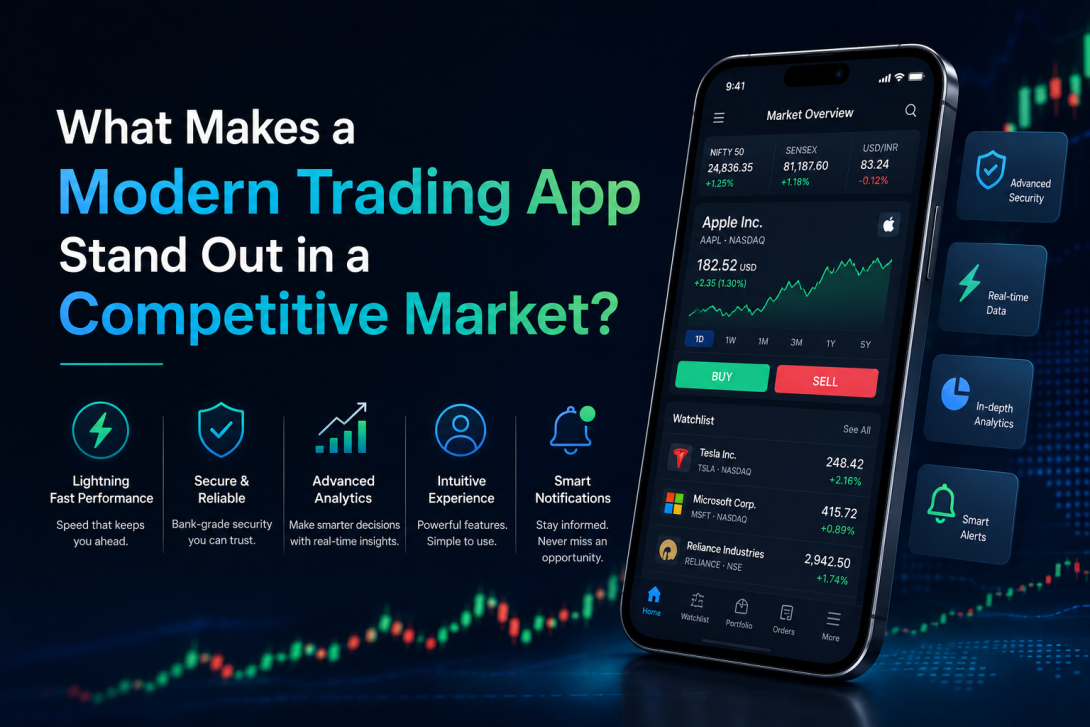
As competition increases, simply offering stock trading is no longer enough. Users expect fast performance, secure transactions, simple navigation, real-time market information, and personalized features. A trading app must provide a complete experience that helps users make informed investment decisions while ensuring reliability and security.
Modern trading applications combine advanced technologies such as artificial intelligence, cloud computing, data analytics, and automation to improve both user experience and operational efficiency. These technologies help traders monitor markets, execute trades quickly, and manage portfolios more effectively.
This article explores the features, technologies, and development considerations that make modern trading applications stand out in today's competitive market.
Understanding Modern Trading Applications
What Is a Trading App?
A trading app is a software application that allows users to buy and sell financial assets through smartphones, tablets, or web platforms. These applications connect users with financial markets and provide tools for investing, portfolio management, and market analysis.
Modern trading apps support multiple investment options, including:
- Stocks
- ETFs
- Mutual funds
- Bonds
- Commodities
- Cryptocurrencies
Some platforms also provide educational content, financial news, and investment recommendations.
Why Trading Apps Continue to Grow
The adoption of smartphones and digital banking has made investing more accessible than ever. Investors no longer need to contact brokers to execute trades. Instead, they can monitor markets and place orders from anywhere.
Industry reports discussing the online trading platform market size indicate continued growth as more retail investors and financial institutions adopt digital investment platforms.
Why User Experience Matters
Simple Navigation
Many users are new to investing. A trading application should make it easy to understand market information, execute trades, and monitor investments.
Complicated interfaces often discourage users and increase the likelihood of mistakes.
A well-designed application allows users to:
- Search for financial instruments
- View market data
- Buy or sell assets
- Track portfolio performance
- Access account information
without unnecessary complexity.
Fast Performance
Financial markets move quickly. Even small delays can affect trading decisions.
Modern applications should load market information rapidly and process transactions with minimal latency.
Fast performance improves user confidence and supports better trading experiences.
Real-Time Market Data
Access to Live Prices
One of the most important features of any trading application is real-time market information.
Users expect instant access to:
- Stock prices
- Market indices
- Trading volumes
- Price changes
- Market news
Accurate and timely information helps investors make informed decisions.
Interactive Charts
Charts play an important role in investment analysis.
Modern trading platforms provide interactive charts that allow users to view historical price movements across different time periods.
Many applications also include technical indicators to help users analyze market trends.
Portfolio Management Features
Monitoring Investments
A good trading application should provide a complete overview of the user's portfolio.
Investors need quick access to information such as:
- Current holdings
- Portfolio value
- Profit and loss
- Investment allocation
- Transaction history
Presenting this information clearly helps users understand their financial position.
Performance Tracking
Portfolio tracking features allow investors to monitor how their investments perform over time.
Historical reports and visual summaries make it easier to evaluate long-term investment strategies.
Security as a Core Requirement
Protecting User Accounts
Trading platforms manage sensitive financial information and personal data.
Strong security measures are essential for protecting user accounts.
Common security features include:
- Multi-factor authentication
- Biometric login
- Device verification
- Session monitoring
These features reduce the risk of unauthorized access.
Secure Transactions
Trading applications must also protect financial transactions.
Encryption, secure APIs, and continuous monitoring help ensure that user data and trading activities remain protected.
Personalized User Experiences
Customized Dashboards
Every investor has different goals and preferences.
Modern applications allow users to personalize dashboards by selecting watchlists, preferred markets, and portfolio summaries.
This helps users focus on information that matters most to them.
Smart Notifications
Instead of sending generic alerts, modern trading platforms deliver personalized notifications based on:
- Price movements
- Portfolio activity
- Market news
- Order execution
- Watchlist updates
Relevant notifications improve user engagement without becoming overwhelming.
Artificial Intelligence in Trading Apps
Supporting Better Decision-Making
Artificial intelligence is becoming an important part of trading platforms.
AI analyzes market trends, trading behavior, and historical data to generate useful insights.
Although AI should not replace investor judgment, it can help users identify patterns and evaluate opportunities more efficiently.
Risk Analysis
AI systems can also evaluate portfolio risk by analyzing asset allocation and market conditions.
These insights help investors understand potential risks before making investment decisions.
Automation Improves Trading Efficiency
Automated Trading Features
Some trading platforms support rule-based automation.
Users can create predefined conditions that automatically execute trades when specific market events occur.
Automation reduces the need for continuous market monitoring while helping investors respond more quickly to price movements.
Order Management
Modern trading platforms also simplify order management by allowing users to:
- Modify pending orders
- Cancel transactions
- Track execution status
- View complete trading history
These capabilities improve transparency and user control.
Integration With Financial Services
Connected Digital Ecosystems
Trading applications often integrate with other financial services such as:
- Banking platforms
- Payment gateways
- Identity verification systems
- Tax reporting tools
- Financial news providers
These integrations create a more complete investment experience.
Organizations such as Citrusbug develop trading stock app solutions that combine secure trading functionality, portfolio management, analytics, and scalable architecture to support modern investment platforms.
Scalability and Platform Performance
Supporting Growing User Bases
Successful trading applications must handle thousands or even millions of users simultaneously.
System architecture should support increasing trading activity without affecting performance.
Cloud infrastructure, distributed systems, and scalable databases help maintain reliability during periods of high market activity.
High Availability
Financial markets operate continuously during trading hours.
System downtime can lead to missed opportunities and reduced customer trust.
Modern trading platforms are designed with redundancy and monitoring systems to maximize uptime.
Data Analytics and Business Intelligence
Using Data to Improve User Experience
Modern trading platforms generate large amounts of data every day. Every login, trade, watchlist update, and portfolio change provides valuable information about user behavior.
By analyzing this data, businesses can understand how investors use the application and identify areas for improvement.
For example, analytics can reveal:
- Frequently traded assets
- Most-used features
- Common user journeys
- Peak trading hours
- Customer retention patterns
These insights help companies improve both the application and the overall customer experience.
Supporting Better Business Decisions
Analytics is valuable not only for users but also for business teams.
Product managers can identify which features require enhancement, while customer support teams can recognize recurring issues. Marketing teams can also evaluate user acquisition and engagement more effectively.
Data-driven decisions help trading platforms remain competitive in a rapidly changing market.
Regulatory Compliance and Security Standards
Meeting Financial Regulations
Trading platforms operate in a highly regulated environment. Every application must comply with financial regulations that govern user identity verification, transaction monitoring, and record keeping.
Compliance requirements differ between countries, but common areas include:
- Know Your Customer (KYC)
- Anti-Money Laundering (AML)
- Data privacy regulations
- Financial reporting standards
Building compliance into the platform from the beginning helps reduce future operational risks.
Continuous Security Monitoring
Cybersecurity threats continue to evolve, making continuous monitoring an important part of platform management.
Modern trading applications use automated monitoring systems to detect unusual activities, prevent unauthorized access, and respond quickly to potential security incidents.
Mobile-First Development
Designing for Smartphone Users
Many investors now prefer managing their investments through mobile devices instead of desktop computers.
A mobile-first approach ensures that essential features remain easy to access on smaller screens without sacrificing usability.
Applications should provide:
- Quick navigation
- Fast loading times
- Responsive charts
- Simple order placement
- Easy portfolio monitoring
A well-designed mobile experience encourages regular engagement.
Supporting Multiple Platforms
Successful trading applications typically support Android, iOS, and web platforms.
Maintaining a consistent experience across devices improves customer satisfaction and allows users to switch between platforms without confusion.
Building Customer Trust
Transparent Information
Trust is one of the most important factors in financial applications.
Users expect clear information about:
- Transaction fees
- Order status
- Investment risks
- Portfolio performance
Providing transparent information helps users make informed decisions.
Reliable Customer Support
Even the best trading applications require customer support.
Integrated help centers, live chat, FAQs, and support tickets allow users to resolve issues quickly.
Reliable support contributes to long-term customer retention.
Cost Considerations When Developing a Trading App
Factors That Influence Development Costs
Every trading platform has unique business goals, making development costs vary significantly.
Several factors influence project budgets.
Feature Complexity
Basic trading functionality requires less development effort than applications that include:
- AI-powered recommendations
- Advanced analytics
- Automated trading
- Portfolio management
- Multi-market support
The number of advanced features directly affects development time.
Third-Party Integrations
Connecting with payment gateways, banking systems, stock exchanges, identity verification services, and market data providers increases project complexity.
Platform Selection
Developing separate Android, iOS, and web applications also affects overall investment.
For many businesses, understanding stock trading app development cost is an important part of evaluating project feasibility before beginning development.
Planning Long-Term Investment
Looking Beyond Initial Development
The first version of a trading application is only the beginning.
Businesses should also plan for:
- Software maintenance
- Performance optimization
- Security updates
- Compliance updates
- Feature enhancements
- Infrastructure scaling
Considering long-term operational costs helps create a sustainable product.
Estimating Project Budgets
Organizations planning custom investment platforms often begin by trying to estimate cost for stock trading app development based on business requirements, expected user volume, regulatory obligations, technology stack, and integration needs.
Proper planning reduces unexpected expenses and improves project success.
Emerging Technologies Shaping the Future
Artificial Intelligence Will Continue Expanding
Artificial intelligence is expected to play a larger role in trading applications over the coming years.
Future AI capabilities may include:
- More accurate market analysis
- Improved portfolio recommendations
- Better fraud detection
- Enhanced customer support
- Personalized investment education
These features can improve user experience while helping investors make better-informed decisions.
Cloud Infrastructure
Cloud computing will continue supporting scalability and high availability.
As trading platforms attract larger user bases, cloud infrastructure allows businesses to increase computing resources without major infrastructure investments.
Open Financial Ecosystems
The financial industry is becoming increasingly connected.
Future trading platforms will integrate more closely with digital banking, investment services, insurance providers, and personal finance applications.
This will create a more unified financial experience for users.
What Businesses Should Focus On
Prioritizing User Needs
Technology alone does not guarantee success.
Businesses should focus on solving real customer problems by building applications that are:
- Easy to use
- Secure
- Reliable
- Fast
- Scalable
A customer-focused approach often leads to stronger long-term adoption.
Continuous Improvement
Financial markets evolve continuously.
Trading applications must also evolve by introducing new features, improving security, updating compliance measures, and responding to customer feedback.
Regular improvements help platforms remain competitive.
Conclusion
The online trading industry continues to grow as more investors choose digital platforms for managing their investments. In this competitive environment, successful trading applications offer much more than basic buying and selling features.
Modern trading platforms combine intuitive design, real-time market data, portfolio management, artificial intelligence, strong security, cloud infrastructure, and seamless integrations to create a reliable investment experience. They also prioritize compliance, scalability, and continuous improvement to meet changing user expectations and regulatory requirements.
As technology continues to advance, trading applications will become even more intelligent and personalized. Businesses that invest in secure, scalable, and user-focused platforms will be better positioned to attract investors, improve customer satisfaction, and remain competitive in the rapidly evolving financial technology landscape.