
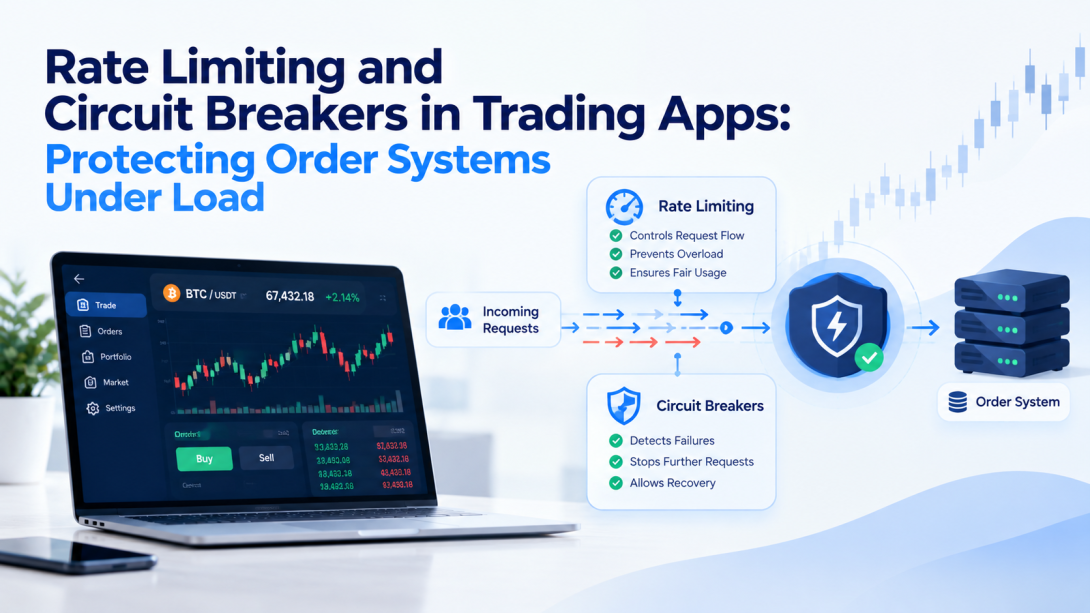
Trading applications have to handle a difficult combination of speed, reliability, and risk control. Users expect an order to be submitted quickly, but the system also needs to remain stable when thousands of users send requests at the same time.
The problem becomes more serious during periods of high market activity. A sudden price movement can cause many users to submit orders, cancel existing orders, refresh market data, or modify positions within a short period. Automated strategies can add another source of traffic because software can generate orders much faster than a person can.
This makes rate limiting and circuit breakers important parts of a trading application's architecture. They are not only tools for protecting servers from excessive traffic. They can also help prevent an application failure from spreading into order management, broker connections, risk systems, and exchanges.
The SEC's Rule 15c3-5 requires broker-dealers with market access to maintain risk management controls designed to manage financial and regulatory risks. The SEC also states that controls should prevent certain orders from reaching an exchange or alternative trading system when they exceed defined limits or appear erroneous.
Why Trading Apps Need Protection Under Load
A normal web application can sometimes tolerate a temporary increase in traffic by slowing requests, adding servers, or placing requests in a queue. An order management system has additional concerns.
An order is connected to a financial transaction. If the system becomes slow, users may retry an order because they do not know whether the first request succeeded. This can create duplicate orders.
For example, a customer submits an order to buy 100 shares. The request takes several seconds because the trading platform is under heavy load. The user does not receive a response and presses the Buy button again.
If the first order was already accepted by the broker, the second request can result in another 100-share order.
The system therefore needs to answer two questions:
How much traffic should the application accept?
What should happen when a downstream service becomes unhealthy?
Rate limiting addresses the first problem. Circuit breakers address the second.
The Difference Between Rate Limiting and Circuit Breaking
Rate limiting controls how many requests are allowed within a specific period.
For example:
100 order requests per second per account 1,000 requests per second per application 5,000 requests per second across a service
A circuit breaker watches the health of a downstream service. If the service repeatedly fails or becomes too slow, the circuit breaker temporarily stops sending additional traffic to that service.
The two mechanisms work together.
Rate limiting controls traffic volume. Circuit breaking controls dependency failures.
Rate Limiting in a Trading Application
Rate limiting should not be implemented as one simple global number. Different API operations have different business and technical requirements.
A market-data request, order submission, order cancellation, portfolio request, and account-information request should not necessarily share the same limit.
Order APIs usually need stricter controls because they directly affect financial positions.
Per-User and Per-Account Limits
A trading platform can assign limits to individual accounts.
For example, an account might be allowed to submit a defined number of orders within a short period. If the limit is reached, the API can reject additional requests or apply another controlled response.
This prevents one account from consuming a disproportionate amount of order-processing capacity.
However, the limit should be designed around the application's actual trading model. A professional trading account, retail account, institutional strategy, and internal service may have different requirements.
Application-Level Limits
Per-user limits are not enough.
Suppose 20,000 users are each within their individual limits. The combined traffic could still overwhelm the order service.
A platform can therefore apply multiple levels of protection:
Per-user or per-account limit
Per-API-key limit
Per-service limit
Per-broker connection limit
Global platform limit
This layered model allows the platform to protect both individual accounts and shared infrastructure.
Rate Limiting Should Consider Order Types
Not every order request has the same operational impact.
A market order, limit order, stop order, cancel request, and replace request may travel through different parts of the trading infrastructure.
The platform should therefore consider the type of operation when defining limits.
For example, cancellation requests may need a different policy from new order requests. A trading application experiencing a market event may receive a large number of cancel-and-replace requests as users and strategies adjust their positions.
FINRA's guidance emphasizes monitoring the handling of different types of marketable orders and maintaining supervisory procedures over customer order flow.
Choosing a Rate-Limiting Algorithm
There are several common approaches to rate limiting.
Fixed Window
A fixed-window limiter allows a defined number of requests during a fixed period.
For example:
1,000 requests per minute
The counter resets at the beginning of each minute.
It is simple to implement, but it can create a burst at the boundary between two windows.
Sliding Window
A sliding-window approach considers requests across a continuously moving period. This provides better control over short bursts but requires more tracking.
Token Bucket
The token-bucket model is useful when an application needs to allow controlled bursts.
Tokens are added to a bucket at a defined rate. A request consumes a token. When there are no tokens available, the request is rejected or delayed according to the application's policy.
This can work well for APIs where occasional bursts are acceptable but sustained excessive traffic is not.
For trading systems, the choice should be based on measured traffic patterns rather than simply selecting the most popular algorithm.
Why Circuit Breakers Matter for Order Systems
A trading application rarely operates as one isolated service.
An order may move through several components:
Trading App ↓ API Gateway ↓ Order Service ↓ Risk Checks ↓ Broker/Exchange Connection ↓ Execution ↓ Order Status Service
If the broker connection becomes slow, the order service can start accumulating requests. If the risk service becomes unavailable, orders may also remain waiting.
Without protection, the application can continue sending requests to an unhealthy dependency.
This creates a failure loop.
The circuit breaker interrupts that loop.
Closed, Open, and Half-Open States
A typical circuit breaker has three states.
Closed: Requests are flowing normally. The system monitors failures and latency.
Open: The failure threshold has been reached. Requests to the affected dependency are temporarily stopped or handled through a controlled fallback.
Half-open: After a defined recovery period, the system allows a small number of test requests. If the dependency works again, the circuit returns to closed. If it fails, the circuit opens again.
This prevents an unhealthy service from receiving a sudden flood of traffic when it starts recovering.
Order Idempotency Is Essential
Rate limiting and circuit breakers cannot solve duplicate orders by themselves.
A trading application should also use idempotency.
Each order submission can receive a unique client-generated identifier.
For example:
clientOrderId = "ORD-20260928-84921"
If the same request reaches the server twice, the order service can recognize the identifier and avoid creating two separate orders.
This is especially important when a circuit breaker, network timeout, or broker connection failure causes uncertainty about whether an order was accepted.
The system should distinguish between:
Request failed before order creation
and
Order was created but the response was lost
Those two situations require different handling.
Pre-Trade Risk Controls Should Be Separate From Traffic Controls
Rate limiting is an infrastructure control. It should not replace financial risk checks.
An account could remain below its API request limit while still attempting to place an invalid or excessive order.
The order system may therefore need controls for:
Buying power
Position limits
Maximum order quantity
Price boundaries
Credit or capital limits
Duplicate orders
Restricted securities
Account permissions
The SEC specifically requires market-access risk controls to be reasonably designed to prevent orders that exceed appropriate preset credit or capital thresholds or appear erroneous. These controls apply to orders entered manually as well as orders generated automatically by computer systems.
This distinction is important: a request can be technically valid but financially unacceptable.
Handling Traffic Spikes Without Losing Orders
A common mistake is to reject traffic immediately whenever a threshold is reached.
That may protect the infrastructure but can create a poor trading experience.
The better approach depends on the operation.
For non-critical requests, the system may return a rate-limit response and ask the client to retry after a defined interval.
For order submission, however, blindly retrying can be dangerous.
If an order request times out, the client should first determine whether the order was accepted before sending another submission.
This is where order status lookup and idempotency become important.
A robust workflow can look like this:
Submit Order ↓ Receive Client Order ID ↓ Validate Request ↓ Apply Rate Limit ↓ Apply Pre-Trade Risk Checks ↓ Send to Broker ↓ Store Order State ↓ Return Accepted/Rejected Status
Monitoring Rate Limits and Circuit Breakers
A protection mechanism is only useful if the operations team can see what it is doing.
The platform should monitor rate-limit events, rejected requests, circuit-breaker state changes, dependency latency, order queue depth, broker response times, and error rates.
For example, if the order service suddenly reports a large increase in circuit-breaker openings, the problem may not be the circuit breaker itself. It may indicate a broker connection problem, database saturation, network issue, or downstream service failure.
The metrics should therefore be connected to tracing and logs.
Useful measurements include:
Request rate: Number of requests arriving per second.
Rejected rate: Number of requests rejected by rate limits.
Order latency: Time from submission to acknowledgement.
Dependency latency: Time taken by broker, risk, or market-data services.
Circuit state: Number and duration of open and half-open events.
Duplicate detection: Number of repeated client order identifiers.
Using AI Agents Without Bypassing Trading Controls
AI-driven systems can introduce another source of automated activity. An AI system may analyze market information, generate trade ideas, or interact with other services that eventually result in an order request.
This makes the control boundary important.
AI agents in trading should not be allowed to bypass the same authentication, rate limits, pre-trade risk checks, and authorization controls that apply to other order sources.
An AI-generated order should enter the same controlled order pipeline as a manually submitted order.
This creates a clear separation:
AI Decision ↓ Order Request ↓ Authentication ↓ Rate Limit ↓ Risk Controls ↓ Order Validation ↓ Broker/Exchange
The AI system can generate an instruction, but the order gateway remains responsible for deciding whether that instruction can proceed.
FINRA notes that firms using algorithmic strategies should focus on development, testing, implementation, monitoring, and controls because failures in automated trading can have broader effects.
Building Trading Apps for High-Traffic Market Conditions
When designing modern trading apps in competitive market conditions, performance cannot be considered separately from reliability.
A fast API that becomes unstable during a market event is not useful. Similarly, an application that stays online but allows duplicate or invalid orders creates a different type of risk.
A scalable architecture should combine:
Load Balancing
Multiple application instances can distribute incoming traffic. Load balancing prevents one server from becoming a single point of failure.
Queue Management
Queues can help separate incoming requests from slower processing operations. However, order queues need careful design because delaying an order can affect its business meaning.
Connection Pooling
Broker and database connections should be managed carefully. Creating excessive connections during a traffic spike can make the underlying problem worse.
Backpressure
Backpressure prevents an overloaded component from accepting more work than it can safely process.
Citrusbug develops stock trading apps with capabilities covering trading workflows, real-time market interaction, API integrations, authentication, scalable backend services, and trading-related tools. Its Cicada case study describes a trading platform supporting stocks, bonds, futures, and options, with real-time functionality, multifactor authentication, role-based access, and scalable architecture. The case study reports 99.99% system uptime and less than 200 ms order execution latency.
Technology Architecture for a Resilient Trading App
A practical architecture can place controls at several layers.
At the edge, an API gateway can authenticate users and apply basic request limits. The order service can then apply account-specific limits and idempotency checks.
Before an order reaches a broker or exchange, the system should perform appropriate validation and risk checks.
Downstream connections should use circuit breakers, timeouts, connection limits, and carefully designed retry policies.
The system should also maintain an order state machine so that an order can move through states such as:
NEW → VALIDATED → SUBMITTED → ACKNOWLEDGED → PARTIALLY_FILLED → FILLED → CANCELLED → REJECTED
This is more reliable than treating an order as a simple API request.
Where Fintech App Development Fits Into the Design
The reliability requirements of a trading application should be considered during the initial architecture rather than added after the application starts experiencing traffic problems.
Fintech app development for trading platforms involves more than building screens for charts, watchlists, portfolios, and order forms. The backend needs controls that protect financial transactions when traffic increases or dependencies fail.
The application should be tested under different conditions, including normal traffic, sudden traffic spikes, slow broker responses, database latency, partial service failures, duplicate requests, network interruptions, and recovery after an outage.
Load testing should also examine order-processing behavior rather than measuring only page response time.
A platform may appear fast from the user's perspective while its order-processing system is approaching saturation.
Testing Rate Limits and Circuit Breakers Before Production
Testing should reproduce realistic failure scenarios.
One useful test is a sudden increase in order requests. The team can measure how many requests are accepted, rejected, delayed, or duplicated.
Another test can simulate a broker becoming slow rather than completely unavailable. This is important because partial degradation can be harder to handle than a clean outage.
The team should also test recovery.
When the broker becomes healthy again, the system should not immediately release every waiting request at once. Otherwise, recovery can create another traffic spike.
The circuit breaker should gradually test the dependency and restore normal traffic according to controlled conditions.
Conclusion
Rate limiting and circuit breakers are important controls for trading applications because order systems operate under both technical and financial constraints.
Rate limiting prevents excessive traffic from consuming shared resources. Circuit breakers prevent repeated calls to unhealthy dependencies. Idempotency protects against duplicate order creation, while pre-trade risk controls protect against financially or regulatorily unacceptable orders.
The most important point is that these mechanisms should work together rather than operate as isolated features.
A resilient trading architecture can follow a simple principle:
Accept only the traffic the system can safely process, validate every order before it reaches the market, and stop unhealthy dependencies from causing wider failures.
This approach becomes even more important as trading applications support automated strategies and AI-driven workflows. The goal is not simply to make an application handle more requests. The goal is to keep order processing controlled and traceable when market activity, user demand, or system failures increase at the same time.