
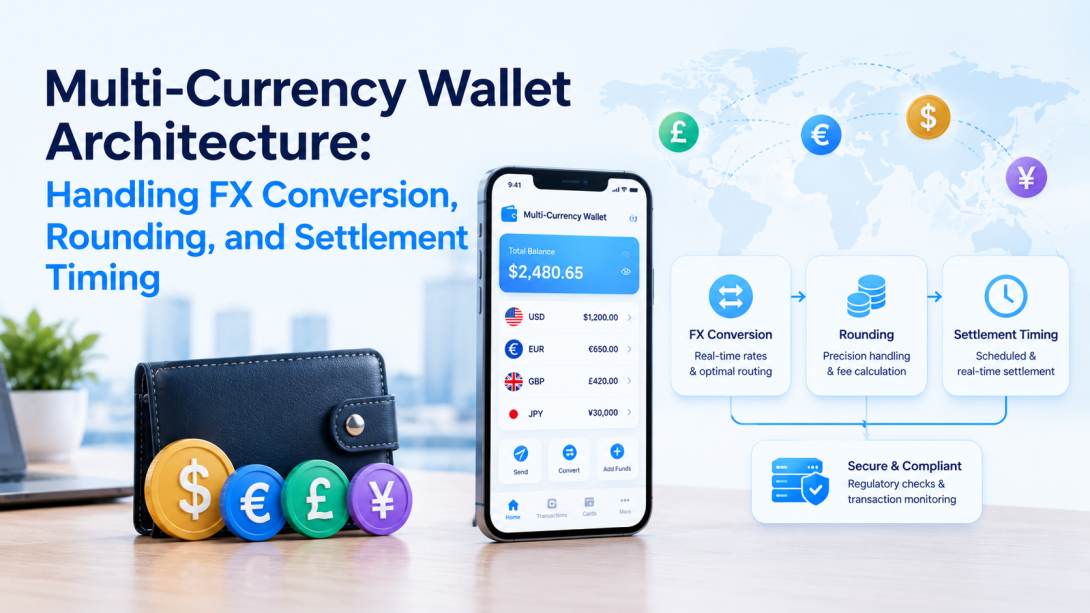
Multi-currency wallets allow users to hold, receive, convert, and spend money in more than one currency from a single account. They are useful for international customers, travelers, freelancers, businesses, marketplaces, remittance platforms, and fintech applications that handle cross-border payments. However, building a multi-currency wallet is not simply a matter of adding USD, EUR, GBP, INR, or other currencies to a database. The difficult part is making sure that currency conversion, rounding, fees, balances, and settlement remain correct throughout the transaction lifecycle.
A wallet may show one balance to the customer while several different amounts exist behind that balance. There can be the original transaction amount, the FX conversion amount, the fee, the amount reserved for settlement, and the final amount received by another institution. If these values are not recorded separately, even a small rounding difference can create reconciliation problems later.
This is why multi-currency wallet architecture needs clear rules for money representation, exchange rates, transaction states, and settlement timing. The system should know exactly which exchange rate was used, when it was applied, how many decimal places were allowed, which party paid the FX fee, and when the transaction became final.
Why Multi-Currency Wallets Need a Different Architecture
A single-currency wallet can often maintain a straightforward relationship between a user's available balance and the currency used for transactions. A multi-currency wallet has several balances and several possible transaction paths. A customer might receive EUR, convert part of it to USD, pay a merchant in GBP, and later receive a refund in GBP. Each event can involve a different currency and exchange rate.
The wallet therefore needs to treat each currency as a separate monetary balance while maintaining a common transaction history. For example, a user may have 1,000 EUR and 500 USD. The application should not simply calculate a combined balance using today's exchange rate and store that result as the user's actual money. The original currency balances must remain intact.
The system can calculate an equivalent value for display purposes, but the underlying ledger should preserve the actual amounts held in each currency.
Currency Balances Should Be Ledger-Based
A strong architecture normally uses a ledger rather than updating a balance field without a detailed transaction record. Every credit, debit, conversion, fee, reversal, and adjustment should create a ledger entry. The balance can then be calculated or maintained from these controlled entries.
This provides an audit trail. If a customer's EUR balance changes from €2,000 to €1,750, the system should be able to explain exactly why the €250 difference occurred. It could be a transfer, conversion, fee, withdrawal, or other transaction. The reason should not depend on application logs alone.
Designing the FX Conversion Layer
Foreign exchange is one of the most important parts of a multi-currency wallet. The application needs an FX service that receives a source currency, target currency, amount, rate information, and applicable fees. It then returns the conversion result with enough information for the transaction to be audited later.
The FX rate should not be treated as a generic value that changes whenever a user opens the application. A transaction needs a specific rate associated with it. If a user converts EUR to USD at 1 EUR = 1.10 USD, that rate should be recorded with the conversion transaction, along with the timestamp and the source of the rate.
This becomes even more important because the global FX market operates at a very large scale. The Bank for International Settlements reported average OTC foreign exchange turnover of about $9.6 trillion per day in April 2025, up 28% from the 2022 survey. Spot FX accounted for about $3 trillion per day. Source: Bank for International Settlements.
Rate Selection Should Be Explicit
A wallet can use different rate models depending on its business model. It may use a market rate plus a markup, a provider rate, a locked quote, or a rate supplied by a banking or payment partner. The architecture should not hide this logic inside random parts of the application.
A better design keeps rate calculation in a dedicated FX service. This service can manage rate sources, spreads, validity periods, currency pairs, provider fallbacks, and quote expiration.
For example, if a user requests a conversion of €500 into USD, the system might generate a quote that remains valid for 30 seconds. If the user confirms within that period, the wallet uses the agreed rate. If the quote expires, the application requests a new rate rather than silently applying another value.
Rounding: A Small Number With a Large Impact
Rounding is one of the areas where multi-currency wallet implementations can create problems. Developers may assume that every currency uses two decimal places, but that is not true. Some currencies use zero decimal places, while others use three or have special payment rules.
The wallet therefore needs a currency configuration table that defines the supported precision for each currency. It should also define how rounding is performed and at which stage it happens.
Do Not Round Too Early
Suppose a conversion calculation produces a value such as 548.3764 USD. If the system immediately rounds this to 548.38 and then performs another calculation using that rounded amount, the final result can differ from a calculation that retained the higher precision until the final monetary step.
A safer approach is to maintain sufficient internal precision during calculations and round only at the point required by the relevant currency or payment operation. The final rounded value should then be stored as part of the transaction record.
The same principle applies to fees. If a wallet calculates a percentage-based FX fee, it should define whether the fee is calculated from the original amount, converted amount, or another defined base. The rule should be consistent across all transaction types.
Settlement Timing Changes the Meaning of a Balance
Another important part of wallet architecture is settlement timing. A transaction can be initiated at one time, authorized at another time, processed later, and settled after that. These events should not be treated as the same state.
For example, a customer might convert USD to EUR and immediately see the EUR balance increase. However, the external payment provider or banking partner may settle the corresponding funds hours or days later. The wallet therefore needs to distinguish between the customer's available balance and amounts that are pending settlement.
Available, Pending, and Settled Amounts
A practical wallet architecture can maintain separate concepts for available funds, pending funds, and settled funds. The exact model depends on the payment network and regulatory structure, but the principle is important: the system should not make unsettled money appear permanently available when the business has not yet received final confirmation.
This is especially important for card transactions, bank transfers, cross-border payments, refunds, and chargebacks. A transaction can appear successful from the customer's perspective while remaining subject to later settlement or reversal.
The transaction state should therefore be explicit. Common states can include initiated, pending, authorized, processing, settled, failed, reversed, and refunded. Not every wallet needs all of these states, but the lifecycle should be defined before development begins.
How the Ledger Should Handle Currency Conversion
A currency conversion should normally be represented as two sides of a monetary movement rather than as a simple edit to two balance fields. When €1,000 is converted into USD, the ledger should record the EUR debit and USD credit, along with the FX rate, timestamp, fee, and transaction reference.
This makes reconciliation much easier. If the customer later questions the conversion, the system can show the original EUR amount, the applied rate, the USD amount, and any associated charge.
The ledger should also use immutable transaction records wherever possible. Instead of changing an old transaction when a correction is required, the system can create a reversal or adjustment entry linked to the original transaction. This preserves the history of what happened.
Idempotency Is Essential
Payment systems often retry requests because of network failures or delayed responses. Without idempotency, the same payment request could potentially be processed twice.
Every important wallet operation should therefore have an idempotency key or unique transaction reference. If the same request reaches the system again, the wallet should recognize it and return the existing result instead of creating another debit or credit.
This is particularly important when the wallet communicates with external banks, payment processors, FX providers, or settlement networks.
Security and Reconciliation in Multi-Currency Wallets
A multi-currency wallet needs strong controls because a small accounting error can affect multiple currencies. Security should cover authentication, authorization, transaction signing, API protection, encryption, fraud monitoring, and access controls.
Reconciliation is equally important. The wallet's internal ledger should be compared with external provider records on a defined schedule. Differences should create reconciliation cases instead of being silently adjusted.
For example, if the wallet records a $1,000 settlement but the external provider reports $998 after fees, the system should not simply overwrite the internal amount. It should identify the $2 difference, determine whether it is an expected provider fee, and record the corresponding accounting entry.
Where eWallet Development Fits Into the Architecture
Businesses entering digital payments often start with the visible wallet interface because it is what customers interact with. However, the wallet screen is only one layer of the product. The underlying architecture must handle ledger management, payment processing, currency conversion, compliance, transaction monitoring, reconciliation, notifications, and settlement.
This is why ewallet app development needs to consider financial operations from the beginning rather than adding them after the user interface is complete. A wallet that looks simple on the front end may require several backend services to process one cross-border transaction correctly.
Useful Wallet Services
A scalable architecture can separate responsibilities into services such as wallet management, ledger management, FX conversion, payment processing, transaction monitoring, settlement, notification, and reporting. This separation does not mean every business needs dozens of microservices. The right level of separation depends on transaction volume, regulatory requirements, operational complexity, and team capabilities.
The key is to keep financial rules clear. FX calculation should not be mixed with notification logic, and ledger updates should not depend on whether a mobile screen successfully loads.
What Mobile Wallet Statistics Tell Us About Scale
The growth of digital wallets makes these architecture decisions increasingly relevant. According to Worldpay's 2026 Global Payments Report, digital wallets represented an estimated 56% of global e-commerce transaction value and 33% of point-of-sale transaction value in 2025. Source: Worldpay.
Worldpay also reported that digital payment methods, including digital wallets, account-to-account payments, and BNPL, increased from 34% of global e-commerce value in 2014 to 66% in 2024.
These mobile wallet statistics show why wallet infrastructure needs to be designed for more than basic payment acceptance. As wallets support multiple funding sources, currencies, payment methods, and cross-border transactions, their backend systems must maintain accurate monetary records even when transaction volumes increase.
Using AI Without Changing Core Money Rules
AI can assist a multi-currency wallet, but it should not become the authority for core financial calculations. Exchange rates, balances, fees, settlement states, and ledger entries should be controlled by deterministic financial logic.
AI can instead support areas such as transaction monitoring, customer support, anomaly detection, risk analysis, and operational investigation. For example, an AI system could identify unusual conversion patterns or help an operations team investigate why a settlement did not match the expected provider amount.
The same principle applies to AI agents in trading. Agentic systems can potentially support market analysis, execution workflows, or risk monitoring, but a consumer wallet should not allow an autonomous system to modify balances or execute financial operations without clearly defined authorization, controls, and audit trails.
Keep AI Outside the Source of Truth
The ledger should remain the source of truth. An AI system can recommend an action or identify an anomaly, while deterministic services decide whether that action is permitted and record the resulting financial event.
This separation provides a safer architecture. It also makes compliance and auditing easier because every financial decision can be traced to defined rules rather than an opaque model response.
Building a Multi-Currency Wallet With a Technology Partner
For companies building a wallet from scratch, the development team needs experience across payment APIs, backend architecture, databases, security, financial ledgers, mobile applications, and third-party integrations. A partner should also understand that payment functionality cannot be treated like a standard CRUD application.
Citrusbug develops fintech app solutions that can support businesses working on financial applications, payment products, digital wallets, and related software systems. For a multi-currency wallet, the technology partner's role can include backend architecture, API integration, mobile development, transaction workflows, and the supporting systems required for financial operations.
The important part is to define the financial model before writing large amounts of application code. The team should first determine how balances are represented, how FX rates are sourced, how rounding works, when funds become available, how settlement is recorded, and how reversals are handled.
Key Architecture Principles to Follow
A multi-currency wallet becomes easier to maintain when its financial rules are explicit and consistent. The following principles should guide the architecture:
- Maintain separate balances for each currency rather than converting everything into one stored base balance.
- Use a ledger with traceable entries for every financial movement.
- Store the FX rate and rate timestamp used for every conversion.
- Keep sufficient calculation precision and apply currency-specific rounding rules at the correct stage.
- Separate available funds from pending and unsettled amounts where the payment flow requires it.
- Use idempotency controls to prevent duplicate financial transactions.
- Reconcile internal records with banks, payment processors, and FX providers.
- Keep AI and analytics services separate from the core financial source of truth.
Conclusion
Multi-currency wallet architecture is mainly an accounting and transaction-consistency problem supported by software. The user interface may show a simple balance and a currency conversion button, but the backend needs to manage exchange rates, precision, rounding, fees, transaction states, settlement, reversals, and reconciliation.
The most important design decision is to treat money as structured financial data rather than ordinary application data. Each currency should have its own balance, every movement should be recorded in the ledger, and every conversion should preserve the rate and calculation details used at the time.
As digital wallets become a larger part of global payment activity, these controls become more important. Worldpay's 2026 data puts digital wallets at 56% of global e-commerce value in 2025, while BIS data shows the enormous scale of the underlying global FX market.
A well-designed wallet therefore does not simply convert currencies. It creates a reliable financial record from the moment a transaction begins until the moment the corresponding funds are finally settled and reconciled.