
Introduction
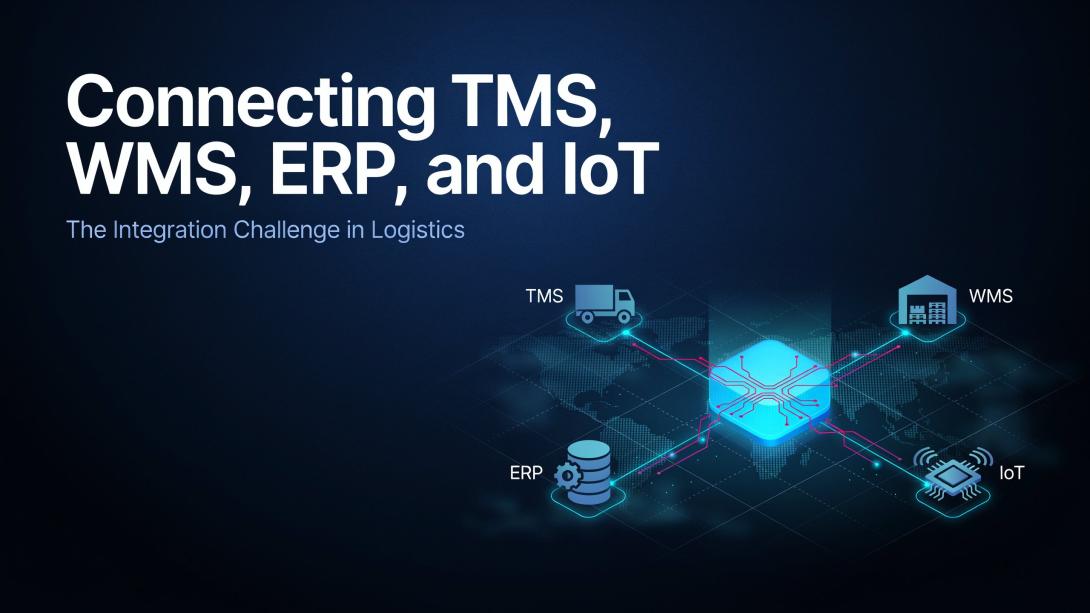
Modern logistics operations depend on many software systems. A transportation management system, or TMS, manages transportation planning and execution. A warehouse management system, or WMS, controls warehouse activities. An enterprise resource planning system, or ERP, manages business functions such as purchasing, finance, inventory, and orders. IoT devices add another layer by collecting real-time information from vehicles, shipments, warehouses, equipment, and other assets.
Each system has an important role, but the real business value comes when they work together.
The challenge is that these systems are often developed by different vendors, introduced at different times, and built around different data structures. A TMS may use one shipment identifier while the ERP uses another order number. A WMS may report inventory in a different unit from the ERP. IoT sensors may send location or temperature information every few minutes, while business applications are designed around scheduled data updates.
This creates an integration problem that goes beyond connecting APIs. Businesses need to make sure that information is accurate, synchronized, secure, and useful across the entire supply chain.
What TMS, WMS, ERP, and IoT Systems Do
Before understanding the integration challenge, it is important to understand the role of each system.
Transportation Management System
A TMS manages transportation-related activities. It can support carrier selection, route planning, shipment scheduling, freight tracking, transportation costs, delivery status, and carrier communication.
For example, when an order is ready for shipment, the TMS can help determine how it should be transported and which carrier should handle it.
Warehouse Management System
A WMS manages activities inside warehouses and distribution centers.
It can control receiving, put-away, inventory locations, picking, packing, replenishment, and dispatch. The WMS needs accurate information about orders and inventory to ensure that warehouse employees or automated equipment know what needs to be moved.
Enterprise Resource Planning System
An ERP connects broader business operations.
It may manage purchasing, sales orders, finance, suppliers, inventory, accounting, and other enterprise functions. For logistics, the ERP often acts as an important source of commercial and financial information.
Internet of Things
IoT adds real-world information to the software environment.
Sensors can monitor vehicle locations, shipment temperatures, equipment conditions, warehouse conditions, fuel levels, and other operational information. DHL notes that IoT can connect vehicles, shipments, warehouses, and personnel to create greater supply chain visibility.
When these four technologies work together, businesses can create a connected flow of information from customer order to warehouse to transportation and finally to delivery.
Why Integration Is Difficult
The basic idea of integration sounds simple: connect one system to another and exchange information. In practice, the process is much more complicated.
Different Data Structures
Every system may store information differently.
An ERP could identify an order using an internal order number. The WMS might use a warehouse order ID, while the TMS uses a shipment ID. An IoT platform may identify the same shipment using a sensor ID.
The integration layer must understand that these different identifiers can refer to the same business object. Without this mapping, systems may exchange data successfully while still producing incorrect results.
Different Update Frequencies
Another challenge is timing.
An ERP might update order information when a business transaction occurs. A WMS may update inventory every time an item moves. An IoT sensor might send location information continuously.
If the systems do not synchronize properly, users may see different versions of the same information. For example, a warehouse may show that an item is available while the ERP has already allocated it to another order.
Building a Common Data Layer
A strong integration strategy usually requires a common understanding of important business objects.
Creating a Shared Data Model
Businesses should define common models for orders, products, shipments, customers, warehouses, vehicles, inventory, carriers, and locations.
The purpose is not necessarily to force every system to store information in exactly the same way. Instead, the integration architecture should translate information between systems while maintaining consistent meaning.
Master Data Management
Master data management becomes important when multiple systems maintain information about the same entities. Product codes, supplier records, warehouse locations, customer information, and carrier details should have consistent identifiers.
If the ERP calls a product "SKU-1001" while the WMS calls it "ITEM-A45," the integration system must know that both refer to the same product. Poor master data can create errors across the entire supply chain.
APIs and Event-Driven Integration
APIs are one of the main technologies used to connect logistics systems.
API-Based Communication
An API allows one application to request or send information to another. For example, a WMS can send shipment-ready information to a TMS through an API.
The TMS can then create a transportation request and return the assigned carrier and tracking information. APIs are useful for controlled and structured communication between business applications.
Event-Driven Architecture
Some logistics processes require faster responses. An event-driven architecture allows systems to respond when something happens rather than waiting for a scheduled data exchange.
For example, an IoT sensor can generate an event when a refrigerated shipment exceeds its permitted temperature. That event can trigger an alert, update a shipment record, notify an operations team, and potentially initiate an exception workflow.
DHL's research on IoT in logistics highlights the value of real-time connectivity and automatically triggered actions based on IoT data.
Connecting IoT With Enterprise Systems
IoT creates a different integration challenge because devices can generate large amounts of real-time information.
From Sensor Data to Business Information
A sensor may report that a vehicle has moved several kilometers or that the temperature inside a shipment has changed. That information alone may not mean much to an ERP user. The integration system needs to connect the sensor information with business context.
For example, it may identify which customer order is inside the vehicle, which shipment it belongs to, its delivery deadline, and whether the temperature change creates a product risk. This is where IoT integration becomes more valuable than simple device tracking.
Handling Large Data Volumes
IoT systems can produce large data streams. Not every sensor event needs to be stored in the ERP or WMS. Sending every reading into every business system can increase infrastructure costs and create unnecessary data.
A better architecture determines which information needs to be processed in real time, which information should be stored for analytics, and which events require action.
How Integration Improves Supply Chain Efficiency
The purpose of integration is not simply to create technical connections. The main objective is better business performance.
When TMS, WMS, ERP, and IoT systems share reliable information, companies can improve supply chain efficiency by reducing duplicate data entry, improving visibility, identifying exceptions earlier, and coordinating decisions across departments.
Better Inventory Visibility
When warehouse inventory is synchronized with ERP orders and transportation information, teams can understand what stock is available, what has been allocated, what is being moved, and what is expected to arrive.
This can improve planning and reduce the risk of making decisions using outdated inventory information.
Better Transportation Planning
A TMS connected to WMS and ERP systems can receive more accurate order information. It can know which orders are ready, where they need to go, what delivery commitments exist, and what transportation resources are available.
IoT information can then provide real-time updates after the shipment leaves the warehouse.
Real-Time Exception Management
One of the strongest reasons to connect these systems is exception management.
Traditional logistics workflows often depend on employees discovering problems and responding manually. An integrated platform can identify exceptions earlier.
Shipment Delays
Suppose an IoT device shows that a vehicle has stopped for an unusual amount of time. The integration layer can connect that event with TMS information, identify affected shipments, check delivery deadlines, and notify the appropriate team.
The system may then recommend an alternative route or transportation option.
Warehouse Problems
A WMS can identify that an important order has not been picked within the expected timeframe.
If connected to the ERP and TMS, the business can understand the financial priority of the order and whether the delay could affect a scheduled delivery. This creates a more complete view of the problem.
Integration and Data Security
Connecting more systems also creates more security responsibilities. Each API, device, application, and integration point can become a potential entry point into the logistics environment.
Identity and Access Management
Systems should use controlled authentication and authorization.
An IoT device should not have the same access rights as a warehouse administrator. A transportation application should only be able to access the information required for its operations.
Role-based permissions and service-level access controls can reduce unnecessary exposure.
Monitoring and Audit Logs
Integration platforms should record important data exchanges and system activities.
Logs help teams understand what happens when a shipment update fails, an API request is rejected, or incorrect information reaches another system. Monitoring also helps detect unusual system behavior.
The Challenge of Legacy Logistics Systems
Many logistics companies cannot replace their entire technology stack.
They may have an ERP that has been used for years, a WMS introduced later, and a TMS purchased for a specific transportation operation. Replacing everything at once would be expensive and disruptive.
Integration Instead of Replacement
An integration layer can allow existing systems to remain in place while new applications are added around them. This makes modernization more practical.
For example, a company can keep its existing ERP while introducing a modern IoT platform and analytics system. APIs and middleware can connect the new technology with the existing enterprise environment.
This approach allows gradual modernization rather than requiring a complete technology replacement.
Moving From Automation to Agentic Logistics
Integration becomes even more important as logistics companies move from fixed automation toward AI-driven decision-making.
The transition from automation to agentic logistics requires AI systems to access information from multiple operational platforms.
An AI agent responsible for shipment coordination may need order information from an ERP, inventory information from a WMS, transportation status from a TMS, and real-time location information from IoT devices. Without reliable integration, the agent cannot build a complete picture of the situation.
From Data Access to Action
The future is not only about allowing AI to read information.
An AI agent may eventually identify a delayed shipment, check inventory at another facility, compare transportation options, request approval for additional costs, and update the relevant systems.
For this to work, APIs need to support both information retrieval and controlled actions.
DHL's current Logistics Trend Radar places AI and IoT among major technology trends shaping logistics, while also identifying integration with existing systems as a challenge for organizations adopting emerging technologies.
Designing an Integration Architecture
A reliable logistics integration architecture should be designed around business workflows.
Integration Middleware
An integration platform or middleware layer can manage communication between ERP, WMS, TMS, IoT platforms, and other applications. It can transform data, route messages, handle errors, monitor transactions, and maintain connections between systems.
Real-Time and Batch Processing
Not every process requires real-time integration. Shipment location may need real-time updates, while financial reporting may only require scheduled data synchronization. Using the appropriate integration method for each workflow helps control infrastructure costs while maintaining operational performance.
Planning the Cost of Logistics Integration
The cost of integration depends on the number of systems, APIs, devices, data sources, security requirements, customization, and complexity of existing infrastructure.
An estimated cost for developing logistics software should therefore include integration development rather than focusing only on the visible application. Costs can include API development, middleware, cloud infrastructure, IoT connectivity, data migration, testing, security, monitoring, maintenance, and third-party services.
A phased approach can make the project easier to manage. Companies can begin by integrating the systems that create the greatest operational value and expand the architecture later.
Building Integrated Logistics Software
Integration requires both logistics knowledge and software engineering expertise. A development team needs to understand warehouse workflows, transportation processes, ERP data, IoT devices, APIs, databases, cloud platforms, security, and business rules.
Organizations looking for custom platforms can work with providers such as Citrusbug develops logistics software, particularly when they need to connect existing enterprise systems with modern logistics applications.
The focus should remain on business outcomes. A technically connected system is not enough if users still need to manually reconcile data or work around inconsistent information.
Best Practices for TMS, WMS, ERP, and IoT Integration
Companies should approach integration as a long-term architecture rather than a collection of individual connections.
It is important to define common business data, establish master data ownership, document APIs, and create clear rules for how information moves between systems. Security should be included at every integration point. Data should be encrypted where appropriate, access should be controlled, and system activity should be monitored.
Organizations should also create error-handling processes. If a WMS update does not reach the TMS, the system should identify the failure and provide a way to recover rather than silently losing the transaction.
Testing should include real operational scenarios such as delayed shipments, partial orders, inventory changes, duplicate messages, unavailable APIs, and IoT connectivity failures.
Measuring the Business Impact
Integration projects should be evaluated using operational results.
Businesses can measure improvements in order processing time, inventory accuracy, shipment visibility, delivery performance, manual data entry, exception response time, warehouse productivity, and transportation costs.
For example, if integrating WMS and TMS reduces the time required to prepare shipments, the organization can measure the improvement before and after implementation.
Similarly, if IoT data allows teams to identify temperature problems earlier, businesses can measure reductions in damaged or rejected shipments. These metrics help demonstrate whether integration is creating real value.
The Future of Connected Logistics
The future of logistics will involve more connected systems, but connectivity alone will not be enough. AI, IoT, robotics, analytics, and automation will increasingly depend on a common digital foundation.
DHL's latest Logistics Trend Radar identifies a broad set of technology trends, including artificial intelligence, IoT, robotics, advanced analytics, generative AI, and the digital backbone.
This indicates that logistics technology is moving toward connected environments where data can flow between physical operations and digital systems. The next stage will involve software that not only reports what is happening but also helps decide what should happen next.
Conclusion
Connecting TMS, WMS, ERP, and IoT systems is one of the major technology challenges in modern logistics. Each platform serves a different purpose, but supply chain decisions often depend on information from several of them at the same time.
The challenge comes from different data structures, legacy applications, inconsistent identifiers, update frequencies, security requirements, and large volumes of IoT information. A strong integration architecture can solve many of these problems by using APIs, event-driven communication, middleware, shared data models, master data management, and controlled access.
The value of integration goes beyond technical connectivity. It can improve inventory visibility, transportation planning, warehouse coordination, exception management, and overall supply chain efficiency. It also creates the foundation for the next stage of logistics technology. As businesses move from traditional automation toward agentic systems, AI will need access to accurate information across the TMS, WMS, ERP, and IoT environment. It will also need controlled ways to take action.
For logistics companies, the goal should therefore be to build a connected technology foundation that can support today's operations while preparing for future AI and automation. The organizations that treat integration as a core part of their logistics strategy will be better positioned to create responsive, data-driven, and scalable supply chain operations.