
Introduction
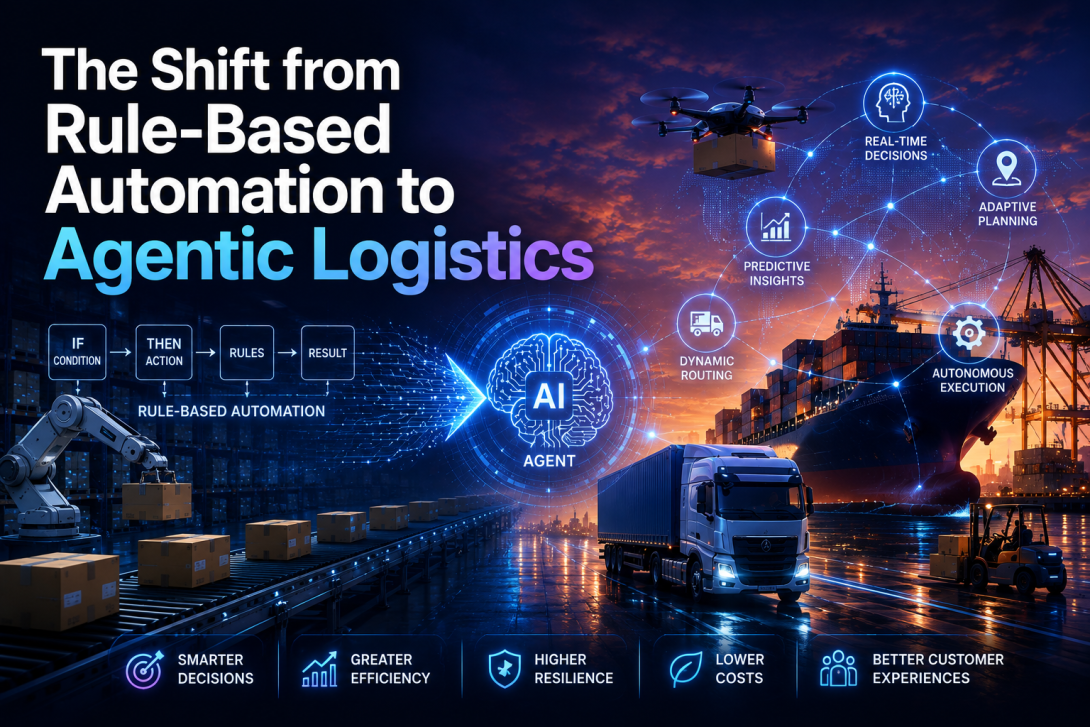
Logistics has long relied on automation such as automated sorting, shipment assignment, reorder alerts, and route planning. These systems boost speed and cut manual work, but follow fixed rules: if a condition occurs, a specific action follows. This works when operations are predictable, but modern supply chains rarely stay that way. Weather, traffic, delays, demand shifts, labor shortages, and disruptions can change things within hours, making old rules obsolete.
This is where agentic logistics comes in. Instead of following only fixed instructions, AI agents can analyze changing conditions, understand goals, evaluate actions, and adjust decisions in real time. It's not just adding AI to existing software, but redesigning how workflows operate. McKinsey's 2025 global AI survey found 62% of organizations were experimenting with AI agents, though few had scaled them enterprise-wide.
What Is Rule-Based Automation in Logistics?
Rule-based automation uses predefined conditions and actions to manage repetitive processes. A logistics system might be programmed to send a reorder notification whenever inventory falls below a certain level. A transportation system may assign a shipment to a particular carrier based on predefined cost or location rules.
How Traditional Automation Works
The basic structure is simple: when an event occurs, the software checks a predefined condition and performs an associated action.
For example, if a delivery is delayed by more than two hours, the system may send a notification to the customer. If warehouse inventory falls below 100 units, the system may generate a purchase order. If a truck reaches a particular location, the system may update its delivery status.
These workflows are useful because they are predictable, easy to test, and relatively straightforward to maintain.
Where Rule-Based Systems Start to Struggle
The problem appears when a situation involves multiple variables.
Suppose a shipment is delayed because of traffic while the destination warehouse is already operating at limited capacity and another nearby warehouse has available stock. A basic rules engine may recognize the delay but may not understand the larger operational situation.
A human logistics manager would consider the available inventory, delivery deadline, transportation cost, customer priority, warehouse capacity, and alternative routes before deciding what to do.
Agentic systems aim to perform this type of multi-step reasoning within defined boundaries.
What Makes Agentic Logistics Different?
Agentic logistics uses AI agents that can perceive information, reason about objectives, make plans, interact with software systems, and adjust their actions as circumstances change.
The difference is important because an AI agent is not limited to one predefined response.
From Instructions to Goals
Traditional automation generally receives instructions such as "if X happens, do Y." An agentic system can instead receive a broader objective such as "deliver this high-priority order by tomorrow while minimizing additional transportation costs."
The agent can then examine available data, evaluate possible options, and coordinate actions across relevant systems.
From Individual Tasks to Complete Workflows
Agentic AI can connect several activities into one workflow.
For example, a logistics agent detecting a delayed shipment could review the current route, check alternative carriers, examine inventory at nearby facilities, calculate delivery estimates, contact a carrier through an API, update the transportation management system, and notify the customer.
The important change is that the system coordinates the workflow rather than automating only one step.
Why Logistics Is Moving Toward Agentic AI
The logistics industry generates large volumes of real-time information. Vehicles, warehouses, orders, suppliers, customers, GPS systems, inventory platforms, and external data sources continuously produce new information.
This creates an environment where AI agents can provide practical value.
Managing Supply Chain Uncertainty
Modern logistics systems must respond to uncertainty rather than simply follow schedules. Agentic systems can continuously reassess conditions and adjust operational plans.
For example, when a supplier misses a scheduled shipment, an agent can check alternative suppliers, compare costs and lead times, review current customer orders, and recommend or initiate an alternative procurement workflow.
This makes logistics software more responsive to real-world conditions.
Practical Use Cases for Agentic Logistics
The strongest applications of agentic AI are found in workflows where multiple systems and decisions are involved.
Intelligent Dispatching
Dispatching is traditionally based on predefined rules involving driver availability, vehicle capacity, distance, delivery windows, and route constraints. An AI agent can consider these factors together with changing traffic, driver schedules, customer priority, weather, vehicle conditions, and new orders.
If circumstances change after a vehicle has already departed, the agent can reevaluate the plan rather than waiting for a dispatcher to intervene manually.
Fleet Optimization
Fleet management involves more than finding the shortest route. Vehicles need maintenance, drivers have working-hour limits, fuel costs fluctuate, and delivery priorities change throughout the day.
An agent can monitor these variables continuously and recommend adjustments. For example, if a vehicle develops a maintenance warning, the system can identify upcoming deliveries, evaluate alternative vehicles, rearrange assignments, and notify the relevant teams.
Warehouse Coordination
Warehouse operations include receiving, put-away, picking, packing, replenishment, and dispatch. Agentic systems can coordinate these activities by examining incoming orders, inventory levels, worker availability, equipment status, and shipping deadlines.
Rather than optimizing each activity independently, the agent can consider the impact of one decision on the wider operation.
Agentic AI for Inventory Management
Inventory decisions are another area where rule-based automation has limitations.
A simple system may reorder products when stock falls below a predefined threshold. However, actual inventory requirements depend on demand patterns, supplier lead times, seasonal changes, promotions, transportation conditions, and customer behavior. AI can evaluate these variables together.
Dynamic Replenishment
An AI agent can monitor inventory continuously and adjust replenishment recommendations as conditions change.
If demand unexpectedly increases, the agent can evaluate available suppliers and transportation options rather than simply following a fixed reorder point. This can help reduce both stockouts and unnecessary inventory.
Building Agentic Logistics Software
Agentic logistics requires a software architecture capable of connecting AI models with operational systems. The AI model itself is only one component.
Connecting Data Sources
An agent needs access to reliable information before it can make useful decisions. This may include transportation management systems, warehouse management systems, ERP platforms, GPS data, inventory databases, supplier information, customer orders, and external conditions such as weather and traffic.
APIs and event-driven systems allow agents to retrieve current information and initiate actions across these platforms.
Giving Agents Controlled Access
Autonomous systems should not receive unlimited access to business systems. Organizations should define which actions an agent can perform independently and which actions require human approval.
For example, an agent may be allowed to reschedule a delivery but may need approval before committing to a major additional transportation expense. This creates a balance between automation and operational control.
The Role of Humans in Agentic Logistics
Agentic logistics does not mean removing people from supply chain operations.
Human expertise remains important, particularly when decisions involve unusual circumstances, major financial consequences, customer relationships, or safety concerns.
Human-in-the-Loop Decisions
A well-designed system can automatically handle routine decisions while escalating important exceptions.
For instance, an agent could automatically reroute a standard shipment within predefined cost limits. However, if the change could cause a major contract violation or significant financial loss, the system could ask a manager for approval.
This approach allows organizations to gain the benefits of automation without giving unrestricted control to AI.
Digital Logistics Platforms and Agentic Workflows
Organizations increasingly need connected systems rather than isolated automation tools.
Modern digital logistics solutions for supply chain operations can bring transportation, warehouse, inventory, procurement, and customer information into a connected environment. Agentic AI can then operate across this data layer to coordinate workflows.
Instead of having separate automation for inventory, transportation, and customer service, businesses can create connected agents that understand how decisions in one area affect another.
This is especially important for complex supply chains where local optimization can sometimes create problems elsewhere.
AI and Logistics: From Prediction to Action
Traditional AI applications often focus on prediction. A system might forecast demand, estimate delivery time, or predict equipment failure. Agentic AI adds an action layer.
The system does not simply predict that a shipment is likely to be delayed. It can investigate why the delay is occurring, evaluate alternatives, and take an approved action. This distinction is one of the main reasons AI in logistics is moving from analytics toward operational automation.
McKinsey reports that supply chain organizations are still relatively early in scaling AI. Its 2025 supply chain survey found that 75% of respondents were planning, blueprinting, or piloting AI use cases, while only 19% said they were deploying AI tools at scale.
This suggests that the next challenge is not simply proving that AI can work, but building the data, architecture, governance, and workflows required to use it reliably at scale.
Measuring the Business Impact
Businesses should evaluate agentic logistics using practical operational metrics. The most useful measurements are usually connected to delivery performance, transportation costs, inventory levels, warehouse productivity, response times, and employee workload.
For example, a logistics company could compare how quickly delayed shipments are resolved before and after introducing an AI agent. A warehouse could measure whether automated coordination reduces order processing time. A fleet operator could examine whether dynamic routing reduces empty miles or fuel consumption.
The goal should be measurable operational improvement rather than simply increasing the number of AI features inside a platform.
Cost of Developing Agentic Logistics Software
The development cost depends heavily on the scope of the system.
A platform that only provides AI-assisted route recommendations will require less development than a system capable of independently coordinating fleets, warehouses, inventory, suppliers, and customer communications.
The estimate cost for logistics software should therefore account for AI model integration, API development, cloud infrastructure, data engineering, dashboards, security, user permissions, monitoring, testing, and ongoing maintenance.
Businesses can reduce initial complexity by starting with one high-value workflow and expanding after the system demonstrates measurable results.
Choosing the Right Technology Partner
Agentic logistics platforms require knowledge of logistics operations as well as AI, cloud computing, APIs, databases, cybersecurity, and enterprise software architecture.
A development partner should understand how transportation, warehouse, inventory, and order management systems work together.
Organizations looking to modernize logistics operations can work with experienced providers such as Citrusbug develops logistics software, particularly when the project requires custom workflows, AI integration, third-party system connectivity, and scalable cloud architecture.
The development process should begin with business requirements rather than AI capabilities. The technology should be selected according to the operational problem the organization needs to solve.
The Future of Agentic Logistics
The transition from rule-based automation to agentic logistics is likely to happen gradually.
Traditional automation will continue handling predictable activities because fixed rules remain useful for stable processes. Agentic systems will increasingly handle workflows where decisions depend on changing information and multiple connected systems.
Future logistics platforms may use groups of specialized agents working together. One agent could monitor inventory, another could coordinate transportation, and another could manage customer communication. A central orchestration layer could coordinate their activities while applying business rules and approval policies.
This shows that agentic logistics is moving from a theoretical concept toward real operational applications.
Conclusion
The shift from rule-based automation to agentic logistics changes how supply chain software handles decisions. Traditional automation still works for predictable tasks, but modern logistics needs systems that respond to changing conditions, coordinate workflows, and decide using current information. Agentic AI moves this forward, from isolated task automation toward intelligent orchestration across dispatching, fleet management, inventory, warehouse operations, and coordination, with human oversight for key decisions.
Organizations benefit most when they start with clear operational problems, reliable data, secure integrations, and measurable goals. Agentic logistics shouldn't be adopted just because it's new; it should target areas where smarter decisions cut delays, improve resource use, control costs, and boost responsiveness. As logistics grows more connected, shifting from fixed rules to adaptive decision-making becomes essential to modern supply chain software.