

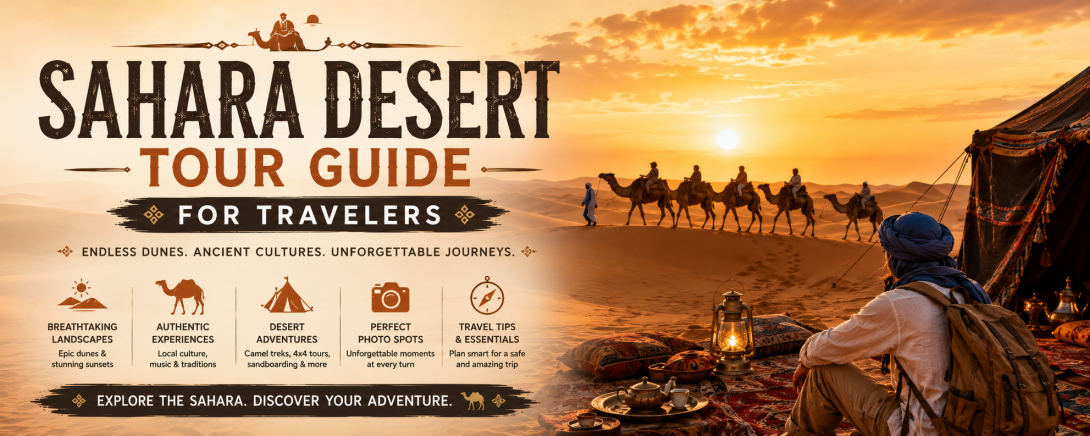
There is nothing quite like the feeling of standing atop a massive golden sand dune, watching the sun dip below the horizon as the sky turns into a brilliant canvas of orange, pink, and deep purple.
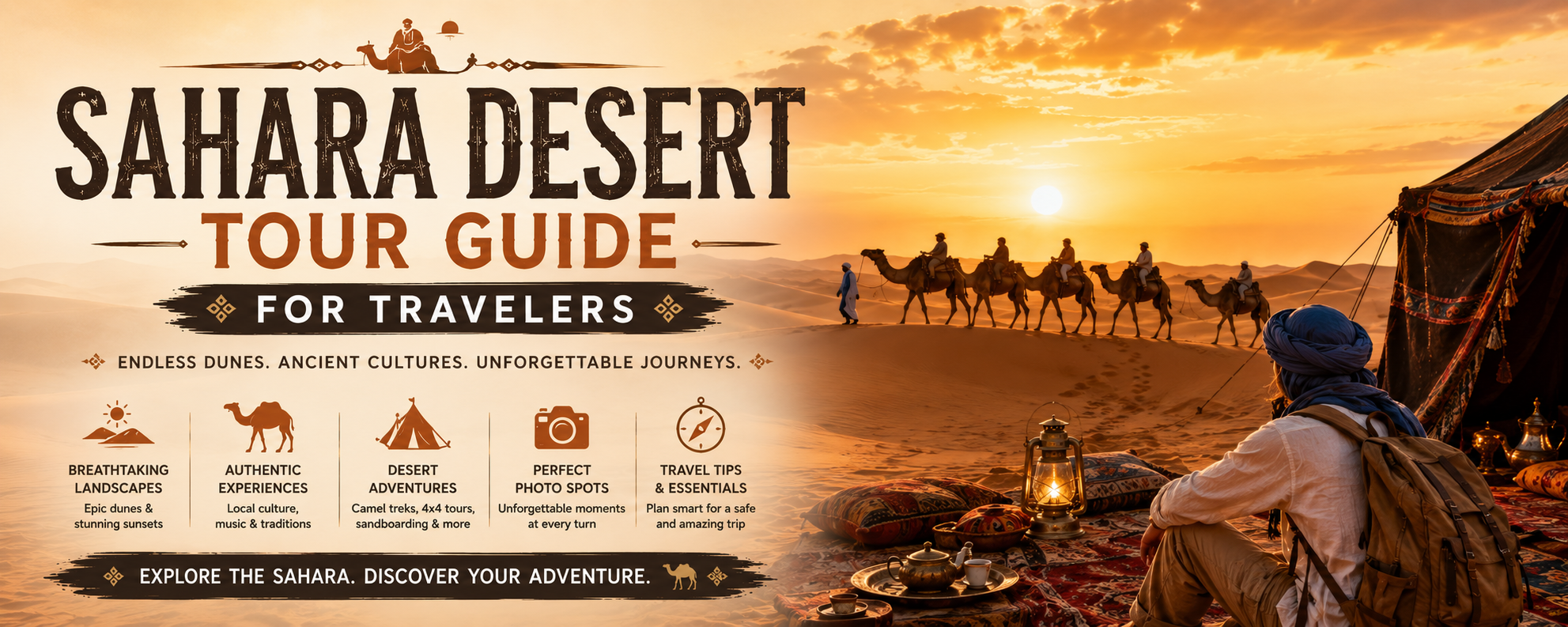
For many travelers, a journey into the Sahara Desert in Morocco is a bucket-list dream. But because the desert is incredibly remote, a trip here requires some careful planning.
In this guide, we answer the most popular questions travelers search for when planning their Sahara Desert adventure. From choosing the right route to getting your travel documents sorted, here is your practical, step-by-step guide to the sands of North Africa.
How far is the Sahara Desert from Marrakech?
The short answer: It is much farther than most people think.
Many first-time travelers assume they can easily visit the dunes on a quick drive from Marrakech. In reality, the journey to the famous dunes of Merzouga takes about $8$ to $10$ hours of solid driving one-way, covering roughly $560\text{ km}$ ($348\text{ miles}$).
Because the road snakes through the rugged High Atlas Mountains via the famous Tizi n'Tichka pass—which sits at an elevation of $2,260\text{ meters}$ ($7,415\text{ feet}$)—the drive is slow but incredibly scenic.
Most travelers break up the long journey by stopping at iconic sites along the way, such as:
- Ksar of Ait Benhaddou: A breathtaking, ancient UNESCO World Heritage clay city featured in Gladiator and Game of Thrones.
- Ouarzazate: Known as the "Hollywood of Morocco" due to its massive film studios.
- Dades Gorges or Todra Gorge: Giant limestone river canyons that are perfect for photos and a leg-stretch.
To avoid spending your entire vacation in a minibus, we highly recommend booking at least a 3-day, 2-night tour so you have plenty of time to enjoy the actual desert.
Can I do a day trip to the Sahara Desert?
Technically, no. If you see an agency offering a "one-day Sahara tour" from Marrakech, they are likely taking you to the Agafay Desert.
While Agafay is a beautiful, rocky desert landscape located just $45\text{ minutes}$ outside Marrakech, it does not have the massive golden sand dunes you see in photos. If you want to ride a camel over rolling orange waves of sand, you must commit to a multi-day trip to the true Sahara.
Which desert region in Morocco should I visit: Merzouga or Zagora?
When booking a tour, you will generally have to choose between two main destinations:
1. Merzouga (Erg Chebbi)
- The Vibe: This is the iconic Sahara you see on postcards. The sand dunes here (Erg Chebbi) rise up to $150\text{ meters}$ high.
- Activities: Perfect for camel trekking, sleeping in luxury desert camps, stargazing, and sandboarding.
- Cons: It takes longer to get here (around $9$ to $10$ hours from Marrakech).
2. Zagora (Erg Chigaga)
- The Vibe: Zagora is closer to Marrakech (about a $6$ to $7$-hour drive), making it possible for a shorter 2-day, 1-night trip.
- The Terrain: The landscape here is much rockier, flatter, and more arid than Merzouga. The true dunes (Erg Chigaga) are located deeper in the wild desert and require a rugged 4x4 to reach.
- Cons: You won't get the instant "sea of sand" view right outside your accommodation unless you take a longer off-road excursion.
The Verdict: If you want the classic, towering sand dunes, make the journey to Merzouga. If you are short on time but still want to sleep under the stars in a quiet desert setting, choose Zagora.
What should I pack for a Sahara Desert tour?
The desert environment is a land of extremes. During the summer months, daytime temperatures can easily exceed $40^\circ\text{C}$ ($104^\circ\text{F}$), while winter nights can drop to a chilly $5^\circ\text{C}$ ($41^\circ\text{F}$) or lower.
Here are the absolute essentials you should pack in a small daypack:
- A long, lightweight scarf: This is essential for protecting your face and hair from blowing sand during camel rides.
- Loose, breathable clothing: Long pants are highly recommended for camel riding to prevent chafing from the saddle.
- A warm jacket or fleece: Even in autumn or spring, the desert gets surprisingly cold the minute the sun sets.
- High SPF sunscreen and lip balm: The desert air is incredibly dry, and the sun is intense.
- A portable power bank: Most desert camps rely on solar power, meaning outlet space for charging your phone or camera can be limited.
- Closed-toe shoes: Sand gets incredibly hot during the day, and you'll want sturdy shoes to climb the dunes.
How do I get a tourist visa for Morocco?
Before you can ride a camel into the sunset, you need to make sure your travel documents are in order. Depending on your nationality, you may need a tourist visa to enter Morocco.
Fortunately, getting your visa does not have to be a stressful or confusing process. You can apply easily online before your trip begins.
To ensure your application is submitted correctly and approved quickly, you can apply for your Moroccan Tourist Visa.
Why Choose Our Visa Services?
- Reliable Travel Visa Services: Our global, traveler-first approach has successfully assisted countless tourists in obtaining their Moroccan visas without the typical bureaucratic headaches.
- Experienced Visa Consultants: Don't risk a rejected application over a simple paperwork mistake. Our expert team reviews your application thoroughly to guarantee its acceptance.
- Efficient Visa Application Process: Skip the long lines at embassies. Our highly simplified online application form allows you to apply for your Moroccan visa in just a few minutes.
- Round-the-Clock Assistance: Have questions during the application? Reach out to our dedicated support team 24/7, and our visa experts will respond with the help you need within 72 hours.
Planning a trip to the Sahara Desert is an unforgettable adventure. By sorting out your travel documents ahead of time, you can step off the plane in Morocco with total peace of mind, ready to experience the magic of the dunes!