

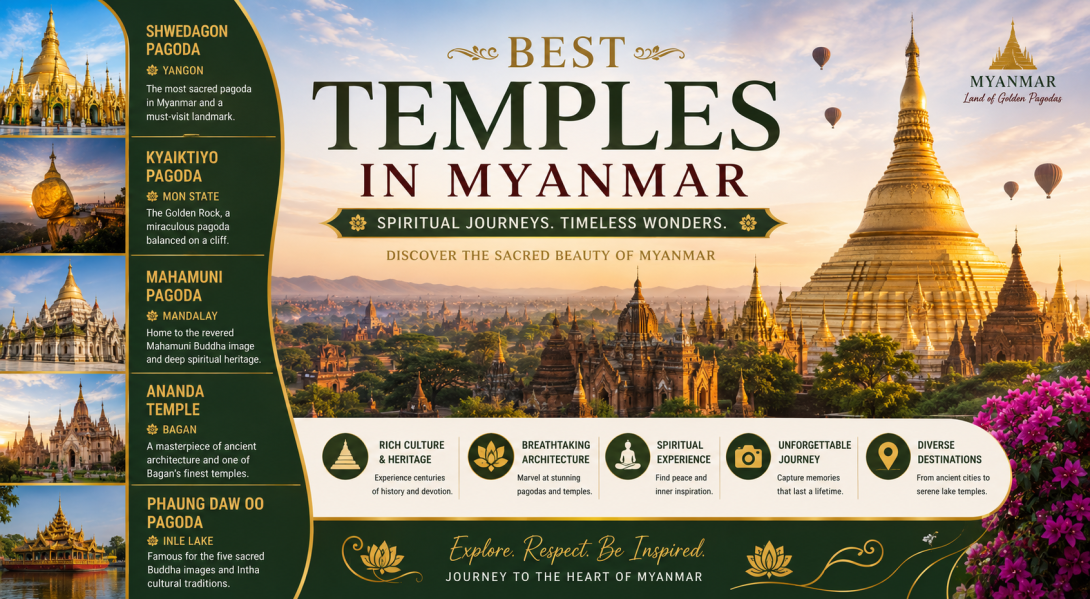
Myanmar is a country filled with deeply rooted traditions, beautiful landscapes, and some of the most remarkable sacred sites on earth. If you are planning a trip, the sheer number of golden spires and ancient ruins can feel overwhelming.
This guide breaks down the absolute best temples in Myanmar, what makes them unique, and how you can prepare for an unforgettable trip.
Why is Myanmar often called the "Land of Pagodas"?
If you fly over Myanmar or drive through its countryside, you will quickly notice thousands of golden spires pointing toward the sky. Myanmar earned the nickname "The Land of Pagodas" because building a temple or pagoda is considered one of the highest acts of merit in Theravada Buddhism.
For centuries, kings, families, and communities have built these structures to show their devotion. Today, these temples are not just historical monuments; they remain the active heart of daily life and spiritual practice for millions of people.
What is the most famous temple in Myanmar?
The most famous and sacred temple in Myanmar is the Shwedagon Pagoda, located in the former capital city of Yangon.
This massive monument stands nearly 100 meters tall on Singuttara Hill, making it visible from almost anywhere in the city. The main stupa is covered in genuine gold plates, and the very top is encrusted with thousands of real diamonds, rubies, and sapphires. According to local belief, the pagoda is over 2,500 years old, making it one of the oldest Buddhist stupas in the world.
Why is Shwedagon Pagoda so important to Buddhists?
Shwedagon is not just a tourist attraction; it is the most sacred Buddhist site in Myanmar. Devotees believe it enshrines holy relics from four previous Buddhas. Most notably, it is said to hold eight sacred hairs of Gautama Buddha.
When you visit, you will see locals walking clockwise around the central stupa, offering flowers, lighting water candles, and pouring water over statues that represent the day of the week they were born.
Which must-visit temples are located in Yangon?
While Shwedagon gets the most attention, Yangon has other remarkable temples you should add to your itinerary:
- Sule Pagoda: Located right in the middle of a busy traffic circle in downtown Yangon, this 44-meter-tall pagoda serves as a landmark and a historic meeting point for the city.
- Chaukhtatgyi Buddha Temple: This temple houses a massive reclining Buddha statue that is 65 meters long. The soles of the Buddha's feet are highly detailed, featuring 108 sacred symbols representing the characteristics of a Buddha.
- Botahtaung Pagoda: Located near the Yangon River, this pagoda was rebuilt after World War II. Unlike most stupas which are solid, you can actually walk inside the hollow interior of Botahtaung to view its relics.
How many ancient temples are actually in Bagan?
Bagan is one of the world's greatest archaeological wonders. Between the 11th and 13th centuries, the kings of the Pagan Kingdom constructed over 10,000 Buddhist temples, pagodas, and monasteries on a vast plain next to the Irrawaddy River.
Today, around 2,200 of these structures still survive. The area is now a protected UNESCO World Heritage Site, offering a landscape that looks like something out of a storybook, especially at sunrise when hot air balloons drift over the plains.
What are the top temples to visit in Bagan?
With thousands of options, it helps to focus on the most architecturally and historically significant ones:
- Ananda Temple: Known for its perfect Greek-cross layout, this beautifully preserved temple features four standing golden Buddhas facing the four cardinal directions.
- Shwezigon Pagoda: This gold-plated stupa served as the prototype for many of the pagodas built later across Myanmar.
- Sulamani Temple: Renowned for its fine brickwork and beautiful interior fresco paintings, this temple lets in soft, golden light through its high arches.
Is there a temple in Bagan with a dark or haunted history?
Yes, the Dhammayangyi Temple is the largest temple in Bagan, and it carries a grim reputation.
It was built in the late 12th century by King Narathu. History says Narathu assassinated his own father and brother to take the throne. To make up for his sins, he commissioned this massive temple.
According to local legends, Narathu was incredibly strict. He allegedly ordered his bricklayers to fit the stones so tightly that a needle could not pass between them. If a bricklayer failed, the king would have their hands chopped off. Today, the inner corridors of the temple are mysteriously bricked up, adding to its eerie, silent atmosphere.
Where can you see the world's largest book?
You can find the world's largest book at the Kuthodaw Pagoda in Mandalay, situated at the base of Mandalay Hill.
This "book" is not made of paper. Instead, it consists of 729 white stone slabs, each housed in its own small, white stupa (called a kyat). Inscribed on both sides of these marble slabs are the complete teachings of the Buddhist Theravada Canon (the Tripitaka). Reading the entire book aloud would take a person months of non-stop chanting.
What makes the Golden Rock (Kyaiktiyo Pagoda) defy gravity?
Located in Mon State, about a four-hour drive from Yangon, the Kyaiktiyo Pagoda—commonly known as the Golden Rock—is one of the country's most unusual pilgrimage sites.
It is a massive granite boulder, completely covered in gold leaf applied by male devotees. The rock sits precariously on the very edge of a steep cliff, looking as though it could tip over at any moment.
According to local legend, the rock remains perfectly balanced because it is held in place by a single strand of the Buddha's hair, gifted to a hermit who designated exactly which cliffside boulder should hold the relic.
Why is the Hsinbyume Pagoda in Mingun completely white?
Unlike the golden or red-brick structures common in Myanmar, the Hsinbyume Pagoda (also called the Myatheindan Pagoda) near Mandalay is entirely painted bright white.
Built in 1816 by Prince Bagyidaw, the temple is a monument of love dedicated to his favorite wife, Princess Hsinbyume, who died during childbirth. The pagoda's unique design represents Mount Meru, the sacred mountain at the center of Buddhist cosmology. Its seven wavy terraces mimic the seven mountain ranges that surround Mount Meru.
What is the correct dress code and etiquette for Myanmar temples?
Temples in Myanmar are active places of worship, so keeping a few strict cultural rules in mind is crucial for a respectful visit:
- Bare Feet Only: You must remove both your shoes and your socks before entering any temple grounds or courtyard. Walking barefoot on brick or marble is the standard.
- Cover Up: Dress modestly. Your shoulders and knees must be covered. Wearing a traditional longyi (a sarong-style wrap worn by both men and women in Myanmar) is highly recommended and widely appreciated.
- Respect the Monks: Never touch a monk’s robes, especially if you are a woman. If you want to take a photo of a monk, always ask for permission first.
- Mind Your Feet: Never point the soles of your feet toward a Buddha image, a monk, or another person, as feet are considered the lowest and dirtiest part of the body.
What is the best time of year to plan your Myanmar temple tour?
The best time to visit Myanmar is during the cool, dry season, which runs from November to February.
During these months, you will experience warm, sunny days without the intense heat of the summer or the heavy downpours of the monsoon season. Because you have to explore the temples barefoot, visiting during the cooler months also means the stone floors and brick paths won’t burn your feet under the afternoon sun.
How do you apply for a Myanmar tourist visa online?
Before you pack your bags to see these magnificent ancient wonders, you must secure the correct travel authorization. Fortunately, Myanmar offers an electronic visa (eVisa) system that makes the process straightforward for tourists.
By applying online, you can bypass long queues at embassies and receive your approval letter directly via email. To ensure a smooth, worry-free journey, you must understand the latest entry rules and processing steps. For a detailed breakdown of eligibility, required documents, and processing times, be sure to review the official Myanmar eVisa Policy.
Why Choose Us?
Planning a trip abroad can come with unexpected paperwork and confusing visa rules. We are here to handle the hard work so you can focus on planning your itinerary.
- Reliable Travel Visa Services: Our global, highly-tailored approach has successfully assisted numerous travelers in obtaining their visas with zero hassle.
- Round-the-Clock Assistance: Got a question late at night? Reach out to us 24/7. Our visa experts will respond with the answers you need within 72 hours.
- Experienced Visa Consultants: We review your documents thoroughly, giving you expert guidance to maximize the acceptance rate of your application.
- Efficient Visa Application Process: No complicated jargon or long forms. You can apply for your travel visa in just a few minutes using our simplified online form.