

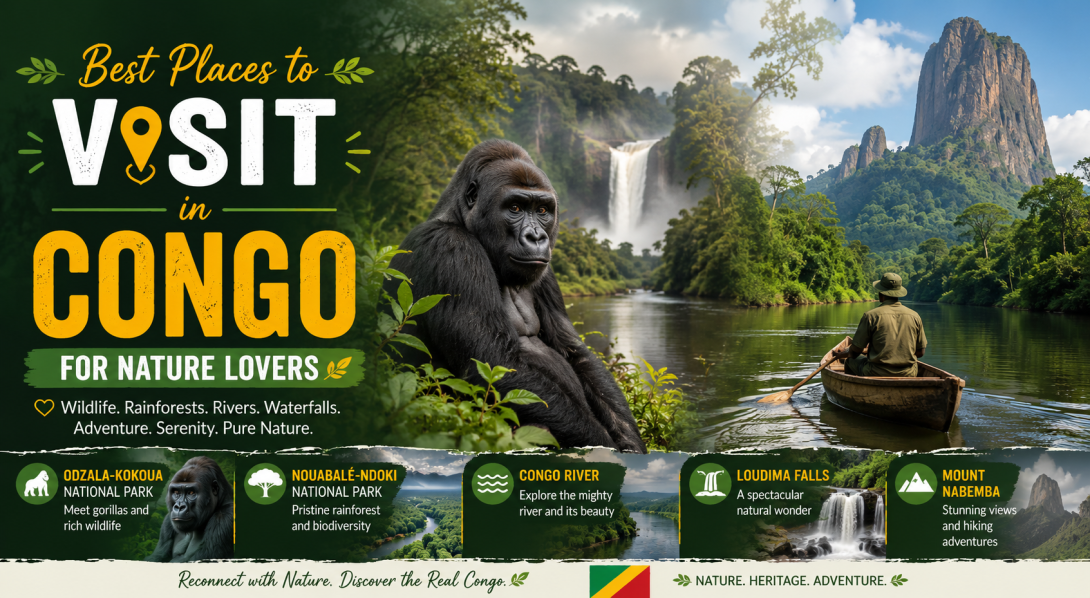
When most people think of classic African safaris, they picture the rolling plains of the Serengeti or the crowded parks of South Africa. But if you are a true nature lover who wants to experience deep, untouched wilderness, there is one place that stands above the rest: the Democratic Republic of the Congo (DRC).
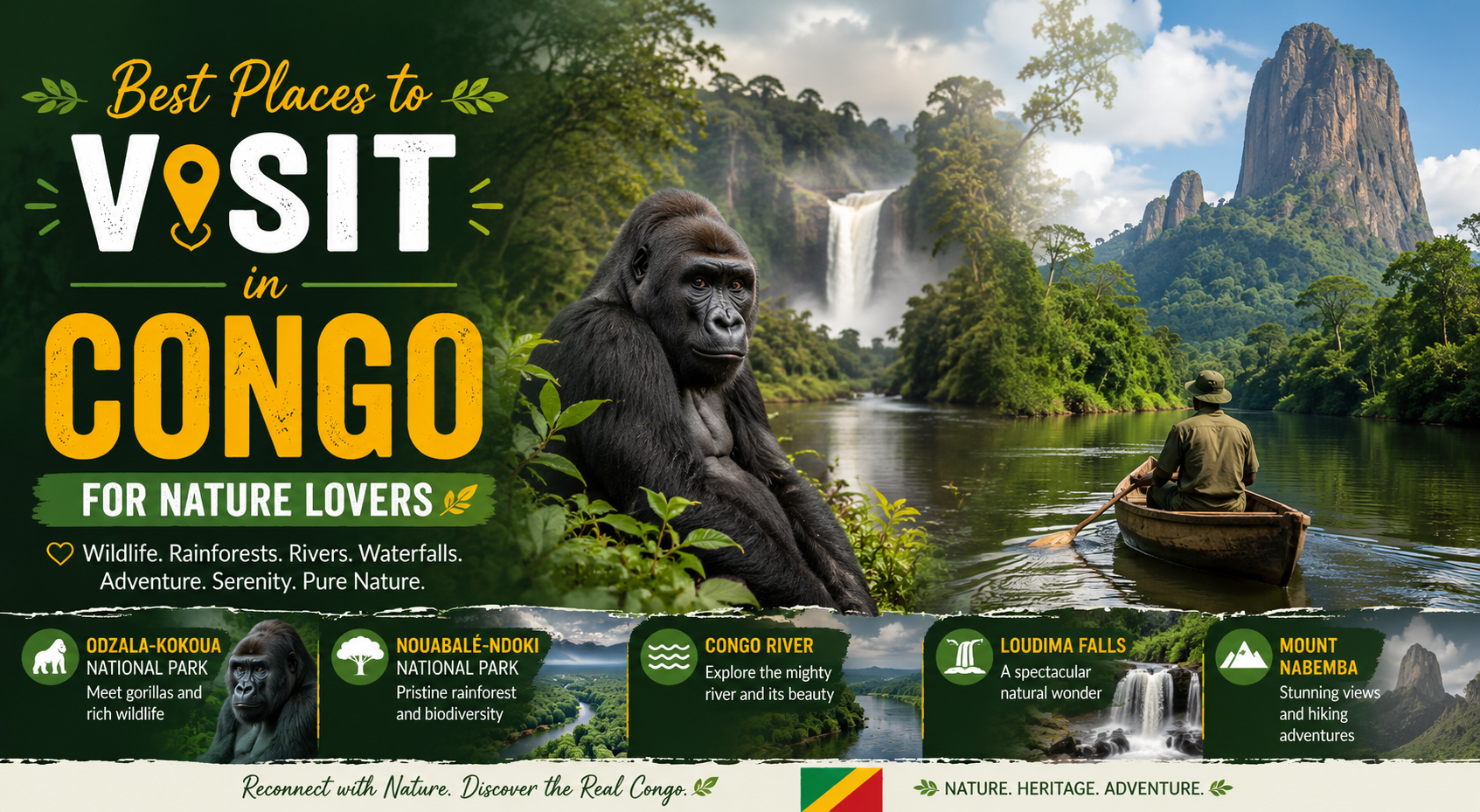
Home to the second-largest tropical rainforest on Earth, the Congo Basin, this country is a wild frontier. It is a land of active volcanoes, misty mountain peaks, and rare animals that you cannot find anywhere else on the planet.
If you are planning your next big adventure, here are the absolute best places to visit in the Congo for nature lovers, written in simple, clear guide format to help you plan an unforgettable trip.
Why is the Democratic Republic of the Congo a Dream Destination for Nature Lovers?
The Democratic Republic of the Congo is one of the most biodiverse countries in the world. It contains over $10$ distinct national parks and massive forest reserves that act as critical carbon sinks for our planet. Because the country does not experience mass commercial tourism, the ecosystems here remain incredibly raw and authentic.
From the snow-capped Rwenzori peaks to the deep equatorial jungles, the variety of habitats is staggering. Here, you are not just a tourist looking through a bus window; you are an explorer trekking through paths forged by wild elephants and local rangers.
Where Can You See the Last Mountain Gorillas in the Wild?
If there is one experience that draws wildlife enthusiasts to the Congo, it is seeing the endangered mountain gorillas. The best place to experience this is Virunga National Park.
Established in $1925$, Virunga is Africa's oldest national park and a UNESCO World Heritage Site. Spanning over $7,800\text{ km}^2$, the park is famous for its dense rainforests, open savannas, and volcanic landscapes. Trekking through the green slopes to find a gorilla family is a life-changing experience. You will spend an hour observing these gentle giants as they eat, play, and interact just a few meters away from you.
- Best time to visit: The dry seasons from June to September and December to February make trekking much easier.
- What to pack: Strong hiking boots, a waterproof jacket, and long trousers to protect against stinging nettles.
Is it Possible to Hike an Active Volcano with a Real Lava Lake?
Yes, it is! Also located inside Virunga National Park, Mount Nyiragongo is one of the most active volcanoes in the world. It stands at $3,470\text{ m}$ high and features the world’s largest persistent, bubbling lava lake.
The hike to the summit takes about $4\text{ to }6\text{ hours}$ depending on your fitness level. While the climb is physically demanding, the reward at the top is unlike anything else on Earth. You will spend the night in basic wooden shelters at the crater rim. As darkness falls, the sky turns a fiery red, and you can watch the bright orange lava churn and bubble right below you.
- Tip: It gets incredibly cold at the summit, with temperatures dropping below $0^\circ\text{C}$. Be sure to pack thermal layers, a warm hat, and gloves.
Where Should You Go to Find the Rare Eastern Lowland Gorillas?
While mountain gorillas get a lot of attention, their larger, shaggier cousins—the Eastern Lowland Gorillas (also known as Grauer's gorillas)—are equally fascinating. Kahuzi-Biega National Park is the ultimate stronghold for this unique subspecies.
Named after two dormant volcanoes, Mount Kahuzi ($3,308\text{ m}$) and Mount Biega, this UNESCO-listed park offers a different jungle experience. The lowland gorillas are larger and have wider faces. Walking through the lush bamboo forests of Kahuzi-Biega to track these primates is highly rewarding, and the park also boasts beautiful hiking trails that lead to the majestic Tshibati Waterfalls.
- Location: Near the town of Bukavu, on the scenic shores of Lake Kivu.
How Can You Visit Our Closest Primate Relatives, the Bonobos?
Bonobos are famous for being incredibly peaceful, matriarchal, and highly intelligent. They share roughly $99.6\%$ of their DNA with humans, making them—along with chimpanzees—our closest living relatives. They are found only in the wild forests of the DRC.
If you are starting your journey in the capital city of Kinshasa, you must visit the Lola ya Bonobo Sanctuary. Located about $35\text{ km}$ south of the city center (roughly $1\text{ to }1.5\text{ hours}$ drive depending on traffic), this sanctuary is a safe haven for orphaned bonobos rescued from the illegal wildlife trade.
Spanning $30\text{ hectares}$ of primary forest, the sanctuary allows these primates to live in social groups that mirror their natural wild habits. Visitors can take a guided walk around the forested enclosures to watch the bonobos play, solve problems, and care for their young.
What is Africa's Largest Tropical Rainforest Reserve, and Can You Visit It?
For the ultimate off-the-beaten-path experience, look into Salonga National Park. This is the largest tropical rainforest reserve in Africa, covering an astonishing $36,000\text{ km}^2$ of the Congo Basin.
Because it is located in a remote, roadless part of the country, Salonga is mostly accessible by water. For brave eco-travelers, a river boat expedition into Salonga is the ultimate adventure. It is home to wild populations of bonobos, forest elephants, giant pangolins, and the rare Congo peacock. Visiting Salonga requires careful planning, local guides, and a true passion for expedition-style travel.
Where Can You See Forest Elephants and the Elusive Okapi in the Congo?
If you want to see a creature that looks like a mix between a giraffe and a zebra, you need to head to the Okapi Wildlife Reserve, located in the historic Ituri Forest in northeastern DRC.
The okapi, often called the "forest giraffe," has striped legs for camouflage in the dense rainforest. The reserve covers about $13,700\text{ km}^2$ and holds about $5,000$ of the remaining wild okapis. The area is also home to:
- Over $370\text{ species}$ of birds (making it a paradise for birdwatchers).
- $17\text{ species}$ of primates, which is the highest diversity in any African forest.
- The indigenous Mbuti and Efe peoples, who have lived in harmony with these forests for thousands of years.
Trekking here alongside local forest guides gives you a rare glimpse into ancient forest survival skills and unique medicinal plants.
What Makes Garamba National Park Unique for Savanna Lovers?
Not all of the Congo is dense, dark jungle. In the far northern part of the country, bordering South Sudan, lies Garamba National Park.
Garamba features vast, golden grasslands and rolling savannas. It is one of the oldest national parks in Africa and is famous for holding the last populations of Kordofan giraffes in the DRC. You can also spot large herds of elephants, forest buffaloes, and various antelopes. While conservationists work hard to protect this area from poaching, visiting Garamba supports critical local conservation efforts and provides an authentic, crowd-free savanna safari.
Where Can You Explore the "Mountains of the Moon" on the Border?
On the border between the DRC and Uganda lie the legendary Rwenzori Mountains, traditionally known as the "Mountains of the Moon."
The highest peak on the Congolese side is Mount Stanley's Margherita Peak, which reaches an elevation of $5,109\text{ m}$. This mountain range is famous for its dramatic glaciers, high-altitude bogs, and unique alpine plants like giant lobelias. The Rwenzoris have a very high rate of endemism—about $13\%$ of the species found here cannot be found anywhere else in the world. It is a challenging but spectacular trek for serious mountaineers.
When is the Best Time to Visit the Congo for Wildlife Adventures?
The DRC lies directly on the equator, meaning it stays warm and humid year-round. However, the country has distinct wet and dry seasons:
- The Dry Seasons (June to September & December to February): This is the prime time for nature lovers. Forest trails are less muddy, roads are more passable, and animals are easier to spot as they gather near water sources.
- The Rainy Seasons (March to May & October to November): While travel can be challenging due to muddy roads, the rainy season is the best time for birdwatching, seeing lush green landscapes, and viewing majestic waterfalls at their highest flows.
How Do You Stay Safe While Exploring the Wild Landscapes of the DRC?
Traveling in the Congo requires respect for the wilderness and careful preparation. To ensure a safe and smooth journey, keep these key safety tips in mind:
- Always Hire a Reputable Local Guide: Never attempt to explore the national parks alone. Rangers and professional operators keep track of wildlife movements and security updates.
- Get Your Health Requirements Checked: You must show a valid Yellow Fever vaccination certificate to enter the country. It is also highly recommended to take malaria prophylaxis and avoid swimming in fresh water to prevent schistosomiasis.
- Respect Local Rules: When trekking near primates, always wear a surgical face mask (usually provided by the park) to protect our animal cousins from human illnesses.
How Do You Get a Travel Visa for the Democratic Republic of Congo?
To experience these magnificent natural wonders, you will need to secure a valid Democratic Republic of the Congo visa before you arrive. The easiest way to organize this is through a professional, streamlined visa service.
If you are looking for a hassle-free way to secure your travel permit, look no further than our expert visa services. We specialize in making your travel preparation simple, fast, and reliable.
Why Choose Us?
- Reliable Travel Visa Services: Our global, simplified approach has successfully assisted numerous international travelers in obtaining their official visas without the headache.
- Round-the-Clock Assistance: We are here for you. You can reach out to our team $24/7$, and our visa experts will respond with guidance within $72\text{ hours}$.
- Experienced Visa Consultants: Get personalized, expert guidance to ensure your application meets all government criteria, maximizing your chances of a quick approval.
- Efficient Visa Application Process: Skip the long embassy queues. You can apply for your Congo visa online in just a few minutes using our simplified form.
Before you book your flights and pack your hiking gear, make sure you understand the travel guidelines. Check out the official Democratic Republic of the Congo Visa Policy to start planning your wild African adventure today!