

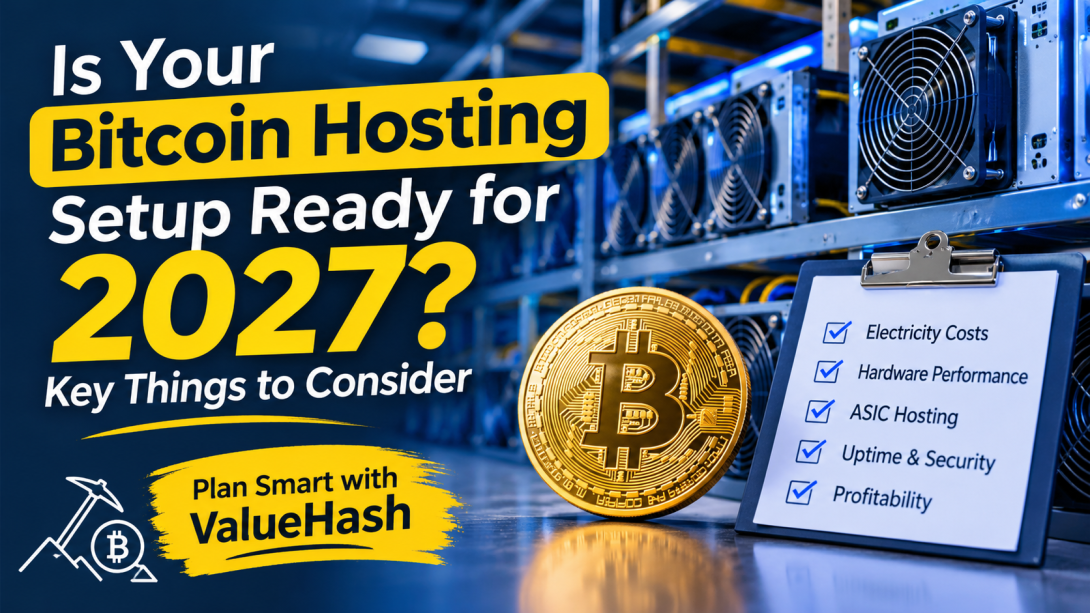
 As 2026 comes to an end, Bitcoin miners should start thinking about their mining plans for 2027. Mining hardware, electricity costs, network difficulty, and maintenance all play an important role in running a successful mining operation. Having the right setup can help miners manage these challenges and avoid unnecessary operating problems.
Whether you are already mining Bitcoin or planning to start, choosing the right hosting arrangement is an important decision.
1. Review Your Electricity Costs
Electricity is one of the biggest expenses in Bitcoin mining. ASIC miners run continuously and require a steady power supply. Even a small difference in electricity rates can affect monthly operating costs.
Before moving into 2027, review your current power expenses and compare available hosting rates. Look for providers that offer clear pricing and explain what is included in their electricity charges.
2. Check Your Mining Hardware Performance
Mining hardware plays a major role in your overall operating costs. Older machines may consume more electricity while producing less hashrate compared to newer models.
Check the following before expanding your setup:
- Hashrate and power consumption
- Energy efficiency (J/TH)
- Hardware condition and age
- Cooling requirements
- Maintenance and repair costs
Choosing suitable equipment can help you manage electricity expenses and maintain consistent mining performance.
3. Consider Professional ASIC Hosting
Running mining machines at home can become difficult as your operation grows. Noise, heat, electrical requirements, and regular maintenance can create additional challenges.
This is where ASIC hosting becomes useful. It allows miners to place their equipment in a professional facility with dedicated power infrastructure, cooling, internet connectivity, and security.
Professional ASIC hosting services can also help reduce the daily workload by providing equipment monitoring and technical support.
Before selecting a provider, check its facility locations, electricity rates, uptime information, security arrangements, and contract terms.
4. Compare Hosting Facilities and Support
Not every mining facility offers the same services. Some providers focus on small mining operations, while others support larger setups.
When comparing Bitcoin hosting solutions, consider:
- Power rates: Check the electricity price per kWh and any additional charges.
- Cooling systems: Proper cooling helps maintain hardware performance.
- Uptime: Understand the provider's uptime commitment.
- Security: Look for surveillance and controlled facility access.
- Technical support: Check whether maintenance and monitoring are available.
- Scalability: Make sure you can add more machines when required.
These factors can help you choose a hosting arrangement that suits your mining requirements.
5. Understand Mining Profitability Before 2027
Bitcoin mining profitability changes with Bitcoin prices, network difficulty, block rewards, electricity costs, and hardware efficiency.
Do not make decisions based only on current daily mining revenue. Calculate your expected monthly expenses and compare them with estimated mining income.
You should also keep some budget for unexpected repairs, hardware downtime, and changing market conditions. This makes it easier to plan your mining operation for the long term.
6. Choose a Hosting Partner That Fits Your Needs
Choosing the right hosting provider is just as important as selecting the right mining machine.
For example, ValueHash provides ASIC hosting facilities in Nebraska, Kansas, and New York. Its hosting infrastructure lists 38 MW of on-site capacity, 10 MW of available hosting space, and a minimum uptime commitment of 95%. Hosting electricity rates are listed between 6 and 7.5 cents per kWh, depending on quantity and contract term.
Miners looking for professional infrastructure can explore ValueHash Bitcoin and ASIC hosting services to review available facilities, hosting options, and service details.
Final Thoughts
Preparing your Bitcoin mining setup for 2027 requires more than buying new hardware. Electricity costs, machine efficiency, cooling, maintenance, and hosting support all deserve attention.
Take time to review your current setup, compare hosting options, and understand your operating expenses. A well-planned mining operation can help you manage costs and stay prepared for the challenges of the coming year.
For miners looking for professional mining infrastructure, ValueHash offers hosting options for both retail and larger-scale mining operations.