
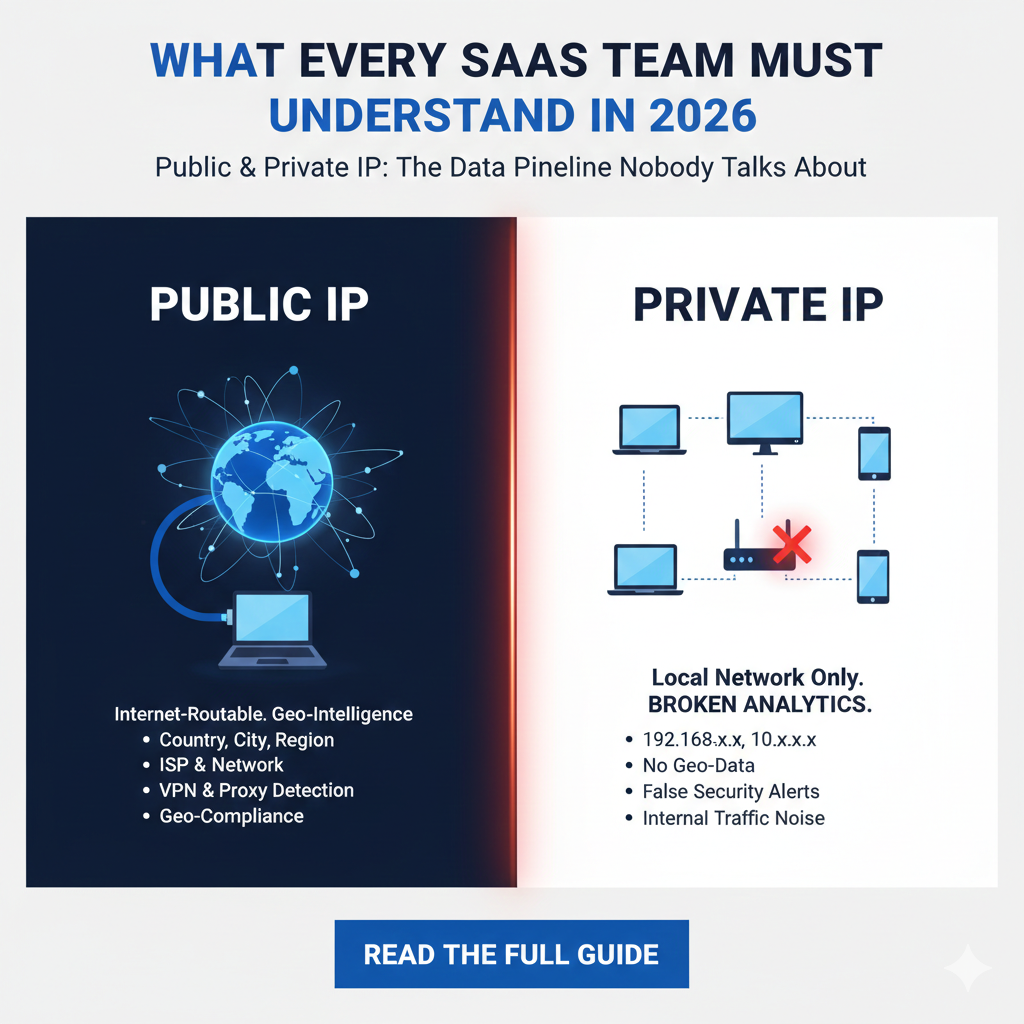
If you've ever stared at a server log full of IP addresses and wondered why your analytics look completely off , this post is for you.
Most developers know what an IP address is. But very few understand the critical difference between a public IP and a private IP , and more importantly, why getting this wrong can silently break your entire data pipeline.
Let's fix that.
What Is an IP Address, Really?
An IP address is a numerical label assigned to every device connected to a network. Think of it as a postal address for your device, it tells the internet where to send and receive data.
But not all IP addresses are created equal. There are two fundamentally different types, and they serve completely different purposes.
📖 Read the complete guide here: https://blog.apilayer.com/public-vs-private-ip-addresses-saas-enterprise-guide/
Public IP Addresses, Your Window to the Internet
A public IP address is assigned by your Internet Service Provider (ISP) or cloud provider. It is globally unique, internet-routable, and visible to the outside world.
When a user opens your SaaS app from their laptop at home, your server sees their public IP. When your cloud VM makes an API call, it uses a public IP. When a CDN edge node pings your webhook , again, public IP.
Public IPs are powerful because they carry real intelligence:
→ They reveal the user's country, city, and region
→ They expose the ISP and network provider
→ They help detect VPNs, proxies, and TOR exit nodes → They power timezone normalisation for global users
→ They enable geo-based access control and compliance
In short , public IPs are the foundation of IP intelligence.
Private IP Addresses, What Stays Inside, Stays Inside
A private IP address, on the other hand, exists only within a local network. It is not routable on the public internet. Nobody outside your internal network can reach a private IP directly.
You've seen them before. Addresses like 192.168.1.1, 10.0.0.5, or 172.16.0.1 , these are all private IPs. They are assigned by your router or internal network and used for communication between devices on the same local network.
Private IPs are essential for internal infrastructure. But here is where teams go wrong , they accidentally log private IPs and treat them as user identifiers.
The result? Broken analytics. Useless fraud detection. False security alerts. Hours wasted investigating traffic that turned out to be your own internal network.
📖 Read the complete guide here: https://blog.apilayer.com/public-vs-private-ip-addresses-saas-enterprise-guide/
How NAT and VPNs Complicate Things
Here's where it gets interesting for enterprise teams.
Network Address Translation (NAT) is the technology that allows multiple devices on a private network to share a single public IP. So when 50 employees are working from the same office, your server might see just one public IP for all of them. That single IP represents an entire organization, not a single user.
VPNs add another layer of complexity. When a user connects through a VPN, your server sees the VPN provider's public IP , not the user's real one. This is why VPN detection matters for SaaS platforms handling sensitive data or enforcing regional licensing.
Understanding these nuances is critical for accurate user attribution, especially for enterprise teams managing multi-tenant platforms.
Why This Matters for SaaS and Enterprise Teams
Let's get practical. Here's how the public vs private IP distinction directly impacts your business:
Analytics & User Segmentation: If private IPs sneak into your analytics pipeline, your location data becomes meaningless. You can't segment users by region, country, or city if you're tracking internal network addresses.
Fraud Detection: Fraud signals are built on public IP intelligence. Private IPs carry zero risk signals , no proxy flags, no VPN detection, and no TOR identification. Logging them as user IPs creates dangerous blind spots.
Security & Access Control: Geo-based access control, IP allowlisting, and anomaly detection all depend on accurate public IP data. One wrong assumption about IP type can leave your platform exposed.
Compliance: GDPR, CCPA, and data residency laws often require you to know where your users are located. That's only possible with accurate public IP data.
The Smart Solution, IP Intelligence APIs
The good news is you don't need to build IP lookup infrastructure from scratch. Tools like IPstack API give you instant access to rich IP metadata, location, ISP, ASN, proxy/VPN flags, and security attributes with a single API call.
Smart SaaS teams use IP intelligence to enrich login events, personalize user experiences, automate compliance checks, and strengthen their security posture, all in real time.
Public vs private IP addresses isn't just a networking concept; it's a business-critical distinction that affects your analytics, security, and compliance every single day.
If your team hasn't audited your IP logging strategy recently, now is the time.
📖 Read the complete guide here: https://blog.apilayer.com/public-vs-private-ip-addresses-saas-enterprise-guide/