
Introduction
People increasingly turn to digital healthcare platforms to understand their symptoms, explore possible health conditions, and decide when to seek medical attention. Instead of waiting for an appointment to discuss basic health concerns, patients can now use symptom checker applications to enter their symptoms and receive preliminary health information and care recommendations.
For healthcare providers, insurers, and digital health businesses, these applications offer an opportunity to improve patient engagement, streamline initial assessments, and make healthcare services more accessible.
However, developing a reliable symptom checker app involves much more than creating a questionnaire or connecting a chatbot to an AI model. It requires medical knowledge integration, natural language processing (NLP), clinical decision-support logic, symptom correlation, risk assessment, and appropriate escalation pathways. Data privacy, clinical validation, and healthcare interoperability are equally important.
This is why selecting the right development partner matters.
Several software development companies now offer healthcare application development, AI-powered symptom assessment, and digital triage solutions. In this article, we explore the top symptom checker app development companies in 2026, comparing their healthcare experience, technical capabilities, industry reputation, and pricing.
Overview of the Top Symptom Checker App Development Companies in 2026
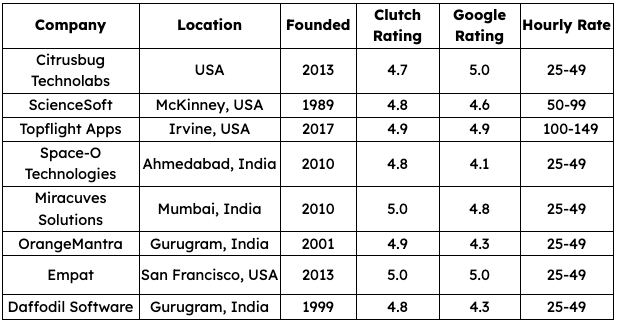
Here is a quick comparison of the companies featured in this listicle.
How We Selected the Top Symptom Checker App Development Companies
Choosing a symptom checker app development company requires evaluating more than its mobile application development experience. The software must be capable of handling health-related information responsibly while delivering useful and understandable results.
We considered the following factors while preparing this list.
- Healthcare domain expertise: Experience developing healthcare applications, telemedicine platforms, patient portals, and clinical software.
- AI and machine learning capabilities: Experience with NLP, intelligent symptom assessment, predictive analytics, and AI-powered healthcare applications.
- Clinical workflow understanding: Ability to develop structured symptom questionnaires, assessment workflows, triage logic, and escalation mechanisms.
- Integration capabilities: Experience integrating EHR/EMR platforms, healthcare APIs, medical databases, and third-party healthcare services.
- Security and compliance: Understanding of healthcare data protection, HIPAA-related requirements, GDPR, secure authentication, and access controls.
- Client reputation: Google and Clutch ratings, review volumes, and available industry recognition.
- Development cost: Available hourly pricing information and potential suitability for different project budgets.
The ranking is an editorial selection based on the supplied company information and publicly documented capabilities. It is not an independently audited industry ranking.
Best Symptom Checker App Development Companies in 2026
1. Citrusbug Technolabs
Location: USA
Founded: 2013
Clutch Rating: 4.7
Google Rating: 5.0
Hourly Rate: 25–49
Awards and Recognition: Clutch Premier Verified, Clutch Awards 2024
Website: https://www.citrusbug.com
Citrusbug Technolabs is a software development company specializing in custom software engineering, AI development, and digital product development. With over 13 years of experience, the company works with businesses across healthcare, fintech, logistics, real estate, and other industries.
Its healthcare development capabilities cover patient-facing applications, clinical platforms, AI-powered healthcare solutions, and healthcare workflow automation.
One particularly relevant project is its work on Mediktor, an AI-powered symptom assessment and clinical decision-support platform.
The engagement involved developing an AI-driven symptom assessment and triage solution capable of interpreting patient-reported symptoms, identifying possible conditions, and guiding users toward appropriate care pathways.
The technical implementation included natural language processing pipelines, probabilistic diagnostic models, real-time inference APIs, and healthcare partner integrations. These capabilities help transform unstructured patient inputs into structured clinical information that can support preliminary assessment and triage.
The project also involved multilingual symptom interpretation, condition ranking, and integration with healthcare systems. According to the company's published case study, the solution achieved a reported 92% triage accuracy rate and supported more than 10 languages.
Beyond this project, Citrusbug offers healthcare AI chatbot development services that include symptom checking, appointment scheduling, EHR-synced documentation, and patient communication.
Why Choose Citrusbug Technolabs?
- AI-powered symptom assessment: Experience building AI-driven systems that interpret patient-reported symptoms and support preliminary health assessments.
- NLP and machine learning: Capabilities involving symptom extraction, probabilistic condition assessment, and intelligent information processing.
- Clinical decision-support workflows: Development experience involving triage recommendations and care pathway guidance.
- Healthcare integrations: Supports API-based integrations and healthcare data exchange workflows.
- End-to-end engineering: Provides services covering product discovery, UI/UX design, development, testing, deployment, and maintenance.
- Cost-effective development: Its supplied hourly pricing makes it worth considering for healthcare startups and businesses seeking custom software development.
Citrusbug is particularly relevant for organizations looking to build AI-powered symptom checker applications with structured assessments, clinical workflows, and scalable healthcare integrations.
2. ScienceSoft
Location: McKinney, Texas, USA
Founded: 1989
Clutch Rating: 4.8
Google Rating: 4.6
Hourly Rate: 50–99
Awards and Recognition: ISO 13485, ISO 27001, ISO 9001, Quadrant Knowledge Solutions SPARK Matrix recognition (Healthcare IT), 2022 and 2024
Website: https://www.scnsoft.com
ScienceSoft is an established IT consulting and software development company with experience in healthcare technology, enterprise applications, and digital transformation.
Its healthcare services cover custom medical software, telemedicine applications, EHR systems, healthcare analytics, and AI-powered healthcare solutions.
One area relevant to symptom checker development is its work involving AI-powered virtual front doors and patient triage.
ScienceSoft describes conversational AI solutions that collect symptom information, ask follow-up questions based on provider-approved protocols, and prepare structured summaries for clinical review.
The approach also includes identifying concerning symptoms and escalating cases to qualified healthcare staff rather than allowing an AI model to independently determine patient acuity.
This is particularly important for symptom checker applications used by hospitals and healthcare networks, where preliminary assessments must connect with appropriate clinical workflows.
The company also offers healthcare mobile application development involving symptom checking, virtual triage, patient communication, and healthcare data management.
Why Choose ScienceSoft?
- Healthcare software experience: Long-standing experience developing applications for healthcare organizations.
- AI-powered triage: Offers conversational AI capabilities for preliminary symptom assessment and patient routing.
- Clinical workflow integration: Supports structured patient information collection and clinical staff handoffs.
- Healthcare interoperability: Experience with healthcare integrations and data exchange technologies.
- Quality and security standards: Holds the certifications and recognitions listed in its company profile.
ScienceSoft is worth evaluating for hospitals, healthcare networks, and enterprises that need symptom assessment functionality connected to larger healthcare technology environments.
3. Topflight Apps
Location: Irvine, California, USA
Founded: 2017
Clutch Rating: 4.9
Google Rating: 4.9
Hourly Rate: 100–149
Awards and Recognition: Clutch Premier Verified
Website: https://topflightapps.com
Topflight Apps is a digital product development company focused on healthcare applications, AI-powered software, and custom mobile and web platforms.
The company has a relevant portfolio of healthcare projects involving patient monitoring, symptom tracking, medical data collection, and clinical applications.
One notable example is its Smarter Symptom Tracker project, developed for the TMJ & Sleep Therapy Centre of San Francisco.
The solution included web, iOS, and Android applications that allowed patients to record pain and sleep-related symptoms, track their progress, refill prescriptions, and communicate with healthcare providers.
The platform also provided healthcare professionals with a web-based dashboard to monitor patient progress and identify significant changes in symptom patterns.
Another relevant project is its work on the You & ME patient registry and symptom tracking application, which helped patients and researchers collect and analyze health-related information.
These projects demonstrate experience with patient-reported symptom data, health tracking, and clinical monitoring workflows. While symptom tracking is different from automated symptom checking and diagnosis, the underlying data collection and visualization capabilities are relevant to symptom checker product development.
Why Choose Topflight Apps?
- Healthcare product development: Has a portfolio of digital health and patient-focused applications.
- Symptom tracking experience: Developed applications for recording, monitoring, and visualizing patient-reported symptoms.
- Clinical dashboards: Supports healthcare professionals with tools to review patient data and track health changes.
- AI development: Offers capabilities for building AI-powered healthcare products.
- Cross-platform engineering: Develops applications for web, iOS, and Android.
Topflight Apps is a relevant choice for businesses developing symptom tracking and assessment applications that require patient engagement, health data visualization, and clinician-facing functionality.
4. Space-O Technologies
Location: Ahmedabad, Gujarat, India
Founded: 2010
Clutch Rating: 4.8
Google Rating: 4.1
Hourly Rate: 25–49
Awards and Recognition: Clutch Top App Development recognition
Website: https://www.spaceotechnologies.com
Space-O Technologies is a software and mobile application development company offering services across healthcare, enterprise software, and digital product engineering.
Its healthcare development capabilities include telemedicine applications, patient engagement platforms, clinical communication tools, and healthcare workflow solutions.
The company's healthcare portfolio demonstrates experience developing applications for medical professionals and patients. Its projects include clinical communication applications, doctor consultation platforms, and digital health solutions.
One relevant example is its development of a mental health screening platform for MBHS Systems. The web-based application administers a structured behavioral health screening questionnaire, evaluates responses across multiple behavioral health scales, and generates clinician-ready reports.
Although behavioral health screening differs from general-purpose symptom checking, it demonstrates relevant experience with structured health assessments, scoring workflows, and clinical reporting.
Space-O also offers healthcare app development involving EHR/EMR integrations, AI clinical analytics, and secure application architecture.
Why Choose Space-O Technologies?
- Healthcare application development: Experience building digital solutions for healthcare providers and medical organizations.
- Structured assessment workflows: Experience with screening questionnaires, response scoring, and clinical reporting.
- AI and analytics: Offers capabilities for incorporating AI and data analytics into healthcare applications.
- Mobile and web development: Supports applications across multiple platforms.
- Healthcare integrations: Provides experience with EHR/EMR integrations and healthcare data workflows.
Space-O Technologies is worth considering for organizations seeking a custom healthcare application with structured patient assessments, reporting, and integration capabilities.
5. Miracuves Solutions Pvt. Ltd.
Location: Mumbai, Maharashtra, India
Founded: 2010
Clutch Rating: 5.0
Google Rating: 4.8
Hourly Rate: 25–49
Awards and Recognition: Clutch Top Developer recognition (2024–2025)
Website: https://miracuves.com
Miracuves Solutions is a software development company offering ready-made and custom digital platforms for businesses across multiple industries, including healthcare and telemedicine.
Its healthcare offerings include white-label doctor appointment applications, patient applications, provider dashboards, and administrative platforms.
The company also lists symptom checker functionality as part of its AI-powered healthcare application offering. Its published healthcare AI solution describes structured symptom intake, follow-up questions, and suggested care routes based on the patient's responses.
The listed functionality includes escalation of red-flag responses to healthcare professionals and recommendations that direct users toward appropriate care settings.
These capabilities are relevant to businesses that want to incorporate preliminary symptom assessment into an existing telemedicine or healthcare application.
However, organizations planning clinically consequential symptom assessment should confirm the underlying medical knowledge sources, validation methodology, and regulatory responsibilities before selecting a ready-made platform.
Why Choose Miracuves Solutions?
- Healthcare application solutions: Offers doctor appointment, telemedicine, and patient-facing applications.
- Symptom checker functionality: Lists AI-powered symptom checking within its healthcare application offering.
- Ready-made development options: Provides white-label platforms that can reduce initial development effort.
- Patient and provider applications: Supports multiple application interfaces and administrative workflows.
- Custom development: Offers scope for extending existing healthcare platforms with additional functionality.
Miracuves is worth evaluating for startups and businesses exploring a ready-made healthcare platform with symptom assessment functionality.
6. OrangeMantra Technology Pvt. Ltd.
Location: Gurugram, Haryana, India
Founded: 2001
Clutch Rating: 4.9
Google Rating: 4.3
Hourly Rate: 25–49
Awards and Recognition: Clutch Premier Verified
Website: https://www.orangemantra.com
OrangeMantra is a digital transformation and software development company providing services across healthcare, retail, manufacturing, and other industries.
Its technology capabilities include custom software development, mobile applications, AI solutions, cloud engineering, and enterprise application development.
The company has explored AI-powered healthcare applications and conversational AI solutions that support patient communication and preliminary health information collection.
Its healthcare AI content discusses symptom collection, triage workflows, and the role of AI chatbots in helping patients understand when they may need medical attention.
For symptom checker application development, this experience can be relevant when building conversational interfaces, patient intake workflows, and AI-powered healthcare assistants.
A well-designed symptom checker can use these capabilities to collect patient information, ask contextual follow-up questions, and present preliminary guidance within a healthcare platform.
However, the clinical assessment engine and its validation should be separately scoped and evaluated.
Why Choose OrangeMantra?
- AI application development: Provides capabilities involving AI-powered applications and conversational interfaces.
- Healthcare technology: Offers software development services for healthcare-related digital products.
- Mobile and web engineering: Supports development across different digital platforms.
- Enterprise integration: Can support API integrations and enterprise application workflows.
- Digital transformation: Offers broader technology consulting and software engineering services.
OrangeMantra is worth evaluating for organizations looking to combine conversational AI, healthcare workflows, and custom application development.
7. Empat
Location: San Francisco, California, USA
Founded: 2013
Clutch Rating: 5.0
Google Rating: 5.0
Hourly Rate: 25–49
Awards and Recognition: Clutch Premier Verified
Website: https://www.empat.tech
Empat is a software and mobile application development company specializing in custom digital products, mobile engineering, and emerging technologies.
Its services cover iOS and Android application development, web applications, AI-powered solutions, and product consulting.
The company specifically lists AI-enabled symptom checker functionality among its healthcare application development capabilities. Its healthcare offering also includes health tracking, analytics, appointment booking, and digital prescription management.
This combination can be useful for organizations developing patient-facing applications that bring symptom assessment together with broader healthcare services.
For example, a symptom checker application may allow users to enter symptoms, answer contextual questions, review preliminary health information, and connect with a healthcare professional when further assessment is required.
Empat's mobile application and AI engineering capabilities can support the development of these connected experiences.
Why Choose Empat?
- AI-enabled symptom checking: Lists symptom checker functionality within its healthcare application development services.
- Mobile application expertise: Develops custom iOS and Android applications.
- Healthcare integrations: Offers development capabilities for connected digital healthcare experiences.
- Patient engagement: Supports appointment booking, health tracking, and digital prescription features.
- Product consulting: Provides assistance with product planning, architecture, and application development.
Empat is worth considering for startups and healthcare businesses looking to build modern mobile applications that combine AI-powered symptom checking with patient engagement features.
8. Daffodil Software
Location: Gurugram, Haryana, India
Founded: 1999
Clutch Rating: 4.8
Google Rating: 4.3
Hourly Rate: 25–49
Awards and Recognition: Clutch Verified, enterprise and industry recognitions for healthcare solutions
Website: https://www.daffodilsw.com
Daffodil Software is a software engineering company with experience in healthcare technology, AI development, enterprise applications, and digital product engineering.
Its healthcare portfolio includes telehealth platforms, patient portals, EHR solutions, remote patient monitoring, and AI-enabled healthcare applications.
One particularly relevant project is its work on MayaMD, an AI-powered telehealth application developed for a US-based healthcare technology company.
The project involved modernizing an AI-powered symptoms tracker and integrating it into a broader telehealth platform. The application enabled patients and physicians to assess health concerns based on selected symptoms.
The solution also included physician-facing functionality that allowed medical professionals to review symptom assessment information, monitor patient vitals, and manage consultations.
Additional capabilities included medication reminders, appointment scheduling, video consultations, and integration with third-party health monitoring tools.
The project demonstrates experience connecting symptom tracking and assessment workflows with broader patient care and telehealth functionality.
Daffodil also offers healthcare AI capabilities involving machine learning-based symptom checkers, clinical data processing, predictive analytics, and healthcare integrations.
Why Choose Daffodil Software?
- AI-powered symptom assessment: Has documented experience integrating an AI-based symptom tracker into a telehealth application.
- Healthcare application engineering: Offers EHR, patient portal, and telemedicine development services.
- Clinical workflow integration: Supports physician dashboards, patient records, and consultation workflows.
- Health monitoring: Provides integration capabilities involving connected health monitoring tools.
- AI and machine learning: Offers AI-powered healthcare application development and analytics capabilities.
Daffodil Software is a strong candidate for organizations looking to connect symptom assessment with telehealth, remote patient monitoring, and broader clinical workflows.
Key Features to Include in a Symptom Checker App
A symptom checker application should make it easy for users to describe their health concerns while ensuring that the information collected is useful for preliminary assessment.
The exact feature set depends on the intended users, clinical scope, and healthcare environment. However, the following capabilities are commonly important.
1. Intelligent Symptom Input
Users should be able to describe their symptoms through structured forms, selectable options, or natural language input.
An AI-powered symptom checker can use NLP to identify relevant information from patient descriptions and convert it into structured symptom data.
For example, a user describing persistent headaches, nausea, and sensitivity to light may be asked additional questions about symptom duration, severity, and associated conditions.
2. Adaptive Questionnaires
A good symptom checker should not ask every user the same questions.
Adaptive questionnaires use previous responses to determine which follow-up questions are relevant. This helps gather more context without overwhelming users with unnecessary information.
Questions may cover:
- Symptom duration and frequency.
- Pain location and severity.
- Existing medical conditions.
- Age and relevant health history.
- Associated symptoms.
- Current medications and allergies, where appropriate.
3. AI-Based Symptom Assessment
AI and machine learning can help identify relationships between reported symptoms and possible health conditions.
Depending on the clinical design, the assessment engine may use NLP, medical knowledge bases, probabilistic models, and rule-based clinical logic.
The system should communicate uncertainty clearly and avoid presenting possible conditions as confirmed diagnoses.
4. Preliminary Triage and Risk Assessment
Triage functionality helps categorize the urgency of a user's reported symptoms.
A symptom checker may recommend different care pathways, such as:
- General self-care information.
- Scheduling a routine medical appointment.
- Seeking prompt medical evaluation.
- Contacting emergency services.
High-risk symptoms should trigger appropriate escalation pathways. Safety-critical decisions should not depend solely on an unrestricted generative AI response.
5. Medical Knowledge Base Integration
A symptom checker needs reliable medical information to support its assessment workflows.
Depending on the intended use, developers may integrate standardized clinical terminology and medical knowledge sources such as:
- SNOMED CT for clinical terminology.
- ICD-10 for disease classification.
- LOINC for laboratory and clinical observations.
- Curated medical guidelines and provider-approved protocols.
Medical content should be reviewed and updated through an appropriate clinical governance process.
6. Patient History and Symptom Tracking
Allowing users to maintain symptom histories can help them understand how their health concerns change over time.
The application can store previous assessments, symptom severity, duration, and relevant patient-reported information.
With appropriate consent, this information can also be made available to healthcare professionals for clinical review.
7. EHR and Healthcare System Integration
Integration with EHR and EMR systems can help transfer relevant patient information into existing clinical workflows.
Standards such as HL7 FHIR can support interoperability between symptom checker applications and healthcare platforms.
This can reduce duplicate data entry and provide clinicians with relevant assessment information before consultations.
8. Healthcare Professional Dashboard
A provider-facing dashboard can allow healthcare professionals to review symptom assessment results, patient history, triage recommendations, and escalation records.
It can also help medical teams monitor patient intake and prioritize cases requiring attention.
9. Security and Privacy Controls
Symptom checker applications may process sensitive health information. Security should therefore be incorporated into the system architecture from the beginning.
Important capabilities include:
- Encryption in transit and at rest.
- Role-based access control.
- Secure authentication.
- Audit logging.
- Patient consent management.
- Secure API communication.
- Data retention and deletion policies.
Applicable requirements depend on the countries and healthcare organizations using the application.
How to Choose the Right Symptom Checker App Development Company
Selecting a development partner requires evaluating whether the company can build both the application interface and the underlying assessment technology.
Here are some important considerations before finalizing your development partner.
1. Evaluate healthcare experience.
Start by reviewing the company's healthcare portfolio. Look for experience with patient applications, telemedicine platforms, clinical assessments, or symptom tracking solutions.
2. Assess AI and NLP capabilities.
If your application requires conversational symptom input, evaluate the company's experience with NLP, machine learning, medical knowledge integration, and AI model development.
3. Understand its approach to clinical validation.
Ask how symptom assessment logic will be reviewed and tested. Clinical experts should participate in defining symptom pathways, risk thresholds, and escalation rules.
4. Review healthcare integration experience.
If the application needs to connect with existing healthcare systems, check the company's experience with HL7, FHIR, EHR, and EMR integrations.
5. Discuss security and regulatory requirements.
Understand how the vendor addresses sensitive patient information, access control, encryption, consent, audit logs, and applicable healthcare regulations.
6. Evaluate scalability and performance.
Symptom checker applications may experience high user volumes, especially when integrated into healthcare networks. Evaluate the proposed cloud infrastructure, API architecture, and monitoring strategy.
7. Compare pricing and ongoing support.
Consider the complete cost of development, clinical validation, hosting, integrations, maintenance, and future updates rather than comparing hourly rates alone.
How Much Does It Cost to Develop a Symptom Checker App in 2026?
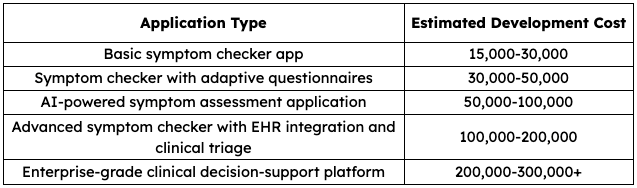
The cost of developing a symptom checker application depends on its functionality, AI capabilities, platform requirements, clinical scope, and integration complexity.
A basic application with structured symptom questionnaires will require less development effort than an AI-powered platform that interprets natural language, evaluates possible conditions, and connects with healthcare systems.
The following are indicative planning estimates rather than verified quotations from the companies listed above.
Factors That Influence Development Costs
AI and machine learning complexity: Developing NLP pipelines, condition assessment models, and intelligent follow-up questionnaires increases engineering effort.
Medical knowledge integration: Connecting standardized medical terminologies, clinical guidelines, and validated knowledge sources requires additional implementation and governance.
Clinical validation: Medical expert involvement, test scenarios, validation studies, and safety evaluations contribute to project costs.
Platform requirements: Developing separate web, iOS, and Android applications may increase the overall budget.
Healthcare integrations: EHR, EMR, telemedicine, and third-party healthcare integrations introduce additional development and testing requirements.
Security and compliance: Encryption, authentication, access control, audit logging, and regulatory documentation should be included in the project scope.
Post-launch maintenance: Medical knowledge updates, application improvements, infrastructure monitoring, and AI model evaluation contribute to long-term ownership costs.
For a more accurate estimate, define the application's intended use, clinical scope, user groups, integrations, and regulatory requirements before requesting vendor proposals.
Conclusion
Symptom checker applications are becoming an important part of digital healthcare. They can help patients understand their health concerns, collect relevant information before consultations, and connect users with appropriate healthcare services.
However, building a dependable symptom checker requires a combination of healthcare domain understanding, AI engineering, clinical assessment logic, and secure application development.
The companies featured in this list offer different strengths. Citrusbug Technolabs has documented experience with AI-powered symptom assessment and clinical triage through its Mediktor project. Daffodil Software has relevant experience through its MayaMD telehealth and symptom tracking solution, while Topflight Apps has developed patient symptom tracking and remote monitoring applications.
ScienceSoft offers relevant virtual front-door and triage capabilities, while Empat and Miracuves list symptom checker functionality within their healthcare offerings.
The right development partner ultimately depends on your application's clinical objectives, technical requirements, budget, and long-term roadmap.
If you are planning to build a symptom checker application, evaluate each company's healthcare portfolio, request relevant project references, and understand its approach to clinical validation before making a decision.
Frequently Asked Questions
1. What is a symptom checker app?
A symptom checker app is a digital healthcare application that allows users to enter their symptoms and receive preliminary health information or care recommendations. Depending on its design, it may use structured questionnaires, AI, medical knowledge bases, and clinical triage logic.
2. What technologies are used to develop a symptom checker app?
Common technologies include Python, Java, JavaScript, React Native, Flutter, NLP frameworks, machine learning libraries, cloud infrastructure, and healthcare APIs. Medical terminology systems and interoperability standards such as SNOMED CT, ICD-10, and HL7 FHIR may also be incorporated.
3. How much does it cost to develop a symptom checker app?
A basic symptom checker application may cost approximately 15,000–30,000, while an advanced AI-powered application with clinical assessment and healthcare integrations may cost 100,000–200,000 or more. The final budget depends on functionality, clinical scope, platform requirements, and integration complexity.
4. How long does it take to develop a symptom checker application?
A basic symptom checker may take approximately three to four months. An advanced AI-powered application involving clinical validation, medical knowledge integration, and EHR connectivity may take six to twelve months or longer.
5. Can AI diagnose diseases through a symptom checker app?
AI can analyze reported symptoms, identify potential condition patterns, and provide preliminary health information. However, an AI symptom checker should not automatically be treated as a diagnostic system. Its intended use, clinical evidence, regulatory classification, and healthcare professional oversight must be established appropriately.
6. What is the difference between a symptom checker and a symptom tracker?
A symptom checker evaluates user-reported symptoms and provides preliminary health information or care recommendations. A symptom tracker records symptoms over time to help users and healthcare professionals monitor changes and identify patterns.
7. Is HIPAA compliance required for a symptom checker app?
HIPAA requirements apply to covered entities and business associates handling protected health information under applicable US regulations. A symptom checker application's obligations depend on its business model, data flows, and relationship with healthcare organizations. Other jurisdictions may impose different data protection requirements.
8. Can a symptom checker app integrate with EHR systems?
Yes. Symptom checker applications can integrate with EHR and EMR systems through suitable APIs and healthcare interoperability standards such as HL7 FHIR. These integrations can help transfer patient-reported symptoms and assessment summaries into clinical workflows.
9. What should I look for in a symptom checker app development company?
Look for healthcare software experience, AI and NLP expertise, clinical workflow understanding, integration capabilities, security practices, and experience with clinical validation. Ask for relevant case studies and clarify whether the company has built a symptom checker, a symptom tracker, or a broader healthcare application.