
Patients increasingly expect to manage their healthcare online. They want to book appointments without calling a clinic, access medical records when needed, review test results, communicate with providers, and stay updated about their treatment.
Patient portals bring these interactions into one digital platform. For healthcare organizations, they can improve patient engagement, simplify administrative workflows, and make information easier to access. But building a reliable portal involves more than designing a convenient interface. It requires secure authentication, accurate health data exchange, EHR integration, accessibility, and compliance-aware development.
That is why selecting the right development partner matters.
In this article, we compare patient portal software development companies to consider in 2027. The list covers their healthcare experience, relevant projects, technical capabilities, ratings, and indicative hourly rates. It also distinguishes companies with documented patient portal projects from those with broader healthcare software experience.
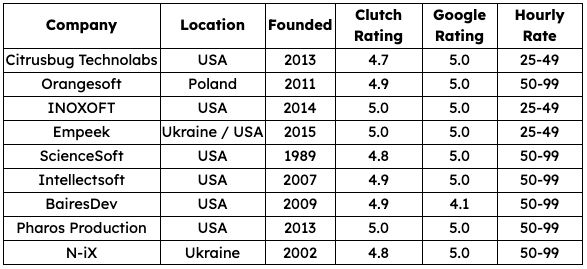
Patient Portal Software Development Companies Compared
How We Selected These Patient Portal Development Companies
We evaluated the companies using a combination of their publicly available portfolios and the company information provided for this comparison.
The main selection factors include:
- Patient portal experience: Evidence of developing patient-facing portals, healthcare applications, or patient engagement platforms.
- Healthcare domain expertise: Experience with EHR/EMR systems, telehealth, patient management, and clinical workflows.
- Integration capabilities: Experience connecting healthcare applications with existing systems through APIs, HL7, FHIR, or other interoperability standards.
- Security and compliance: Publicly documented security practices, healthcare data protection, and experience supporting requirements such as HIPAA.
- Client feedback: Google and Clutch ratings and review counts supplied for the companies.
- Technical capabilities: Expertise in web and mobile development, cloud infrastructure, data engineering, and application modernization.
- Pricing and company background: Founding year, supplied hourly rates, and industry recognitions.
The order is an editorial shortlist, not an independently audited industry ranking. A company's inclusion does not mean every listed capability has been demonstrated in a dedicated patient portal project.
Top Patient Portal Software Development Companies for 2027
1. Citrusbug Technolabs
Location: USA
Founded: 2013
Google Rating: 5.0
Clutch Rating: 4.7
Hourly Rate: 25–49
Recognitions: Clutch Global Fall 2024, Top AI Code Generation Company recognition (2024), CMMI Level 3 certification announcement (2026)
Website: https://www.citrusbug.com
Citrusbug Technolabs is a custom software development company offering healthcare application development, patient management systems, EHR integrations, and digital patient engagement solutions.
Its healthcare portfolio includes applications that support patient information management, prescriptions, provider-patient communication, and healthcare operations. The company's patient management software offering also describes mobile-accessible patient portals, appointment self-scheduling, digital intake forms, and secure access to patient information.
Citrusbug's healthcare engineering capabilities cover both patient-facing applications and the underlying systems that support them.
Relevant capabilities
- Custom patient portal and patient engagement platform development.
- Patient management and appointment scheduling systems.
- Digital intake forms and patient information management.
- EHR and EMR integration using HL7, FHIR, and SMART on FHIR where supported.
- Secure messaging and healthcare workflow automation.
- Healthcare AI, data engineering, and application modernization.
Why Choose Citrusbug Technolabs
Citrusbug is worth considering for healthcare organizations looking to build a custom patient portal around their existing workflows. Its experience across patient management, healthcare integrations, and digital engagement can support projects that need more than a standalone patient interface.
The company can also help connect patient-facing functionality with existing clinical and operational systems. This is relevant for hospitals, clinics, and healthcare businesses that want to improve patient access without replacing their entire technology infrastructure.
2. Orangesoft
Location: Warsaw, Masovian Voivodeship, Poland
Founded: 2011
Google Rating: 5.0
Clutch Rating: 4.9
Hourly Rate: 50–99
Recognitions: App Store Best of 2014 recognition (project claim), multiple Clutch recognitions
Website: https://orangesoft.co
Orangesoft develops healthcare applications, mobile platforms, and custom digital products. Its healthcare portfolio includes patient-facing applications for remote monitoring, virtual care, family caregiving, and health information management.
One relevant example is its work on a family caregiving application that brings medical records, medication information, lab results, and vital signs into a shared digital experience. The application also imports records from hospital patient portals and supports controlled access for family caregivers.
Orangesoft has also worked on a post-stroke monitoring platform that combines a patient-facing mobile application with a web platform for medical staff.
Relevant capabilities
- Patient-facing healthcare web and mobile applications.
- Patient portal and health record access integrations.
- Remote patient monitoring and telehealth.
- Medication management and health tracking.
- Caregiver access and patient engagement features.
- Healthcare application security and compliance engineering.
Why Choose Orangesoft
Orangesoft is a relevant option for healthcare organizations that want to combine patient portal functionality with mobile health applications. Its experience with patient records, caregiver access, and remote monitoring can help support more connected patient experiences.
Its work also demonstrates attention to accessibility and patient usability, which are important when developing portals for users with different ages, abilities, and levels of technical familiarity.
3. INOXOFT
Location: Philadelphia, Pennsylvania, USA
Founded: 2014
Google Rating: 5.0
Clutch Rating: 5.0
Hourly Rate: 25–49
Recognitions: ISO 27001 certification, Microsoft Gold and Google Cloud partnerships, multiple Clutch recognitions
Website: https://inoxoft.com
INOXOFT provides custom software development, healthcare application engineering, and AI-powered solutions. Its healthcare work includes web and mobile applications, patient-facing tools, and systems designed to support communication between patients and healthcare providers.
The company has also published work on virtual health assistants. One project describes an AI health assistant designed to help patients with routine questions, appointment requests, and prescription-related interactions while reducing the workload on healthcare staff.
Although this is not the same as a complete patient portal deployment, the experience is relevant to organizations exploring patient-facing digital healthcare services.
Relevant capabilities
- Healthcare web and mobile application development.
- AI-powered health assistants and conversational interfaces.
- Patient-doctor communication tools.
- Healthcare data and application integrations.
- Cloud-based healthcare solutions.
- Secure application architecture.
Why Choose INOXOFT
INOXOFT is worth evaluating when a patient portal needs intelligent features alongside conventional patient services. Its healthcare and AI capabilities can be relevant to portals that include conversational support, automated information collection, or patient assistance.
Organizations should request specific patient portal references and confirm the company's experience with their required EHR integrations before finalizing a development partner.
4. Empeek
Location: Lviv, Lviv Oblast, Ukraine; registered in Chicago, Illinois, USA
Founded: 2015
Google Rating: 5.0
Clutch Rating: 5.0
Hourly Rate: 25–49
Recognitions: Company-disclosed HIPAA/HITECH-aligned healthcare engineering practices
Website: https://empeek.com
Empeek focuses on healthcare software development, including EHR systems, telemedicine platforms, patient portals, and remote patient monitoring solutions.
Its portfolio includes a HIPAA-compliant EHR system and patient portal developed for a mental health clinic. The solution supports appointment scheduling, automatic reminders, audio and video conferencing, patient documents, assessments, and payment history.
Empeek has also developed healthcare applications for telemedicine and care coordination, giving it experience with patient-facing and provider-facing workflows.
Relevant capabilities
- Custom patient portal development.
- EHR and EMR software development.
- Appointment scheduling and automated reminders.
- Telemedicine and secure patient communication.
- Patient documents, assessments, and payment history.
- Remote patient monitoring and healthcare integrations.
Why Choose Empeek
Empeek is a strong candidate for organizations seeking a healthcare-focused development partner with direct patient portal experience. Its mental health portal project demonstrates how patient access, appointments, telemedicine, and administrative functionality can be brought into one platform.
It may be particularly suitable for clinics and healthcare providers building specialized portals around behavioral health, telemedicine, or remote care workflows.
5. ScienceSoft
Location: McKinney, Texas, USA
Founded: 1989
Google Rating: 5.0
Clutch Rating: 4.8
Hourly Rate: 50–99
Recognitions: Financial Times/Statista – The Americas' Fastest-Growing Companies 2025, Outsourcing 100 recognition
Website: https://www.scnsoft.com
ScienceSoft has extensive experience in IT consulting and custom software development, including healthcare software engineering. Its healthcare portfolio covers patient portals, telehealth platforms, EHR integrations, and healthcare management applications.
A relevant example is an EHR-integrated telehealth patient portal developed for a healthcare provider in New York. The web and mobile solution enabled patients to schedule appointments, join online consultations, and access their health records securely.
The portal was integrated with the client's existing athenahealth EHR environment, helping connect patient-facing services with the provider's clinical systems.
Relevant capabilities
- Custom patient portal development.
- EHR and EMR integration.
- Appointment scheduling and patient self-service.
- Telemedicine and virtual consultations.
- Secure medical record access.
- Healthcare application modernization and support.
Why Choose ScienceSoft
ScienceSoft is a suitable option for healthcare organizations that need an experienced partner for complex portal development and integration work. Its EHR-integrated telehealth portal demonstrates direct experience connecting patient-facing functionality with an existing clinical system.
Its long-standing healthcare software practice may also benefit organizations that need consulting, development, integration, and ongoing support under one engagement.
6. Intellectsoft
Location: Miami, Florida, USA
Founded: 2007
Google Rating: 5.0
Clutch Rating: 4.9
Hourly Rate: 50–99
Recognitions: Multiple Clutch recognitions; patient portal development thought leadership
Website: https://www.intellectsoft.net
Intellectsoft develops custom software and digital platforms for businesses, including healthcare applications. Its healthcare portfolio includes patient-facing web portals, medical information platforms, and digital solutions that support communication between patients and healthcare organizations.
One published project involved building a patient web portal for a US-based healthcare information provider. The portal gave users access to medical articles, drug information, symptom-related resources, and other educational content.
Intellectsoft also publishes guidance on patient portal software development, covering patient-facing features, administrative workflows, and platform architecture.
Relevant capabilities
- Custom patient web portal development.
- Healthcare information and patient engagement platforms.
- Medical content management.
- Appointment and patient request workflows.
- Web and mobile application development.
- Application maintenance and modernization.
Why Choose Intellectsoft
Intellectsoft is worth considering for healthcare organizations developing patient-facing information portals or custom digital health platforms. Its published patient web portal case study demonstrates direct experience designing and building a patient-oriented healthcare interface.
Organizations planning more advanced functionality should discuss EHR integration, secure messaging, patient record access, and the required compliance controls during project discovery.
7. BairesDev
Location: San Francisco, California, USA
Founded: 2009
Google Rating: 4.1
Clutch Rating: 4.9
Hourly Rate: 50–99
Recognitions: Clutch 1000 and Top Global B2B Service Provider recognitions (2023–2026)
Website: https://www.bairesdev.com
BairesDev provides software development and engineering team services across multiple industries, including healthcare. Its healthcare capabilities include custom application development, mobile platforms, and digital health solutions.
One relevant example is its work with Gennev, a telehealth company focused on menopause care. BairesDev supported the development and maintenance of the company's healthcare platform, addressing site reliability, scalability, and user experience.
While this project is not presented as a standalone patient portal, it demonstrates experience supporting a patient-facing digital healthcare service.
Relevant capabilities
- Custom healthcare software development.
- Telehealth platform development and support.
- Web and mobile application engineering.
- Platform scalability and reliability improvements.
- Healthcare data security and privacy considerations.
- Dedicated development teams and engineering support.
Why Choose BairesDev
BairesDev may be suitable for healthcare organizations that need to scale an existing digital health platform or extend their internal engineering capacity. Its healthcare work demonstrates experience supporting patient-facing services and maintaining platform reliability.
For a dedicated patient portal, buyers should confirm the team's experience with patient records, EHR integration, secure messaging, and healthcare-specific workflows.
8. Pharos Production
Location: Las Vegas, Nevada, USA
Founded: 2013
Google Rating: 5.0
Clutch Rating: 5.0
Hourly Rate: 50–99
Recognitions: ISO 27001 alignment/certification claims and multiple Clutch recognitions
Website: https://pharosproduction.com
Pharos Production offers custom healthcare software development, including patient portals, EHR systems, and healthcare engagement platforms.
Its CareConnect project is a direct example of patient portal development. The platform allows patients to access medical records, schedule appointments, participate in teleconsultations, and communicate with healthcare professionals.
The company describes an API-first approach, building the portal as a secure layer over existing clinical systems rather than replacing the client's underlying infrastructure.
Relevant capabilities
- Custom patient portal development.
- Patient appointment scheduling and reminders.
- Medical record access and patient engagement.
- Secure messaging and teleconsultation.
- EHR integration through APIs.
- Cloud-native healthcare platform development.
Why Choose Pharos Production
Pharos Production is one of the more directly relevant options in this list for organizations seeking a dedicated patient portal development partner. Its CareConnect case study covers several core portal functions, including appointments, medical records, virtual consultations, and patient-provider communication.
Its published approach also emphasizes connecting the portal to existing clinical systems, which can be important for healthcare organizations that want to improve patient access without replacing their EHR.
9. N-iX
Location: Lviv, Lviv Oblast, Ukraine
Founded: 2002
Google Rating: 5.0
Clutch Rating: 4.8
Hourly Rate: 50–99
Recognitions: Cloud vendor partnerships and recognitions with AWS, Google, and Microsoft; Clutch category recognitions
Website: https://www.n-ix.com
N-iX provides software engineering, cloud development, and healthcare technology services. Its healthcare portfolio includes digital health platforms, data solutions, and applications designed to connect patients with healthcare providers and other stakeholders.
A relevant example is its work on the Cure Forward healthcare platform. The project involved a multi-sided web application with separate interfaces for patients, recruiters, administrators, managers, and clinical trial-related workflows.
The patient portal enabled users to enter health information, including molecular diagnostic test results, and access educational resources related to treatment options and clinical trials.
Relevant capabilities
- Patient portal and healthcare platform development.
- Multi-role healthcare web applications.
- Patient data collection and management.
- Healthcare platform integration.
- Cloud engineering and application modernization.
- Healthcare UX and workflow design.
Why Choose N-iX
N-iX is a relevant option for organizations developing complex healthcare platforms with multiple user roles. Its Cure Forward project demonstrates direct experience building a patient portal as part of a larger healthcare ecosystem.
Its engineering and cloud capabilities may also suit healthcare businesses that need a scalable platform with separate patient, administrative, and partner-facing applications.
Essential Features of a Modern Patient Portal
A patient portal should make healthcare interactions easier without compromising the accuracy or security of patient information. The exact feature set depends on the organization, its patients, and the clinical systems it already uses.
Here are the features commonly considered during patient portal development.
1. Secure Patient Registration and Authentication
Patients should be able to create accounts and access their information through secure authentication. Common requirements include multi-factor authentication, identity verification, password recovery, and session management.
2. Electronic Health Record Access
A portal can give patients access to authorized medical information, such as diagnoses, prescriptions, allergies, visit summaries, and medical history. The information should remain synchronized with the relevant clinical system.
3. Appointment Scheduling and Management
Patients should be able to view available appointments, book visits, request changes, and receive confirmations. Integration with the provider's scheduling system helps avoid conflicting appointment information.
4. Lab Results and Medical Reports
Patients can use the portal to access laboratory results, diagnostic reports, and other approved documents. The portal should clearly communicate when results are available and when a clinician needs to explain them.
5. Secure Patient-Provider Messaging
Secure messaging allows patients to contact the appropriate healthcare team without relying entirely on phone calls. Organizations should define response expectations, routing rules, and escalation procedures.
6. Prescription and Medication Management
Depending on the healthcare provider's systems, portals can support prescription refill requests, medication lists, and reminders. Prescription changes and clinical decisions must remain under appropriate professional control.
7. Telehealth and Virtual Consultations
Integrated video consultation features allow patients to connect with healthcare professionals remotely. The portal may also support visit preparation, notifications, and access to post-consultation instructions.
8. Billing and Online Payments
Patients can view invoices, review payment history, and pay eligible bills through a secure payment workflow. Payment processing should follow appropriate security requirements.
9. Family and Caregiver Access
Some patients need help managing their healthcare information. A portal can support delegated access for caregivers or guardians, with clearly defined permissions and patient consent.
10. Accessibility and Multilingual Support
The interface should accommodate different levels of digital literacy and accessibility needs. Screen-reader compatibility, keyboard navigation, readable typography, and language options can make the portal easier to use.
How to Choose the Right Patient Portal Software Development Company
A patient portal is closely connected to healthcare operations. The development partner should understand both the patient experience and the systems that healthcare teams use behind the scenes.
Consider these factors when evaluating potential vendors.
1. Look for Relevant Healthcare Projects
Ask companies to demonstrate patient portal or healthcare platform projects they have actually delivered. Review the features, user roles, integrations, and business requirements involved.
A general mobile application portfolio is not enough to establish healthcare-specific expertise.
2. Evaluate EHR and EMR Integration Experience
The portal may need to exchange information with an existing EHR or EMR system. Ask about experience with HL7, FHIR, SMART on FHIR, and vendor-specific APIs.
Also clarify which system remains the source of truth for appointments, clinical records, and patient identity.
3. Review Security and Compliance Practices
Patient portals handle sensitive health information. Assess authentication, encryption, access control, audit logging, data retention, and incident response.
For US healthcare deployments, evaluate HIPAA requirements and applicable Business Associate Agreements. Other markets may require GDPR or local healthcare privacy controls.
A vendor's general security certification should not be treated as proof that the complete portal is compliant.
4. Assess User Experience and Accessibility
Patients may use the portal across different devices, ages, and accessibility needs. Review the company's approach to user research, usability testing, responsive design, and accessibility standards.
5. Understand Integration and Data Migration Plans
If the portal replaces or extends an existing application, understand how patient data will be mapped, validated, migrated, and reconciled.
Ask how the team will handle incomplete records, failed integrations, duplicate data, and changes to source systems.
6. Check Scalability and Performance
The portal should remain responsive during peak appointment periods and other high-traffic events. Discuss infrastructure architecture, monitoring, load testing, backup, and disaster recovery.
7. Clarify Maintenance and Long-Term Support
A portal needs ongoing updates, security patches, integration maintenance, and user support. Confirm the vendor's post-launch responsibilities and service-level expectations before signing an agreement.
Final Thoughts
Patient portals are becoming an important part of connected healthcare experiences. They help patients access information and manage routine interactions while giving healthcare organizations a more structured way to support engagement and communication.
Citrusbug Technolabs is worth considering for organizations looking for custom patient management, patient engagement, and healthcare integration capabilities. The right choice ultimately depends on your portal's features, existing clinical systems, security requirements, budget, and long-term product roadmap.
Frequently Asked Questions
1. What is patient portal software development?
Patient portal software development involves building web or mobile applications that allow patients to access healthcare services digitally. These applications can support medical record access, appointment scheduling, test results, secure messaging, prescription requests, and billing.
2. How much does it cost to develop a patient portal?
The cost depends on the number of features, integrations, platforms, security requirements, and project complexity. A basic patient portal generally costs less than a multi-facility platform with EHR integration, telehealth, billing, and advanced patient engagement features.
A detailed estimate should follow requirements discovery and technical assessment.
3. How long does it take to develop a patient portal?
A basic portal may take a few months to build, while a complex healthcare platform can take considerably longer. EHR integrations, data migration, security reviews, accessibility testing, and regulatory requirements can affect the timeline.
4. Can a custom patient portal integrate with an existing EHR system?
Yes. Custom patient portals can integrate with existing EHR and EMR systems through APIs and interoperability standards such as HL7 and FHIR. The available integration options depend on the source system and the access granted by its vendor.
5. Is patient portal software required to be HIPAA-compliant?
For US organizations and vendors handling protected health information, applicable HIPAA requirements must be addressed. This includes administrative, physical, and technical safeguards, along with appropriate agreements and operational procedures.
Compliance depends on the complete solution and how it is implemented and operated.
6. What is the difference between a patient portal and a patient management system?
A patient portal is primarily designed for patients to access information and interact with healthcare providers. A patient management system supports broader operational workflows, such as patient registration, scheduling, records, billing, and administrative coordination.
The two systems can be integrated or developed as parts of a unified platform.
7. Should a patient portal be a web application or a mobile app?
The choice depends on patient needs and usage patterns. A responsive web portal can provide access across devices without requiring installation. A native or cross-platform mobile application may be useful when the solution needs push notifications, device integrations, or more frequent patient interactions.
Some healthcare organizations offer both.
8. What technologies are used to develop patient portal software?
Common technologies include React, Angular, Vue, Node.js, .NET, Java, Python, PostgreSQL, and cloud platforms such as AWS, Azure, and Google Cloud. Healthcare integrations may use HL7, FHIR, SMART on FHIR, and vendor-specific APIs.
The right stack depends on the existing healthcare infrastructure and product requirements.
9. Can patients give family members access to their portal?
Yes. Patient portals can support delegated access for caregivers, parents, guardians, or other authorized representatives. The implementation should define consent, access permissions, identity verification, and how access is revoked when authorization changes.
10. What should healthcare organizations look for in a patient portal development partner?
Look for proven healthcare software experience, patient-facing application development, EHR integration capabilities, security practices, accessibility expertise, and long-term support. Ask for relevant case studies and references rather than relying only on general software development credentials.