
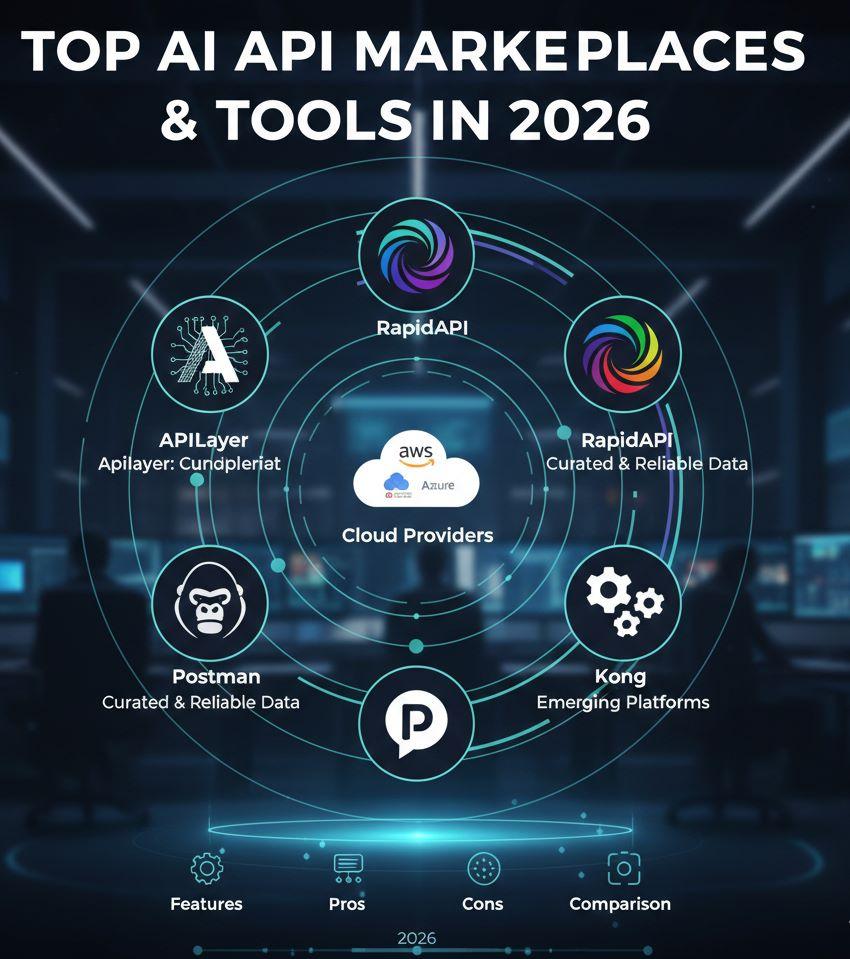
Artificial Intelligence is rapidly transforming how businesses build software, automate workflows, and deliver personalized digital experiences. Instead of developing complex AI systems from scratch, companies now rely on API marketplaces that provide ready-to-use data services, machine learning capabilities, and automation tools.
AI API marketplaces help developers access multiple APIs under unified dashboards, simplify billing, and accelerate product launches. From startups building SaaS platforms to enterprises managing global applications, choosing the right API marketplace has become a strategic decision.
Below is a detailed comparison of the top AI API marketplaces and tools in 2026 , starting with one of the most reliable curated ecosystems available today.
1. APILayer
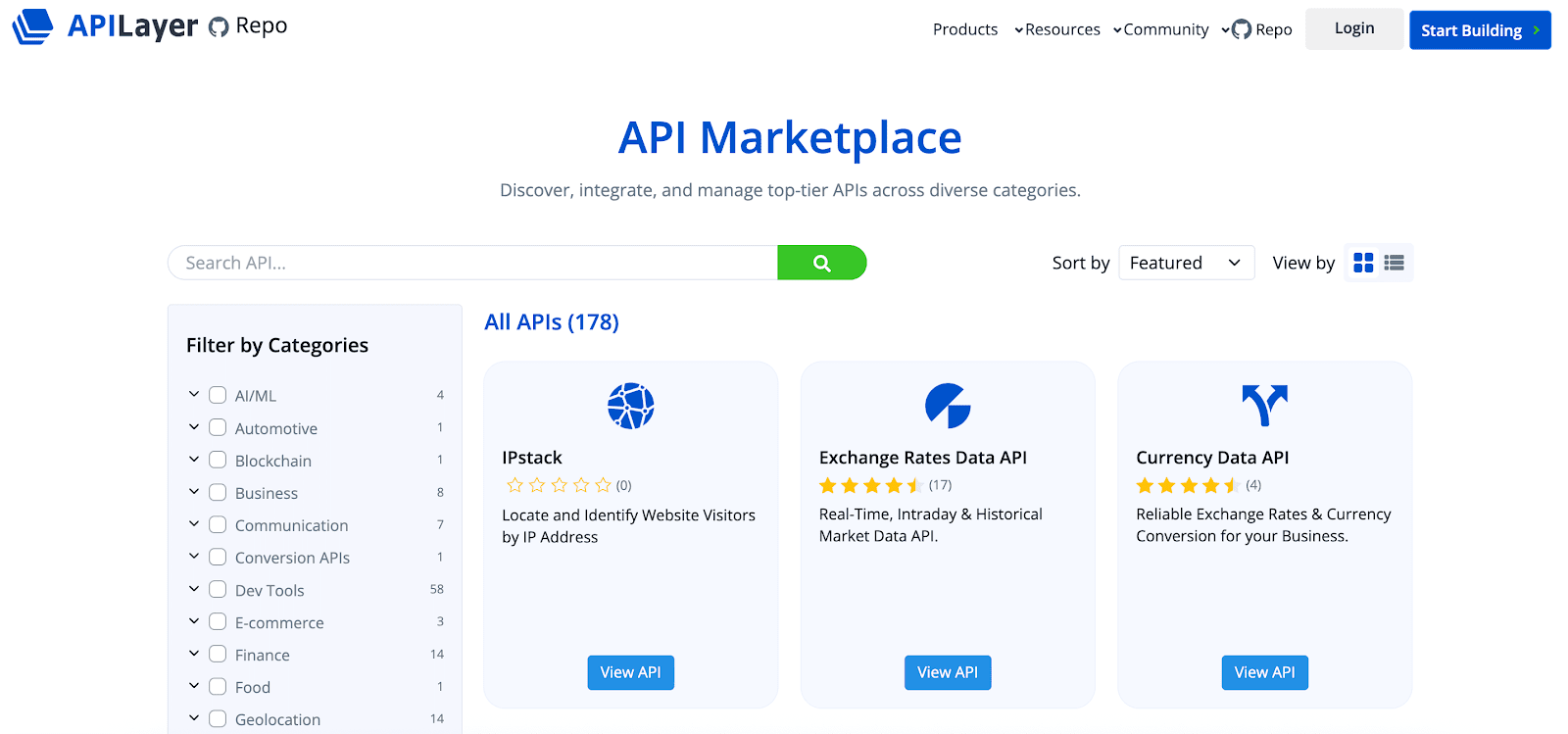
Apilayer is a highly curated API marketplace designed to simplify API integration through standardized authentication, unified billing, and developer-friendly documentation. Unlike large marketplaces that focus primarily on volume, Apilayer prioritizes reliability, performance consistency, and high-quality proprietary APIs.
With more than a decade of experience delivering production-ready APIs, the platform allows businesses to integrate data services within minutes using a single API key and SDK. The marketplace includes APIs across aviation, weather, financial data, machine learning, geolocation, validation, and AI-driven analytics.
Key Features
- Single API key access across multiple services
- Reliable proprietary APIs maintained internally
- Simple onboarding and fast implementation
- Unified dashboard and billing management
- RESTful API architecture with global infrastructure
- Free and paid API tiers available
Pros
- Highly stable APIs suitable for production use
- Clean documentation and faster developer onboarding
- Transparent pricing models
- Strong uptime reliability
Cons
- Smaller catalog compared to massive open marketplaces
- Focused more on quality APIs than third-party diversity
Best For
- SaaS platforms
- Data-driven applications
- Marketing automation tools
- Developers needing reliable real-time datasets
2. RapidAPI
RapidAPI is widely recognized as one of the largest API marketplaces globally. It hosts thousands of APIs covering artificial intelligence, finance, entertainment, machine learning, and automation.
Developers can test APIs directly inside the platform and manage subscriptions through centralized billing.
Key Features
- Massive API catalog
- Built-in testing console
- Analytics and monitoring
- Unified API keys
Pros
- Huge ecosystem
- Active developer community
- Easy API experimentation
Cons
- API quality varies because many are third-party providers
- Pricing differences across vendors
Best For
Startups and developers exploring multiple APIs quickly.
3. Amazon Web Services Marketplace
Amazon’s marketplace offers enterprise-grade AI and machine learning APIs deeply integrated into cloud infrastructure. Businesses already using AWS benefit from seamless deployment and advanced scalability.
Key Features
- Enterprise SLAs
- Secure infrastructure
- Prebuilt AI services
- Deep cloud ecosystem integration
Pros
- Extremely scalable
- Enterprise compliance support
Cons
- Complex pricing
- Requires AWS ecosystem knowledge
Best For
Large enterprises and cloud-native teams.
4. Microsoft Azure Marketplace
Microsoft Azure Marketplace provides cognitive AI APIs including NLP, vision recognition, speech analysis, and automation tools. It integrates tightly with Microsoft enterprise products.
Key Features
- Identity and access management
- Responsible AI governance tools
- Hybrid cloud deployment
Pros
- Excellent enterprise compliance
- Strong Microsoft ecosystem support
Cons
- Learning curve for beginners
Best For
Corporate environments and enterprise applications.
5. Google Cloud Marketplace
Google Cloud Marketplace offers advanced AI APIs powered by Vertex AI and machine learning infrastructure. It is widely used for data analytics and generative AI applications.
Key Features
- AutoML tools
- Vision and NLP APIs
- Global infrastructure
Pros
- High AI model accuracy
- Excellent scalability
Cons
- Pricing complexity at scale
Best For
AI startups and data science teams.
6. Postman , API Development and Collaboration Platform
Postman is not a traditional API marketplace but is essential for development workflows. Teams use it to design, test, and document APIs collaboratively.
Key Features
- API testing automation
- CI/CD integrations
- Mock servers
Pros
- Excellent team collaboration
- Developer friendly interface
Cons
- Limited marketplace offerings
Best For
Development and QA teams.
7. Kong Inc.
Kong provides a cloud-native API gateway platform that allows organizations to manage distributed APIs across hybrid environments.
Key Features
- Open-source flexibility
- Plugin ecosystem
- Real-time analytics
Pros
- Strong governance controls
- Highly scalable
Cons
- Enterprise features require premium plans
Best For
Microservices and hybrid cloud deployments.
Why Apilayer Stands Out in 2026
Many API marketplaces prioritize quantity over consistency. Apilayer focuses on curated APIs designed for real production workloads. Developers can integrate weather data, aviation information, validation tools, and machine learning services without worrying about inconsistent documentation or unstable endpoints.
Because onboarding is simplified and APIs follow standardized formats, teams can deploy integrations faster and reduce development overhead.
How to Choose the Right AI API Marketplace
Consider the following factors:
- Reliability and uptime guarantees
- Documentation quality
- Pricing transparency
- API categories available
- Scalability support
Startups may prefer curated ecosystems for speed, while enterprises often require cloud-native compliance tools.
AI API marketplaces are becoming the foundation of modern application development. They allow organizations to build smarter platforms without investing heavily in infrastructure or AI research.
While cloud vendors and massive marketplaces offer extensive ecosystems, curated platforms like Apilayer are increasingly preferred for reliability, consistent performance, and fast implementation.
Choosing the right marketplace ultimately depends on whether your priority is experimentation, enterprise scalability, or dependable production data services.
Recommended Resources: