

Introduction: Most Enterprise Projects Do Not Fail in Development
They fail in interpretation.
Across large organizations, digital initiatives begin with energy and ambition. Business leaders define objectives. Product teams outline features. Technology teams prepare delivery plans. Yet somewhere between vision and execution, ambiguity enters the system.
Requirements become loosely defined. Assumptions remain undocumented. Edge cases surface late. Testing uncovers gaps that trace back not to coding errors, but to misunderstood expectations.
By the time these gaps are discovered, rework has already consumed budget and timelines.
This is why forward-looking enterprises are revisiting the foundation of delivery itself — requirement engineering. Not as documentation overhead, but as a strategic control point. And increasingly, they are embedding intelligence into that process.
Why Manual Requirement Engineering Struggles at Enterprise Scale
Requirement gathering traditionally depends on workshops, stakeholder interviews, and iterative documentation cycles. In smaller environments, this works. In complex enterprise ecosystems, it introduces risk.
Multiple stakeholders interpret objectives differently. Terminology varies across departments. Documentation formats differ. Traceability becomes fragmented.
As programs scale, consistency declines.
With Agentic AI Assistant integrated into early-stage discovery, requirement articulation becomes structured rather than conversational alone. Business inputs are contextualized. Domain terminology is normalized. Initial drafts are generated with consistency in format and scope.
This does not remove human validation. It strengthens it.
Clarity begins earlier — and remains intact longer.
Converting Business Narratives into Structured Functional Specifications
A recurring challenge in enterprise delivery is translation. Business stakeholders describe goals in operational language. Engineering teams require structured functional and non-functional specifications.
Misalignment at this translation layer leads to defects later.
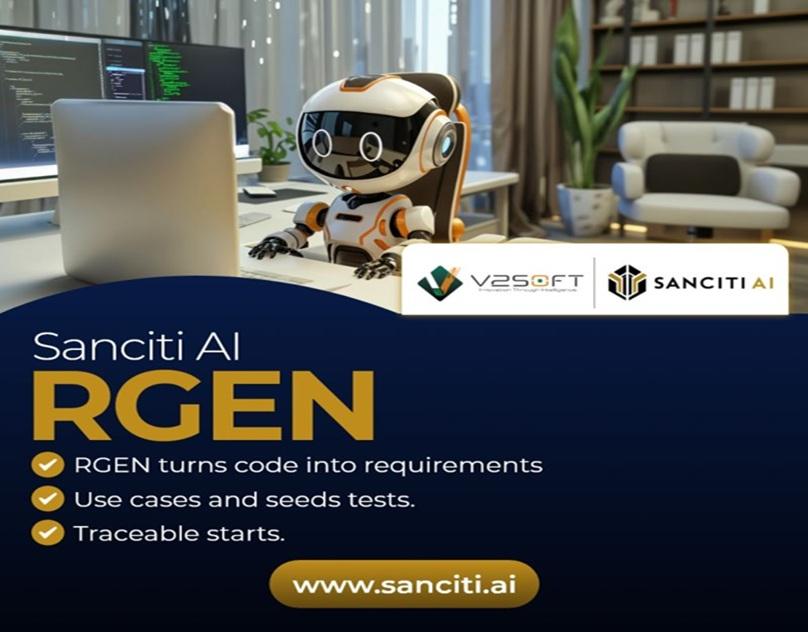
Through AI Powered Requirements Extraction, enterprise documentation — meeting notes, user stories, policy documents — is analyzed and converted into structured requirement artifacts.
Dependencies are identified automatically. Acceptance criteria are suggested. Ambiguities are flagged before development begins.
The benefit is not speed alone. It is risk reduction.
When interpretation improves, rework decreases.
Standardizing Use Case Development Across Distributed Teams
Large enterprises rarely operate from a single geography. Delivery teams span regions. Stakeholders operate in different business units. Maintaining uniform requirement quality across such environments is difficult.
By leveraging AI Use Case Generation, organizations can create consistent, traceable use cases aligned to defined objectives and regulatory standards.
Templates remain standardized. Language remains aligned. Scope boundaries remain visible.
This consistency becomes especially valuable in regulated industries where documentation traceability is mandatory.
Enterprise scale demands structural discipline — not informal coordination.
Integrating Testing Intelligence at the Requirement Stage
Testing is often treated as a downstream validation phase. However, many test gaps originate upstream in incomplete requirement definition.
When acceptance criteria are vague, test cases become reactive.
With AI Test Case Generation, test scenarios are derived directly from validated requirement artifacts.
Edge cases are identified earlier. Coverage gaps become visible before development accelerates.
Testing shifts from corrective validation to preventive alignment.
Quality improves because clarity improves.
Strengthening Traceability Across the Entire Delivery Lifecycle
Enterprise governance increasingly requires demonstrable traceability. Auditors and compliance teams expect linkage between objectives, requirements, implementation, and validation.
Manual traceability mapping is labor-intensive and prone to oversight.
AI-enabled requirement platforms maintain structured linkage automatically. Use cases connect to extracted requirements. Requirements connect to generated test cases.
Traceability becomes intrinsic rather than supplementary.
Governance strengthens without increasing administrative overhead.
Reducing Scope Volatility in Large-Scale Transformation Programs
Scope creep is rarely malicious. It often stems from incomplete articulation at inception. Stakeholders refine expectations once prototypes appear.
By introducing structured intelligence early, enterprises reduce interpretive volatility. Ambiguities are clarified before commitment. Assumptions are documented explicitly.
Programs stabilize.
This stabilization does not eliminate change. It ensures change is intentional rather than corrective.
Elevating Business Analysts into Strategic Orchestrators
There is concern in some circles that AI-assisted documentation may diminish the role of business analysts. In reality, it enhances it.
Routine drafting and formatting tasks are automated. Analysts focus on validation, stakeholder alignment, and strategic interpretation.
The role evolves from document producer to value orchestrator.
Enterprise capability increases — not decreases.
Aligning Requirement Governance with Digital Acceleration Goals
Digital transformation initiatives demand both speed and precision. Enterprises cannot afford prolonged discovery cycles, nor can they tolerate ambiguity-induced rework.
AI-assisted requirement engineering aligns with this dual mandate. Documentation accelerates. Validation improves. Traceability strengthens.
Delivery pipelines become more predictable because foundational clarity improves.
Predictability, in large enterprises, is competitive advantage.
Financial Impact: Lower Rework, Faster Release Cycles
Requirement ambiguity carries measurable cost. Rework consumes development hours. Delayed releases affect revenue timing. Stakeholder misalignment erodes confidence.
By embedding intelligence at the earliest phase of delivery, enterprises reduce downstream correction cycles.
The financial return is subtle but powerful — fewer escalations, fewer late-stage redesigns, more reliable program timelines.
Precision at inception creates efficiency at completion.
Conclusion: Intelligent Requirement Engineering is a Structural Advantage
Enterprise delivery complexity will only increase. Distributed teams, evolving regulations, and expanding digital portfolios introduce constant interpretive risk.
Organizations that treat requirement engineering as strategic infrastructure — rather than administrative formality — build stronger foundations for innovation.
Agentic AI-driven requirement intelligence does not replace human judgment. It amplifies it. It reduces ambiguity. It strengthens traceability. It stabilizes transformation.
In large enterprises, clarity is not a luxury. It is leverage.
Have Questions? Ask Us Directly!
Want to explore more and transform your business?
Send your queries to: info@sanciti.ai