
Introduction
Technology spending has become one of the most important operational expenses for modern businesses. Cloud infrastructure, software subscriptions, enterprise applications, cybersecurity tools, AI workloads, and IT support systems all contribute to the growing cost of running a business. While these investments help organizations scale and innovate, managing them efficiently is becoming increasingly challenging.
The problem is not always how much a company spends on technology. It is whether that spending delivers the expected business value.
Businesses often continue paying for unused cloud resources, overlapping software subscriptions, oversized infrastructure, outdated applications, and services that no longer support their operational priorities. As technology environments become more complex, these expenses can accumulate without attracting much attention.
This is where IT cost optimization becomes important. Rather than simply cutting technology budgets, the objective is to identify unnecessary spending, improve resource utilization, simplify infrastructure, and ensure that technology investments contribute to measurable business outcomes.
In 2027, this approach is becoming increasingly relevant as organizations manage multi-cloud environments, AI infrastructure, growing SaaS portfolios, and increasingly distributed IT operations. Companies are also looking beyond one-time cost audits toward continuous optimization supported by FinOps practices, automation, and better financial visibility.
However, identifying the right improvement opportunities requires both financial understanding and technical expertise. An IT cost optimization partner should be able to analyze infrastructure, evaluate software usage, understand architectural dependencies, and recommend changes without compromising performance, security, or business continuity.
To help businesses evaluate their options, we have compiled a list of leading IT cost optimization service providers in 2027. The companies included in this guide offer capabilities across cloud cost optimization, FinOps, infrastructure management, DevOps, IT consulting, and managed technology services.
How We Selected These IT Cost Optimization Service Providers
Not every IT services company specializes in cost optimization. Some focus directly on FinOps and cloud financial management, while others approach cost reduction through infrastructure modernization, managed IT services, or operational improvements.
We considered the following factors when compiling this list:
- Cloud cost optimization expertise: Capabilities in analyzing cloud spending, identifying unused resources, rightsizing infrastructure, and improving resource allocation.
- FinOps capabilities: Experience with cloud financial management, cost visibility, budgeting, forecasting, and continuous spending optimization.
- Infrastructure and DevOps expertise: Ability to improve infrastructure efficiency through automation, containerization, monitoring, and architectural improvements.
- Managed IT services: Experience in maintaining IT environments, reducing operational overhead, and improving technology utilization.
- Technical and engineering capabilities: Ability to implement optimization recommendations while maintaining system performance, security, and reliability.
- Industry reputation: Publicly available Clutch and Google ratings, client reviews, company history, and industry recognition.
- Commercial considerations: Reported hourly rates and the potential suitability of the provider for different business sizes and technology requirements.
The list is an editorial selection, not an independently verified ranking of cost savings delivered. Some providers offer dedicated cost optimization and FinOps services, while others offer adjacent capabilities that can help businesses manage IT expenditure. Organizations should validate relevant case studies, engagement scope, and measurable outcomes before selecting a partner.
Top IT Cost Optimization Service Providers in 2027
1. Citrusbug Technolabs
Best for: End-to-end IT cost optimization, cloud FinOps, AI infrastructure cost management, and software modernization.
Citrusbug Technolabs is a software development and technology consulting company based in Ahmedabad, Gujarat, India. Founded in 2013, the company works with businesses looking to improve their technology infrastructure, streamline software operations, and build more cost-efficient digital systems.
For organizations running applications across AWS, Microsoft Azure, or Google Cloud, Citrusbug can help identify idle resources, overprovisioned infrastructure, storage inefficiencies, and unused cloud commitments. Its approach also considers AI-related expenses, including GPU utilization, model inference, and compute requirements, which can become significant as businesses expand their AI initiatives.
Another important part of its approach is legacy system rationalization. Instead of recommending immediate system replacement, the focus is on understanding maintenance costs, technical dependencies, hosting expenses, and modernization opportunities before deciding which systems should be optimized, migrated, or retired.
Citrusbug also incorporates engineering considerations into its cost optimization process. This helps ensure that proposed savings do not come at the expense of application performance, reliability, or operational requirements.
Why Choose Citrusbug Technolabs?
Citrusbug is worth considering for organizations that want to address multiple IT cost drivers through a coordinated engagement rather than treating cloud bills, software licenses, and infrastructure expenses as separate problems.
Its capabilities span:
- Cloud infrastructure optimization across AWS, Azure, and GCP.
- FinOps-aligned cost visibility, allocation, and governance.
- AI, GPU, and compute cost management.
- SaaS subscription and software license optimization.
- Legacy application rationalization and modernization planning.
- Technology vendor and contract optimization.
- IT spending accountability and continuous cost reviews.
The company can be particularly relevant for growing businesses and technology-driven organizations that need engineering-led cost improvements alongside their broader software development initiatives.
Company Details
Location: USA and India
Founded: 2013
Clutch Rating: 4.7
Google Rating: 5.0
Hourly Rate: 25–49/hr
Website: https://www.citrusbug.com
2. IT Svit
Best for: Dedicated FinOps consulting, multi-cloud cost management, and Kubernetes optimization.
IT Svit is an IT services and infrastructure engineering company based in Tallinn, Estonia. Founded in 2005, the company provides cloud infrastructure, DevOps, and technology operations services.
Its FinOps and cloud cost optimization offering makes it particularly relevant for organizations managing complex cloud environments. Rather than focusing exclusively on reducing infrastructure bills, IT Svit approaches optimization through financial visibility, engineering improvements, and continuous cost governance.
Why Choose IT Svit?
IT Svit is worth evaluating for businesses that need a dedicated FinOps partner rather than general IT consulting.
Its cloud cost optimization services include:
- Cloud cost audits and spending assessments.
- Infrastructure rightsizing and idle resource cleanup.
- Reserved Instance and Savings Plans optimization.
- Kubernetes cost management.
- Multi-cloud financial management.
- Cost allocation, tagging, and governance.
- AI and LLM infrastructure cost management.
The company's use of the FinOps Foundation lifecycle, covering Inform, Optimize, and Operate, provides a structured approach to managing cloud spending beyond an initial audit.
Company Details
Location: Tallinn, Harju County, Estonia
Founded: 2005
Clutch Rating: 4.9
Google Rating: 4.4
Hourly Rate: 50–99/hr
Website: https://itsvit.com
3. IT GOAT
Best for: Managed IT services, infrastructure support, and predictable IT operations.
IT GOAT is a managed IT services provider based in Dallas, Texas, USA. Founded in 2018, the company supports businesses looking to improve their IT operations through proactive infrastructure management, technical support, and ongoing technology services.
For organizations with limited internal IT resources, maintaining infrastructure, managing employee devices, resolving technical issues, and coordinating technology vendors can create considerable operational overhead.
Why Choose IT GOAT?
IT GOAT may be suitable for small and mid-sized businesses that need reliable IT operations without building a large internal technology support department.
Its capabilities include:
- Managed IT and help desk support.
- Network and infrastructure management.
- Proactive monitoring and maintenance.
- Cybersecurity and technology protection.
- Software migration and virtualization.
- Vendor coordination and hosted solutions.
- Strategic IT planning and operational support.
Businesses evaluating IT GOAT should examine how its managed service model aligns with their current infrastructure, support requirements, and internal IT spending.
Company Details
Location: Dallas, TX, USA
Founded: 2018
Clutch Rating: 4.7
Google Rating: 5.0
Hourly Rate: 100–149/hr
Website: https://www.itgoat.com
4. Devopsbay
Best for: DevOps automation, Kubernetes infrastructure, and cloud cost efficiency.
Devopsbay is a technology services company headquartered in Sopot, Poland. Founded in 2018, the company specializes in DevOps, MLOps, cloud infrastructure, Kubernetes, and AI-related engineering.
Its capabilities are particularly relevant for organizations whose infrastructure costs are closely connected to application deployment, development operations, and cloud resource utilization.
Why Choose Devopsbay?
Devopsbay is worth considering for technology companies and businesses operating cloud-native applications that want to improve infrastructure efficiency through engineering and automation.
Its capabilities include:
- Cloud infrastructure optimization.
- DevOps as a Service.
- Kubernetes configuration and management.
- Infrastructure as Code.
- CI/CD pipeline automation.
- Infrastructure monitoring and observability.
- MLOps infrastructure and automation.
- Multi-cloud infrastructure support.
The company's focus on DevOps and cloud-native environments makes it relevant for businesses looking to connect infrastructure spending with development and operational efficiency.
Company Details
Location: Sopot, Pomeranian Voivodeship, Poland
Founded: 2018
Clutch Rating: 4.7
Hourly Rate: 50–99/hr
Google Rating: 5.0
Website: https://www.devopsbay.com
5. Alpacked
Best for: Cloud cost optimization, managed cloud infrastructure, and FinOps implementation.
Alpacked is a cloud and DevOps engineering company based in Kyiv, Ukraine. Founded in 2019, the company works with businesses looking to build, manage, and optimize scalable cloud environments.
Cloud infrastructure can become expensive when organizations provision resources for peak demand without accounting for actual utilization. Similarly, inefficient scaling policies, poorly configured services, and limited infrastructure monitoring can make monthly cloud expenditure difficult to predict.
Why Choose Alpacked?
Alpacked may be a suitable option for scale-ups and technology companies that want to improve cloud spending while maintaining reliable infrastructure operations.
Its capabilities include:
- Cloud cost optimization and FinOps.
- Cloud infrastructure consulting.
- Managed cloud services.
- Cloud migration and architecture design.
- Kubernetes and container management.
- Infrastructure automation and CI/CD.
- Hybrid and multi-cloud infrastructure.
- Continuous monitoring and operational support.
Its emphasis on combining cost control with predictable infrastructure scaling makes it relevant for organizations experiencing rapid cloud growth.
Company Details
Location: Kyiv, Kyiv City, Ukraine
Founded: 2019
Clutch Rating: 5.0
Hourly Rate: 50–99/hr
Google Rating: 4.0
Website: https://alpacked.io
6. Euristiq
Best for: Cloud architecture optimization, AWS infrastructure, and application modernization.
Euristiq is a technology consulting and software engineering company based in Toronto, Ontario, Canada. Founded in 2016, the company works on custom software development, cloud engineering, infrastructure modernization, and digital product development.
For businesses with growing cloud environments, cost optimization often requires examining the architecture behind applications rather than simply adjusting infrastructure configurations.
Why Choose Euristiq?
Euristiq is worth considering for businesses that need cloud engineering and application modernization as part of a broader IT cost optimization strategy.
Its capabilities include:
- Cloud migration and infrastructure optimization.
- AWS architecture and Well-Architected reviews.
- Cloud operations across AWS, Azure, and GCP.
- DevOps and CI/CD automation.
- Legacy application modernization.
- Cloud infrastructure management.
- Performance and scalability improvements.
Its AWS Advanced Tier Services Partner recognition and ISO/IEC 27001:2022 certification are additional credentials businesses can consider during vendor evaluation.
Company Details
Location: Toronto, Ontario, Canada
Founded: 2016
Clutch Rating: 4.8
Google Rating: 5.0
Hourly Rate: 50–99/hr
Website: https://euristiq.com
7. Intellias
Best for: Enterprise cloud optimization, infrastructure modernization, and large-scale technology environments.
Intellias is a technology services and engineering company headquartered in Lviv, Ukraine. Founded in 2002, the company works with organizations across industries on software engineering, digital transformation, cloud solutions, and enterprise technology initiatives.
Large organizations often operate complex cloud environments involving multiple applications, teams, services, and infrastructure providers. Managing costs across these environments requires more than identifying individual unused resources.
Why Choose Intellias?
Intellias may be particularly relevant for enterprises managing large-scale cloud environments or planning infrastructure modernization initiatives.
Its capabilities include:
- Cloud infrastructure assessment.
- Cloud cost optimization strategies.
- Resource utilization and provisioning improvements.
- Cloud monitoring and observability.
- Infrastructure automation.
- Hybrid and multi-cloud optimization.
- Cloud architecture modernization.
- Ongoing infrastructure support.
Its established engineering presence and experience with enterprise technology environments make it a potential choice for organizations with complex infrastructure requirements.
Company Details
Location: Lviv, Lviv Oblast, Ukraine
Founded: 2002
Clutch Rating: 4.8
Google Rating: 4.9
Hourly Rate: 50–99/hr
Website: https://www.intellias.com
Key IT Cost Optimization Services Businesses Should Look For
IT cost optimization is not limited to reducing cloud bills or negotiating lower software subscription prices. It involves evaluating how different technology investments contribute to business operations and identifying opportunities to improve their overall efficiency.
The following services are particularly relevant when evaluating potential optimization partners.
1. Cloud Infrastructure Cost Optimization
Cloud infrastructure is one of the most common areas where unnecessary IT expenditure accumulates.
Organizations may continue paying for oversized virtual machines, unused storage, idle databases, inactive development environments, and resources provisioned beyond actual workload requirements.
Cloud cost optimization involves analyzing usage patterns, adjusting resource allocation, reviewing storage configurations, and evaluating pricing commitments.
A capable provider should also understand how to balance infrastructure savings with availability, performance, and scalability.
2. FinOps and Cloud Financial Management
FinOps brings engineering, finance, and business teams together to manage cloud spending more effectively.
Instead of reviewing cloud invoices only after expenses occur, organizations establish ongoing visibility into resource consumption, budgets, forecasts, and cost ownership.
Typical FinOps activities include:
- Cloud spending analysis.
- Resource-level cost allocation.
- Budget monitoring and forecasting.
- Cost anomaly detection.
- Showback and chargeback reporting.
- Continuous optimization reviews.
This approach is particularly useful for organizations operating multiple cloud environments or managing several product teams.
3. SaaS and Software License Optimization
Businesses often accumulate software subscriptions as different departments adopt tools to support their work.
Over time, this can lead to duplicate applications, unused licenses, overlapping functionality, and unnecessary subscription renewals.
SaaS optimization involves reviewing the software portfolio, identifying actual usage, evaluating contract terms, and consolidating tools where appropriate.
A good optimization strategy should also consider the operational impact of removing a tool before making licensing changes.
4. IT Infrastructure Modernization
Legacy infrastructure can create recurring costs through maintenance, licensing, hardware requirements, and operational complexity.
Modernization does not necessarily mean replacing every existing system. It may involve improving application architecture, migrating selected workloads, automating infrastructure management, or retiring components that no longer provide sufficient business value.
The goal is to reduce long-term total cost of ownership while maintaining the functionality the business depends on.
5. DevOps Automation and Operational Efficiency
Manual deployments, repetitive infrastructure configuration, and fragmented monitoring processes consume engineering time and increase operational overhead.
DevOps automation can improve efficiency through CI/CD pipelines, infrastructure as code, automated testing, monitoring, and standardized deployment processes.
These improvements can reduce repetitive work, limit configuration errors, and help engineering teams spend more time on activities that deliver business value.
6. AI and GPU Infrastructure Cost Management
As businesses expand their AI initiatives, infrastructure costs can extend beyond traditional cloud computing.
GPU utilization, model inference, API consumption, vector databases, training workloads, and data processing can all contribute to AI operating expenses.
AI cost optimization involves monitoring workload usage, evaluating model selection, scheduling compute-intensive tasks efficiently, and matching infrastructure capacity to actual demand.
Businesses should also evaluate performance and output quality when optimizing AI expenditure. The lowest-cost model or infrastructure configuration is not necessarily the most economical if it requires additional processing or produces unreliable results.
7. Managed IT Services and Vendor Optimization
Managing technology through multiple vendors can create overlapping services, inconsistent pricing, and administrative complexity.
Managed IT services can consolidate selected responsibilities under a single provider, while vendor optimization involves reviewing contracts, renewal dates, service levels, and technology overlap.
The objective is to improve service value and spending visibility rather than simply selecting the lowest-priced vendor.
How to Choose the Right IT Cost Optimization Service Provider
Selecting an IT cost optimization partner requires understanding where your technology budget is being spent and what kind of improvements your organization needs.
A provider specializing in cloud FinOps may be suitable for a company with rising AWS or Azure expenditure. A managed IT services provider may be more relevant for an organization struggling with internal infrastructure support costs.
Consider the following factors before making a decision.
1. Identify Your Biggest IT Cost Drivers
Start by understanding which areas are creating the most expenditure.
Review cloud infrastructure bills, software subscriptions, licensing arrangements, hardware expenses, IT support contracts, and ongoing maintenance costs.
A provider should be able to work with this information to identify where optimization efforts are likely to deliver the greatest value.
2. Look for Relevant Technical Expertise
IT cost optimization requires an understanding of the systems being optimized.
Depending on your requirements, look for expertise in:
- AWS, Microsoft Azure, and Google Cloud.
- Kubernetes and container orchestration.
- Infrastructure as Code.
- DevOps and CI/CD automation.
- SaaS and enterprise software licensing.
- Legacy application modernization.
- AI infrastructure and GPU workloads.
The provider should be able to explain not only what needs to change but also how those changes will affect the existing environment.
3. Evaluate the Optimization Methodology
Avoid choosing a provider solely because it promises a particular percentage of savings.
Ask how it identifies cost inefficiencies, prioritizes opportunities, estimates financial impact, and validates results.
A structured engagement should include an initial assessment, a prioritized optimization roadmap, implementation support, and ongoing monitoring where required.
4. Understand Security and Operational Risks
Cost reductions should not compromise business continuity or information security.
Before approving infrastructure changes, discuss backup arrangements, access controls, compliance requirements, disaster recovery, and rollback procedures.
The provider should also explain how performance will be monitored after optimization activities are implemented.
5. Compare Pricing and Engagement Models
Different providers may offer different commercial arrangements, including hourly consulting, fixed-scope assessments, managed services, and ongoing optimization engagements.
Compare the scope of work, deliverables, support coverage, implementation responsibilities, and long-term costs.
A lower hourly rate does not necessarily translate into a lower overall engagement cost.
6. Ask for Measurable Outcomes
A credible provider should be able to explain how it measures optimization results.
Useful indicators include:
- Reduction in unnecessary cloud expenditure.
- Improved infrastructure utilization.
- Lower SaaS spending.
- Reduced infrastructure maintenance overhead.
- Better cost allocation and budget forecasting.
- Lower operational effort.
- Improved cost per transaction or workload.
Savings should be measured against an agreed baseline, with adjustments for changes in workload, business growth, and service requirements.
How Much Do IT Cost Optimization Services Cost?
The cost of IT cost optimization services depends on the size of the organization's technology environment, the number of systems involved, and the level of implementation support required.
A focused cloud cost assessment is generally different from a broader engagement involving infrastructure modernization, software licensing, vendor contracts, and continuous FinOps management.
The following ranges are illustrative budgeting estimates, not verified quotations from the companies listed above.
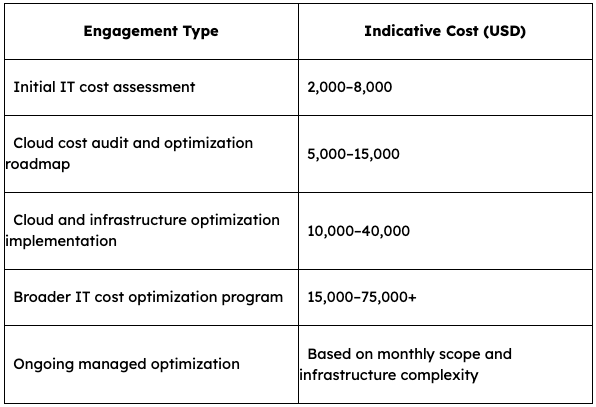
Several factors influence the final cost:
- Infrastructure size: Larger environments generally require more assessment and engineering effort.
- Cloud complexity: Multi-cloud and hybrid environments may require additional analysis.
- Software portfolio: Organizations with numerous applications and enterprise licenses may need more extensive reviews.
- Implementation requirements: Identifying savings opportunities is different from executing infrastructure and application changes.
- Security and compliance: Additional validation and documentation may increase project scope.
- Ongoing support: Continuous monitoring, reporting, and governance require a recurring engagement.
When evaluating proposals, businesses should compare the total cost of the engagement against realistic, measurable savings rather than relying on advertised percentages alone.
Conclusion
IT cost optimization has become an important part of technology planning as businesses manage increasingly complex infrastructure, growing software portfolios, and expanding AI workloads.
The right optimization strategy is not about reducing expenditure at any cost. It is about ensuring that every technology investment delivers meaningful value while maintaining the performance, security, and reliability that business operations require.
The IT cost optimization service providers featured in this guide offer different approaches to this challenge. Some specialize in cloud FinOps and infrastructure optimization, while others focus on managed IT services, DevOps automation, enterprise engineering, and technology modernization.
The best choice depends on your organization's existing infrastructure, primary cost drivers, internal capabilities, and long-term technology objectives.
For businesses looking for a partner that can address cloud expenditure, SaaS licensing, AI compute costs, legacy systems, and technology governance together, Citrusbug Technolabs is worth evaluating. Its engineering-led approach can help organizations move beyond identifying unnecessary spending toward implementing practical improvements that support long-term technology efficiency.
Ultimately, successful IT cost optimization should create a more sustainable technology environment, where businesses can continue investing in innovation without allowing operational expenses to grow unchecked.
Frequently Asked Questions
1. What are IT cost optimization service providers?
IT cost optimization service providers help organizations identify and reduce unnecessary technology expenditure while improving the efficiency of their IT environments. Their services may cover cloud infrastructure, software licenses, SaaS subscriptions, IT operations, legacy systems, and vendor contracts.
2. Which are the leading IT cost optimization service providers in 2027?
Some providers worth evaluating include Citrusbug Technolabs, IT Svit, IT GOAT, Devopsbay, Alpacked, Euristiq, Intellias, Win-Pro Consultancy, MIS Solutions, and 9series. Their areas of expertise differ, so businesses should select a partner based on their specific optimization requirements.
3. What is the difference between IT cost optimization and IT cost reduction?
IT cost reduction generally focuses on lowering technology expenditure. IT cost optimization takes a broader approach by improving resource utilization, eliminating unnecessary spending, and maximizing the business value of technology investments without compromising essential capabilities.
4. What is FinOps, and how does it help optimize IT costs?
FinOps is an operational and financial management practice that brings engineering, finance, and business teams together to manage cloud expenditure. It helps organizations understand cloud spending, allocate costs, forecast budgets, and continuously identify optimization opportunities.
5. How can businesses reduce cloud infrastructure costs?
Businesses can reduce cloud infrastructure costs by identifying idle resources, rightsizing compute instances, optimizing storage, reviewing pricing commitments, automating resource scheduling, and improving workload allocation. Regular monitoring helps prevent unnecessary spending from accumulating again.
6. Can IT cost optimization reduce expenses without affecting performance?
Yes. Effective optimization focuses on matching infrastructure and software resources to actual business requirements. Changes should be evaluated against performance, availability, and reliability metrics before implementation to avoid negatively affecting critical systems.
7. How long does an IT cost optimization project take?
The timeline depends on the engagement scope. A focused IT or cloud cost assessment may take a few weeks, while broader optimization programs involving infrastructure changes, software rationalization, and governance improvements may take several months. Continuous FinOps and managed IT engagements can operate on an ongoing basis.
8. Is outsourcing IT services a good way to optimize technology spending?
Outsourcing selected IT responsibilities can help businesses reduce internal staffing requirements, simplify vendor management, and establish predictable support arrangements. However, the financial benefit depends on service scope, pricing, internal capabilities, and the quality of the provider.
9. What is the role of AI in IT cost optimization?
AI can help analyze infrastructure usage, detect spending anomalies, forecast resource requirements, and automate selected operational tasks. It can also help organizations manage AI-related expenses by monitoring model inference, GPU utilization, and compute consumption.
10. How should businesses measure the success of IT cost optimization?
Businesses should measure success using an agreed spending baseline and indicators such as cloud cost reduction, improved resource utilization, lower software licensing expenses, reduced operational overhead, and cost per business transaction. Savings should be evaluated alongside system performance, security, and service reliability.