

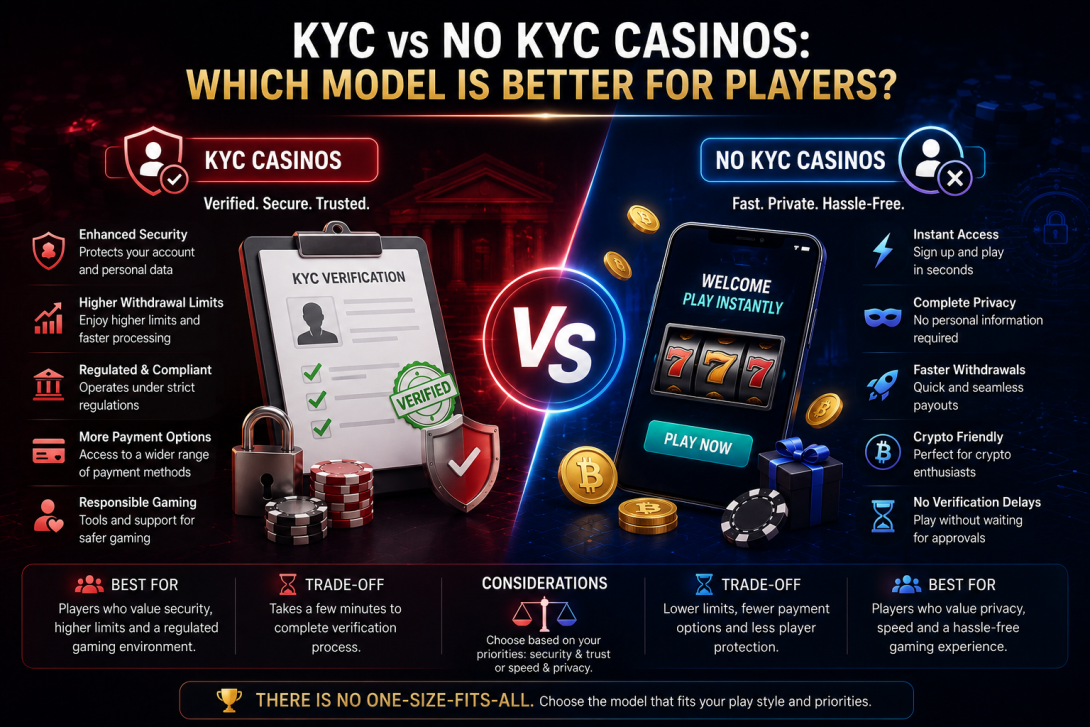
KYC and no KYC casinos offer very different account experiences. Traditional KYC casinos verify a player’s identity, while no KYC casinos aim to reduce or delay the amount of personal information requested.
For players, the choice usually comes down to convenience, privacy, payment flexibility and protection.
No KYC casinos can offer faster registration and fewer document requests. However, a properly licensed KYC casino will generally provide stronger account protection, clearer dispute procedures and more reliable responsible gambling controls.
The important point is that “no KYC” does not always mean “no identity checks ever”. A casino may allow registration or initial play without documents but still request verification before a withdrawal, after a transaction limit is reached or when unusual activity is detected.
What Does KYC Mean at an Online Casino?
KYC stands for Know Your Customer. It is the process an online casino uses to confirm that a player is who they claim to be.
A standard KYC check may ask for:
- The player’s full name, date of birth and residential address.
- A passport, driving licence or national identity card.
- A bank statement, utility bill or another proof of address.
- Evidence that the player owns the payment method being used.
- Additional information about the source of funds in higher-risk situations.
KYC forms part of a casino’s wider customer due diligence process. Customer due diligence means checking a customer’s identity, assessing relevant risks and monitoring account activity where required.
In Great Britain, licensed online gambling businesses must verify a customer’s age and identity before allowing them to gamble. The Gambling Commission explains that these checks help confirm age, identity and whether a person has previously self-excluded.
What Is a No KYC Casino?
A no KYC casino is generally an online gambling site that allows players to register, deposit or begin playing without immediately uploading traditional identity documents.
Registration may involve only:
- An email address.
- A username and password.
- A mobile number.
- A cryptocurrency wallet connection.
However, the term can be misleading. Different casinos use “no KYC” to describe different systems.
One casino may perform automatic identity checks without asking the player to upload documents. Another may delay verification until a financial threshold is reached. A third may claim not to conduct KYC but reserve the right to request documents before processing a withdrawal.
Players should therefore read the verification policy and withdrawal terms instead of relying on the phrase “no KYC”.
Quick Answer: Which Model Is Better for Players?
A licensed KYC casino is the better overall choice for most players.
It usually provides stronger identity protection, safer account recovery, clearer regulatory oversight and more effective responsible gambling measures.
A no KYC casino may be attractive to privacy-conscious players who value rapid registration or cryptocurrency payments. However, it may also create greater uncertainty around withdrawals, complaints, licensing and account ownership.
The quality of the operator matters more than the label. A well-regulated casino with a smooth digital verification process can provide both convenience and protection.
KYC vs No KYC Casinos at a Glance
Area
KYC Casino
No KYC Casino
Registration
Registration may include automatic or document-based verification.
Registration is usually faster and requests less information initially.
Privacy
The operator collects verified personal information.
The operator may collect fewer identity documents at sign-up.
Withdrawals
Withdrawals are usually smoother after verification is complete.
Verification may still be requested when the player withdraws.
Licensing
The model is standard in established regulated markets.
The licensing position varies considerably between operators.
Account recovery
Verified identity can make account recovery easier.
Account recovery may depend heavily on email or wallet access.
Responsible gambling
Identity checks can help enforce age limits and self-exclusion.
Reduced identification may make duplicate-account detection more difficult.
Payment options
The casino may support cards, bank transfers, wallets and local methods.
The casino may focus heavily on cryptocurrency payments.
Player protection
Players may have access to regulatory complaints procedures.
Protection depends on the operator and its licence.
1. Registration Speed and Convenience
No KYC casinos often provide the faster registration experience.
Players may be able to create an account using an email address or connect a cryptocurrency wallet without completing a long form. This can reduce friction, particularly for mobile users.
Traditional KYC casinos may require more information. However, modern verification does not always involve manually sending several documents.
Digital identity services can check information automatically using approved data sources. The UK Gambling Commission has also recognised that digital identity can support verification, although operators remain responsible for completing their wider customer due diligence duties.
For players, the best experience is not necessarily no verification. It is fast, transparent and proportionate verification.
2. Privacy and Personal Data
Privacy is the strongest argument in favour of no KYC casinos.
Some players do not want to provide a passport, address document or financial information to another online company. A service that requests fewer documents can reduce the amount of sensitive information stored by the operator.
However, no KYC does not automatically mean anonymous.
A casino may still collect:
- The player’s internet protocol address.
- Device information.
- Email and mobile details.
- Deposit and withdrawal records.
- Cryptocurrency wallet addresses.
- Location and gameplay information.
Cryptocurrency transactions are also recorded on their relevant blockchain. A blockchain is a shared digital record of transactions. Although a wallet address does not display a person’s name directly, it should not automatically be treated as completely anonymous.
KYC casinos collect more verified information, but licensed operators are expected to protect that information through suitable security and access controls.
Players should review the privacy policy, data retention terms and licence details before opening an account under either model.
3. Deposits and Withdrawals
No KYC casinos are often promoted as offering fast cryptocurrency deposits and withdrawals.
This can be convenient when the casino has clear rules and sufficient payment systems. However, players should check whether identity documents can be requested later.
A casino may require verification when:
- A player reaches a deposit or withdrawal threshold.
- The name on a payment method does not match the account.
- The operator detects unusual transaction activity.
- The player requests a large withdrawal.
- The operator must investigate fraud or money laundering concerns.
- The player attempts to use several accounts.
Verification rules can differ between jurisdictions. Curaçao regulatory material, for example, describes KYC information as a requirement from the start of the account relationship, with full verification expected by a specified cumulative transaction threshold.
Players should answer five questions before depositing:
- Can the casino request KYC documents later?
- Is there a withdrawal limit for unverified accounts?
- Which documents may be required?
- How long can a withdrawal review take?
- What happens if the player cannot pass verification?
A casino that hides these conditions until withdrawal creates an unfair and frustrating experience.
The UK Gambling Commission has stated that licensed operators should not delay identity checks until withdrawal when they could reasonably have completed them earlier.
4. Account Security and Recovery
KYC can provide an additional layer of account security.
When an account is compromised, the operator can use verified information to help establish who owns it. This can be useful if a player loses access to an email address, forgets account details or reports unauthorised activity.
A no KYC casino may rely more heavily on:
- Email access.
- Passwords.
- Two-step verification.
- Recovery codes.
- Control of a connected cryptocurrency wallet.
This approach can be secure when the player manages their credentials carefully. However, recovering an account may become difficult if the player loses access to the registered email or wallet.
Players using either model should create a unique password and enable two-step verification where available. Two-step verification requires a second confirmation method in addition to a password.
5. Licensing and Regulatory Protection
Licensing is more important than whether a casino markets itself as KYC or no KYC.
A licence does not guarantee that every player will have a perfect experience. However, a credible regulator can set standards covering player funds, identity checks, complaints, responsible gambling, security and fair treatment.
The Curaçao Gaming Authority now regulates the jurisdiction’s online gaming industry under its updated legal framework and supervises compliance with anti-money laundering and counter-terrorist financing requirements.
Players should confirm:
- Which authority issued the licence.
- Whether the licence number is genuine.
- Whether the casino is authorised to accept players from their country.
- Whether the regulator provides a public licence register.
- Which complaints or dispute process is available.
- Whether an independent alternative dispute resolution service is offered.
A logo in a website footer is not enough. Players should verify the licence through the regulator’s official register.
6. Responsible Gambling Protection
KYC can play an important role in responsible gambling.
Identity checks help an operator identify underage users, detect duplicate accounts and recognise customers who have previously self-excluded.
Self-exclusion allows a player to block their own access to gambling for a selected period. It is more difficult to apply effectively when a casino cannot reliably connect a person to their previous accounts.
The Malta Gaming Authority has highlighted the value of robust identity procedures for identifying duplicate accounts linked to self-excluded or potentially at-risk players.
A no KYC platform may still provide deposit limits, cooling-off periods and self-exclusion. However, those controls are only effective when the operator can prevent the same person from immediately creating another account.
Players should look for:
- Deposit, loss and session limits.
- Cooling-off and time-out options.
- Immediate self-exclusion.
- Reality checks and session reminders.
- Access to account and transaction history.
- Restrictions on marketing after self-exclusion.
- Clear links to independent support services.
Privacy should not come at the cost of meaningful player protection.
7. Cryptocurrency Payments
No KYC casinos are closely associated with cryptocurrency because wallet payments can be completed without a card or traditional bank transfer.
This may provide:
- Faster international transfers.
- Access to digital currencies.
- Fewer traditional banking restrictions.
- Direct wallet-to-wallet payments.
However, the use of cryptocurrency does not remove all verification responsibilities.
In the Malta Gaming Authority’s virtual currency framework, players using virtual currencies must complete verification within a defined period, and control of the relevant wallet must be checked before the first deposit.
Players must also consider currency volatility. Volatility means that the value of a cryptocurrency can rise or fall quickly. A player’s balance may change in value even when no casino game is being played.
The casino should clearly explain:
- Which currency is used to calculate the account balance.
- Which network fees apply.
- How exchange rates are calculated.
- Which blockchain network should be used.
- Whether withdrawals return to the original wallet.
- What happens if funds are sent through the wrong network.
8. Bonuses and Promotional Terms
KYC requirements can affect bonuses under both models.
A casino may cancel a bonus or associated winnings when a player:
- Creates more than one account.
- Registers with false information.
- Uses a payment method belonging to someone else.
- Attempts to avoid country restrictions.
- Cannot prove eligibility for the promotion.
Players should read the full bonus terms before accepting an offer. They should pay particular attention to wagering requirements, maximum bets, restricted games, withdrawal limits and verification conditions.
A large bonus is not valuable when the conditions make a successful withdrawal unrealistic.
9. Disputes and Player Complaints
A licensed KYC casino will normally have clearer information about account ownership and transaction history. This can make it easier to investigate disputes involving payments, unauthorised activity or duplicate accounts.
No KYC casinos can also maintain detailed account and transaction records. However, resolving a dispute may be more complicated when the operator has little verified information about the player.
Before depositing, players should check whether the casino provides:
- A written complaints policy.
- A clear response timeframe.
- An independent dispute service.
- Contact details for the licensing authority.
- A complete transaction history.
- Terms explaining when an account may be suspended.
The Curaçao Gaming Authority’s player complaints policy requires licensed operators under its framework to provide a transparent complaints process and access to alternative dispute resolution.
Are No KYC Casinos Legal?
The answer depends on the casino’s licence, the player’s location and the local gambling laws.
A no KYC casino may operate legally under a framework that permits simplified or threshold-based verification. It may also use automatic checks that are not visible to the player.
However, a casino offering gambling without the checks required in the player’s jurisdiction may be operating illegally in that market.
For example, a casino cannot legally offer a genuinely verification-free service to customers in Great Britain under a British remote gambling licence because age and identity checks must take place before gambling begins.
Players should not assume that a casino is legal simply because its website is accessible from their country.
Are KYC Casinos Completely Safe?
No online casino is completely risk-free.
KYC can improve compliance, security and player protection, but players must still evaluate the operator.
A KYC casino can provide a poor experience when it:
- Requests unnecessary documents without explaining why.
- Stores personal information carelessly.
- repeatedly asks for documents already approved.
- Delays withdrawals without a valid reason.
- Uses vague terms to suspend accounts.
- Operates under a weak or unsuitable licence.
The strongest model combines proportionate verification with secure data handling, fast reviews and transparent communication.
Who May Prefer a KYC Casino?
A KYC casino may be more suitable for players who value:
- Strong regulatory oversight.
- Reliable account recovery.
- Traditional payment methods.
- Clear complaints procedures.
- Effective self-exclusion.
- Greater certainty around withdrawal rules.
- Long-term use of the same platform.
For most mainstream players, these protections outweigh the short inconvenience of verification.
Who May Prefer a No KYC Casino?
A no KYC casino may appeal to players who value:
- A faster sign-up process.
- Fewer document uploads.
- Greater initial privacy.
- Cryptocurrency payments.
- Short-term or occasional use.
These players must still check the licence, withdrawal rules, geographic restrictions and possibility of later verification.
No KYC should never be treated as a substitute for due diligence.
Warning Signs Players Should Avoid
Players should consider leaving a casino website when:
- The operator does not name its legal company.
- The licence cannot be verified.
- The withdrawal terms are missing or contradictory.
- The casino guarantees complete anonymity without explaining its limits.
- Customer support cannot explain the KYC policy.
- The operator requests unusual payments to release a withdrawal.
- The casino does not provide responsible gambling tools.
- The terms allow the operator to confiscate funds without a clear reason.
- The website accepts players from every country without restrictions.
- The operator has no transparent complaints procedure.
A fast registration process is not worth the risk when basic information is hidden.
What Should Casino Operators Learn From Both Models?
Players do not necessarily dislike verification. They dislike slow, repetitive and poorly explained verification.
Operators can improve the KYC journey by:
- Explaining required checks before the player deposits.
- Using secure digital verification where permitted.
- Requesting only the information that is genuinely necessary.
- Showing the current verification status clearly.
- Providing realistic review times.
- Avoiding duplicate document requests.
- Completing checks before withdrawal wherever possible.
- Protecting personal data through suitable controls.
- Offering trained support when automatic checks fail.
Security and convenience should work together.
Operators looking to strengthen compliance while maintaining a competitive player experience can read this guide on how casino operators can stay competitive in the evolving iGaming market. It covers the importance of modern technology, payments, security, player experience and scalable operations.
An outdated platform may make verification slower because player data, payment information and compliance tools are spread across separate systems. Operators facing these limitations can review this online casino platform migration guide before planning an upgrade.
Playage Gaming supports KYC verification, anti-fraud protection, responsible gaming tools and other compliance functions within its casino and sportsbook platform. These connected features can help operators create a smoother journey without treating player protection as an afterthought.
Frequently Asked Questions
What does KYC mean in online gambling?
KYC means Know Your Customer. It is the process a casino uses to verify a player’s age and identity. It may involve automatic database checks or requests for identity, address and payment documents.
Can I withdraw from a no KYC casino without verification?
It depends on the casino’s terms. Some casinos process withdrawals without traditional documents, while others request verification after a player reaches a limit or triggers a security review.
Players should check this before depositing.
Why do casinos ask for identification?
Casinos may request identification to confirm a player’s age, prevent fraud, detect duplicate accounts, apply self-exclusion and meet legal obligations.
Is a no KYC casino anonymous?
Not necessarily. The casino may still collect email details, device information, internet protocol addresses, payment records and cryptocurrency wallet addresses.
Can a casino ask for KYC after I win?
A casino may request additional information when legally or reasonably required. However, verification terms should be clear before a player deposits, and an operator should not unnecessarily postpone checks until withdrawal.
Are crypto casinos always no KYC?
No. Many crypto casinos conduct identity and wallet checks. The use of cryptocurrency does not automatically make a casino anonymous or exempt it from regulation.
Is KYC safe?
KYC can be safe when a properly licensed operator uses secure systems and collects only necessary information. Players should review the casino’s licence, privacy policy and data protection practices.
Which casino model offers faster withdrawals?
Either model can offer fast withdrawals. The result depends on the operator’s payment systems, verification process and withdrawal rules.
A verified KYC account may provide more predictable withdrawals because the required checks have already been completed.
Final Verdict
KYC casinos are the better overall model for most players in 2026.
A properly managed KYC process supports age verification, account security, responsible gambling, fraud prevention and dispute resolution. It also gives players greater clarity about who operates the casino and which authority oversees it.
No KYC casinos can provide greater convenience and initial privacy. However, the term must be approached carefully. Verification may still take place later, and the level of player protection can differ considerably between operators.
Players should not choose a casino based only on how quickly they can register. They should check the licence, payment rules, withdrawal terms, privacy policy and responsible gambling features.
The best player experience comes from a licensed operator that makes necessary verification fast, secure, proportionate and transparent.
Responsible gambling notice: Gambling should be treated as paid entertainment, not as a way to earn money. Players should set affordable limits, avoid chasing losses and use time-out or self-exclusion tools when gambling stops feeling controlled.