

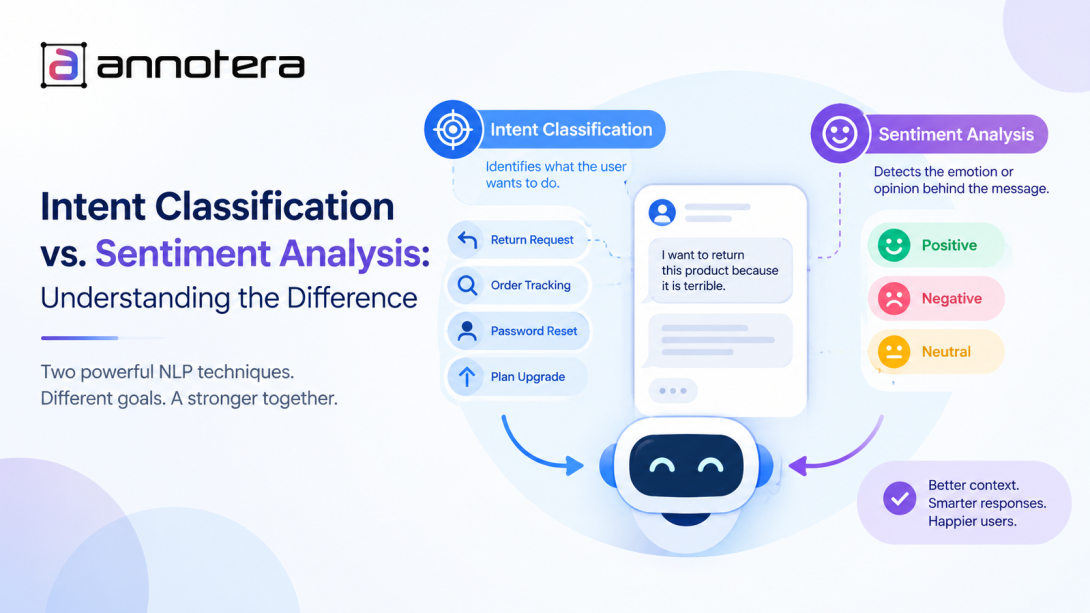
Understanding human language is essential for building intelligent AI systems. From customer support chatbots to virtual assistants and recommendation engines, modern applications rely on Natural Language Processing (NLP) to interpret user messages and respond appropriately. Two important techniques that support this process are intent classification and sentiment analysis.
Although these techniques often work together, they serve different purposes. Intent classification identifies what a user wants to accomplish, while sentiment analysis determines the emotion or opinion expressed in their message. Understanding the difference helps businesses develop more accurate conversational AI systems, improve customer experiences, and build reliable training datasets.
At Annotera, we recognize the importance of high-quality text annotation in helping AI models distinguish between user intentions and emotional expressions.
What Is Intent Classification?
Intent classification is an NLP technique that categorizes text according to the purpose behind a user's message. It helps AI systems understand what action a person wants to perform or what information they are seeking.
For example, consider the following customer messages:
- "I want to cancel my subscription."
- "Where can I track my delivery?"
- "Can you help me reset my password?"
- "I would like to upgrade my plan."
An intent classification model assigns these messages to categories such as subscription cancellation, order tracking, password reset, and plan upgrade.
The objective is to identify the user's intended action, allowing an AI system to select an appropriate response or trigger a relevant workflow.
Common Applications of Intent Classification
Intent classification supports several business applications, including:
- Customer service chatbots: Identifying whether customers need technical support, billing assistance, or account information.
- Virtual assistants: Recognizing commands related to reminders, scheduling, navigation, or information retrieval.
- E-commerce platforms: Understanding shopping requests, product searches, order updates, and return inquiries.
- Voice-enabled applications: Interpreting spoken commands and routing them to the appropriate function.
- Automated business workflows: Classifying incoming requests and directing them to the correct department.
Accurate intent classification depends on representative training examples, clearly defined categories, and consistent annotation guidelines.
What Is Sentiment Analysis?
Sentiment analysis is an NLP technique used to identify the emotional tone or opinion expressed in a piece of text. Rather than focusing primarily on the action a user wants to perform, it examines whether the message communicates a positive, negative, or neutral sentiment.
For example:
- "The delivery arrived earlier than expected." — Positive sentiment
- "I am disappointed with the quality of this product." — Negative sentiment
- "My order is scheduled to arrive tomorrow." — Neutral sentiment
Depending on the application, sentiment analysis can also identify more specific emotions, such as frustration, satisfaction, excitement, disappointment, or anger.
Common Applications of Sentiment Analysis
Businesses use sentiment analysis to understand customer opinions and improve decision-making.
Typical applications include:
- Customer feedback analysis: Identifying satisfaction levels across reviews, surveys, and support conversations.
- Social media monitoring: Evaluating public reactions to products, services, and marketing campaigns.
- Brand reputation management: Detecting negative feedback and identifying emerging customer concerns.
- Product improvement: Understanding recurring complaints and positive experiences.
- Customer experience analytics: Monitoring emotional patterns across customer interactions.
Reliable sentiment analysis requires training data that captures different expressions, writing styles, cultural contexts, and emotional nuances.
Intent Classification vs. Sentiment Analysis: Key Differences
Although both techniques analyze text, their objectives, labels, and applications differ.
1. Primary Objective
Intent classification determines what a user wants to do. Sentiment analysis identifies how a user feels or what opinion they express.
For example, "I want to return this product because it is terrible" expresses a return intent and negative sentiment.
2. Classification Labels
Intent classification uses task-specific categories, such as booking a reservation, requesting a refund, checking an order, or resetting a password.
Sentiment analysis typically uses labels such as positive, negative, and neutral. More advanced systems may include emotion-specific labels.
3. Training Data Requirements
Intent classification datasets require clearly defined intent categories and examples that represent different ways of expressing the same request.
Sentiment analysis datasets require examples that capture emotional tone, subjective opinions, contextual expressions, and sometimes sarcasm or mixed emotions.
4. Business Applications
Intent classification helps automate actions, route requests, and identify the next appropriate step in a workflow.
Sentiment analysis helps businesses evaluate customer opinions, detect dissatisfaction, and understand emotional responses.
5. Evaluation Criteria
Intent classification is commonly evaluated using accuracy, precision, recall, and F1-score across intent categories.
Sentiment analysis uses similar metrics, but evaluation also depends on the quality of sentiment labels and the model's ability to interpret context, ambiguity, and subtle emotional expressions.
How Intent Classification and Sentiment Analysis Work Together
These techniques are most effective when combined. A conversational AI system can use intent classification to understand a customer's request and sentiment analysis to assess the emotional context surrounding it.
Consider the message: "I have contacted support three times, and my issue still hasn't been resolved. Please escalate my complaint."
An intent classification model might identify the primary intent as complaint escalation. A sentiment analysis model might classify the message as negative and detect frustration.
Using both outputs, the system can route the complaint to the appropriate team while prioritizing a response that acknowledges the customer's frustration.
Similarly, an e-commerce chatbot can identify a refund request while detecting whether the customer is satisfied, disappointed, or angry. This combination enables more context-aware responses and supports better customer service decisions.
However, sentiment should not automatically determine intent. A frustrated customer might request a refund, ask for technical assistance, or simply provide feedback. The system must distinguish the requested action from the emotional tone.
The Role of Text Annotation in Building Reliable NLP Models
High-quality training data is essential for both intent classification and sentiment analysis. If the underlying dataset contains inconsistent labels, ambiguous categories, or insufficient examples, even advanced NLP models may produce unreliable predictions.
Text annotation establishes the structured labels that models learn from during training and evaluation.
For intent classification, annotators identify the primary purpose of each message according to predefined guidelines. For sentiment analysis, they evaluate the emotional polarity or opinion expressed in the text.
Challenges arise when messages contain multiple intentions, mixed emotions, sarcasm, informal language, or insufficient context. Clear annotation rules and expert human review help address these challenges.
Partnering with a reliable text annotation company can help businesses develop structured datasets aligned with their specific AI objectives. Professional annotation workflows may include quality assurance checks, inter-annotator agreement reviews, ambiguity resolution, and consistent labeling standards.
For organizations managing large or multilingual datasets, text annotation outsourcing services can also provide access to scalable annotation operations while supporting defined quality requirements and project timelines.
Annotera helps businesses strengthen their AI development initiatives through structured text annotation workflows designed around their project requirements. By prioritizing consistency, contextual understanding, and quality control, organizations can build training datasets that better support NLP model performance.
Best Practices for Annotating Intent and Sentiment Data
To improve dataset reliability, organizations should follow several practical guidelines:
- Define separate annotation taxonomies: Maintain distinct labels for user intentions and emotional expressions.
- Establish clear guidelines: Document how annotators should handle ambiguous messages, multiple intents, sarcasm, and mixed sentiment.
- Include diverse examples: Capture variations in wording, spelling, language, and communication style.
- Conduct regular quality checks: Review disagreements and correct recurring labeling errors.
- Use human oversight: Involve trained reviewers when context-dependent decisions require careful interpretation.
- Evaluate datasets continuously: Analyze model errors and update annotation guidelines when new use cases emerge.
These practices help create more consistent datasets and improve the reliability of AI systems in real-world environments.
Conclusion
Intent classification and sentiment analysis address two complementary aspects of human communication. Intent classification identifies what a user wants to accomplish, while sentiment analysis reveals the emotional tone or opinion expressed in their message.
When combined with high-quality text annotation, these techniques help organizations develop conversational AI systems that understand requests more accurately and respond with greater contextual awareness.
Annotera supports businesses in building reliable NLP training datasets through structured annotation processes and quality-focused workflows. Whether your project requires intent classification, sentiment analysis, or both, investing in consistent, well-defined training data is an important step toward developing more effective AI applications.