
Introduction
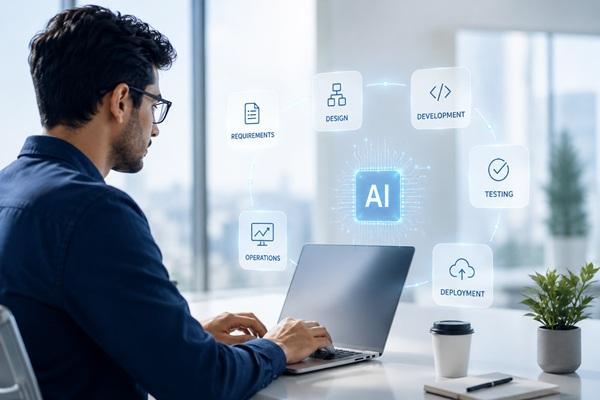
Enterprise software development has become increasingly complex as organizations manage distributed teams, multiple technology stacks, cloud-native applications, and continuous delivery pipelines. Every stage of the Software Development Life Cycle (SDLC), from requirements gathering to deployment and maintenance, requires collaboration between business analysts, developers, testers, architects, and operations teams. Managing these activities manually often creates bottlenecks, delays, and inconsistencies that affect delivery timelines and software quality.
Organizations are now embracing intelligent automation to streamline engineering workflows without sacrificing governance or quality. Rather than automating isolated tasks, modern enterprises are connecting every SDLC phase into a unified workflow that supports continuous collaboration and decision-making.
This is where Full Stack SDLC Automation is redefining enterprise software delivery by enabling organizations to automate repetitive activities while improving visibility, consistency, and engineering productivity.
Why Fragmented Development Processes Slow Innovation
Many enterprises rely on separate tools and disconnected workflows for planning, coding, testing, deployment, and production support. While each tool performs its individual function effectively, the lack of integration often creates operational inefficiencies.
Organizations commonly experience:
- Delayed handoffs between teams
- Inconsistent project visibility
- Manual status tracking
- Repeated documentation activities
- Longer release cycles
- Limited engineering transparency
As software portfolios continue growing, these disconnected processes reduce overall development efficiency.
Connecting Every Stage of the SDLC
Successful software delivery depends on information flowing seamlessly across every engineering activity.
Organizations implementing AI SDLC Framework establish connected development workflows where planning, implementation, testing, deployment, and governance remain aligned throughout the project lifecycle.
Instead of treating each phase independently, intelligent automation enables engineering teams to work with shared project information, reducing communication gaps while improving delivery confidence.
Supporting capabilities such as AI Requirements Generation, AI Code Generation, AI Test Automation, and AI Meeting Transcript help strengthen engineering workflows while allowing teams to focus on delivering business value.
Improving Engineering Collaboration
Collaboration is essential for enterprise software success.
Intelligent SDLC automation strengthens communication through:
Better Project Visibility
Engineering teams gain access to consistent project information across planning, development, testing, and deployment activities.
Faster Decision Making
Shared engineering insights enable project teams to respond more quickly to changing business priorities.
Reduced Manual Coordination
Automated workflow management minimizes repetitive administrative tasks while improving operational efficiency.
Stronger Delivery Governance
Integrated engineering processes improve traceability, accountability, and quality throughout software delivery.
Organizations adopting Enterprise AI Code Migration Tool also simplify modernization initiatives by connecting legacy transformation activities with broader software engineering workflows.
Building an Engineering Model for Continuous Improvement
Enterprise software delivery should evolve continuously instead of relying on isolated process improvements.
Organizations achieve stronger long-term results by focusing on:
- Connected engineering workflows
- Consistent development practices
- Continuous quality monitoring
- Intelligent project governance
- Sustainable automation strategies
Supporting capabilities such as AI Fullstack SDLC Platform, AI Legacy Conversion Tool, Enterprise Requirements Management, and AI Software Quality Testing strengthen software engineering while preserving flexibility for future innovation.
Looking Ahead
Modern software engineering will increasingly depend on intelligent platforms that integrate planning, development, testing, modernization, and governance into a unified delivery ecosystem.
Organizations implementing Agentic AI for Enterprise establish engineering environments where artificial intelligence supports collaboration, automation, and continuous improvement throughout the SDLC, enabling faster innovation while maintaining enterprise-grade quality.
Conclusion
Enterprise software delivery requires more than isolated automation tools. Organizations need connected engineering environments that improve collaboration, reduce manual effort, and accelerate software delivery without compromising governance or quality.
Full Stack SDLC Automation enables enterprises to streamline every phase of software development, creating more efficient engineering workflows while supporting long-term business growth and digital transformation.