

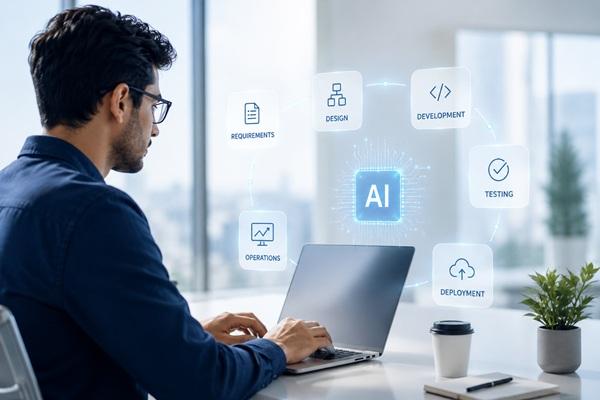
Connecting requirements, development, testing, modernization, and release activities to reduce workflow bottlenecks and improve enterprise software delivery performance
Introduction
Enterprise software delivery delays are not always caused by slow development.
A development team may complete implementation quickly but wait for requirement clarification. Testing may be delayed because QA teams need additional information about application changes. Release managers may spend considerable time gathering quality evidence, while modernization teams may operate through workflows disconnected from mainstream development.
These delays accumulate across the software development lifecycle.
As a result, improving one individual activity does not necessarily improve overall delivery performance.
AI Fullstack SDLC provides a broader approach by applying intelligent automation across interconnected software engineering activities rather than optimizing each stage independently.
When combined with Full Stack SDLC Automation, enterprises can reduce repetitive handoffs, improve information continuity, accelerate engineering feedback, and create a more coordinated path from business requirement to production deployment.
The strategic objective is not automating every software engineering decision. It is removing avoidable friction while keeping professional judgment where business, architecture, security, and quality decisions require it.
Software Delivery Delays Often Exist Between Teams
Organizations frequently evaluate productivity within individual engineering functions.
Analysts measure requirement completion.
Developers measure implementation velocity.
QA teams measure test execution.
DevOps teams measure deployment performance.
Each function may perform efficiently while the complete delivery lifecycle remains slow.
The problem often exists between these activities.
Typical bottlenecks include:
- Requirement clarification delays
- Development-to-testing handoffs
- Dependency investigation
- Test environment preparation
- Failure triage
- Release evidence collection
- Approval waiting periods
- Manual status synchronization
Reducing these transition delays can create substantial improvements in overall delivery time.
AI SDLC Framework Can Improve Information Continuity
An AI SDLC Framework can help maintain relationships between information created at different stages of software development.
Consider a requirement that changes during implementation.
In a fragmented lifecycle, the analyst updates the requirement. Developers then determine how the modification affects code. QA independently investigates testing impact, and release teams later verify whether the changed functionality was adequately validated.
A more connected model can preserve the relationship:
Requirement Change → Development Impact → Code Modification → Relevant Testing → Release Evidence
Each professional still evaluates the information according to their expertise.
The difference is that teams begin with more context and spend less time reconstructing information already available elsewhere.
Requirements Automation Can Reduce Development Waiting Time
Developers cannot implement functionality efficiently when business expectations remain ambiguous.
Missing validation rules, undefined exceptions, unclear acceptance criteria, or undocumented dependencies frequently generate clarification cycles after development has already started.
AI-assisted requirement analysis can help identify these gaps earlier.
Teams can examine:
Expected behavior
Alternative scenarios
Business rules
Dependencies
Permissions
Acceptance conditions
Unanswered questions can then be resolved during planning rather than becoming development blockers.
This represents an important principle for SDLC efficiency:
The fastest clarification is the clarification completed before implementation begins.
Context-Aware Coding Can Accelerate Implementation
AI coding capabilities can significantly reduce repetitive implementation effort.
However, generic code generation provides limited enterprise value when developers still need to manually reconstruct application context.
An Enterprise AI Development Platform can provide greater value when coding assistance is connected with relevant requirements, application structures, development standards, and existing implementation patterns.
Developers can use AI assistance for activities such as:
- Code generation
- Existing code explanation
- Refactoring preparation
- Unit-test development
- Documentation
- Routine implementation
This reduces repetitive development mechanics while allowing engineers to concentrate on application-specific decisions.
Testing Delays Can Be Reduced Through Change Context
Testing frequently becomes one of the largest downstream constraints when development velocity increases.
Large regression suites require time to execute, while QA teams need to determine which functionality may have been affected by recent changes.
A connected SDLC can provide testing systems with development context.
A more intelligent workflow can follow:
Code Change → Impact Analysis → Relevant Test Selection → Early Validation → Broader Regression
Critical testing can occur earlier without necessarily eliminating comprehensive regression.
This provides developers with faster feedback and reduces the likelihood that significant defects remain undiscovered until late in the release cycle.
Failure Triage Should Not Become the Next Bottleneck
Executing tests faster provides limited benefit if engineers then spend hours investigating failures.
One underlying problem can produce dozens of failed scenarios.
AI-assisted analysis can help identify similarities between errors, test results, affected components, and recent changes.
This allows teams to focus investigation on probable common causes.
The result is shorter feedback loops between:
Failure Detection → Investigation → Correction → Retesting
AI-generated root-cause suggestions should remain hypotheses until validated by engineering professionals.
Modernization Should Operate Within the Same Delivery Model
Legacy modernization is often managed as a separate technology program.
Applications are analyzed, converted, tested, and eventually transferred to mainstream development teams.
This separation can create additional delivery friction.
An Enterprise AI Code Migration Tool can accelerate portions of transformation, but modernized code should still move through standard enterprise engineering controls.
These include:
Code review
Testing
Security validation
CI/CD
Deployment
Production monitoring
Connecting modernization with the normal SDLC reduces the operational gap between application transformation and ongoing software development.
Full Stack SDLC Automation Can Reduce Repetitive Handoffs
Many software-delivery activities involve predictable workflow coordination rather than complex technical decisions.
Full Stack SDLC Automation can help streamline appropriate activities such as:
- Workflow routing
- Status synchronization
- Automated validation triggers
- Traceability updates
- Quality evidence preparation
- Engineering notifications
- Release-information consolidation
This allows professionals to spend less time transferring information manually between tools.
However, organizations should distinguish between administrative handoffs and governance controls.
A security approval, architecture review, or high-risk release decision should not be removed simply because automation can technically bypass it.
Release Readiness Can Become More Transparent
Release preparation frequently requires information from several engineering systems.
Stakeholders may need to determine:
Which requirements were completed?
What code changed?
Which critical tests passed?
Are significant defects still open?
Were required security checks completed?
What deployment risks remain?
An AI Fullstack SDLC Platform can help organize these signals into a more connected view of delivery readiness.
Release stakeholders can therefore spend less time assembling information and more time evaluating whether the available evidence supports deployment.
Production Feedback Should Influence Future Delivery
Production represents an important source of engineering information.
Incidents and application behavior can reveal weaknesses that were not visible during development.
For example, a production defect may indicate:
- A missing requirement scenario
- Inadequate regression coverage
- An unexpected dependency
- Weak error handling
- Performance limitations
- Insufficient observability
A connected lifecycle should return these findings to relevant engineering activities.
The feedback loop becomes:
Plan → Develop → Test → Release → Operate → Learn → Improve
This prevents operational knowledge from remaining isolated within production-support teams.
Governance Should Match Automation Risk
Enterprise SDLC automation requires defined boundaries.
Not every activity carries the same business or technical risk.
Documentation preparation may support extensive automation.
Generating implementation may require developer review.
Security-sensitive changes require stronger validation.
Production deployment may require explicit approval.
Organizations should establish clear policies covering:
- AI permissions
- Source-code access
- Sensitive data
- Human review
- Security controls
- Testing requirements
- Auditability
- Production actions
This allows automation to expand without weakening engineering accountability.
Measure Flow Efficiency Across the Complete SDLC
Organizations should evaluate whether AI automation improves end-to-end delivery rather than individual task speed alone.
Useful measures include:
- Requirement-to-production lead time
- Development cycle time
- Handoff waiting time
- Testing feedback time
- Rework
- Release preparation effort
- Deployment frequency
- Change failure rate
- Production defect rate
These metrics reveal where work continues to wait even after individual activities have been automated.
Building a Connected SDLC Incrementally
Enterprises do not need to automate the entire lifecycle simultaneously.
A practical approach can follow:
1. Map Current Delivery Flow
Identify how requirements, code, testing information, and release evidence currently move.
2. Locate Major Bottlenecks
Measure where work repeatedly waits or requires manual reconstruction.
3. Connect Engineering Context
Strengthen relationships between requirements, implementation, testing, and release activities.
4. Automate Repetitive Work
Target predictable coordination and analysis activities first.
5. Preserve Governance
Maintain professional review for high-impact decisions.
6. Measure Delivery Outcomes
Determine whether overall lead time and quality improve.
7. Expand Proven Automation
Scale successful workflows into additional lifecycle stages.
This incremental model allows organizations to demonstrate value while controlling implementation risk.
From Tool Automation to Lifecycle Automation
Enterprise technology teams already use substantial automation.
The next opportunity is not necessarily adding more isolated tools.
It is connecting the capabilities organizations already use.
Requirements should inform coding.
Code changes should inform testing.
Testing should inform release decisions.
Production should inform future engineering.
This creates a software delivery model where information moves continuously alongside application changes.
AI becomes particularly valuable because it can help interpret and organize that information across different engineering contexts.
Conclusion
Enterprise software delivery delays frequently emerge from fragmented workflows rather than individual team performance.
Requirements clarification, manual handoffs, disconnected testing, failure investigation, modernization transitions, and release preparation can collectively add substantial time to the SDLC.
AI Fullstack SDLC can help organizations address these constraints by connecting intelligent automation across requirements, development, testing, modernization, release, and production feedback.
Full Stack SDLC Automation should not eliminate the professional controls necessary for enterprise software engineering. Instead, it should remove repetitive coordination and make relevant context available earlier.
The strongest outcome is a connected software delivery lifecycle where business intent moves efficiently into development, application changes trigger appropriate quality validation, release decisions rely on accessible evidence, and production learning continuously improves future engineering.