

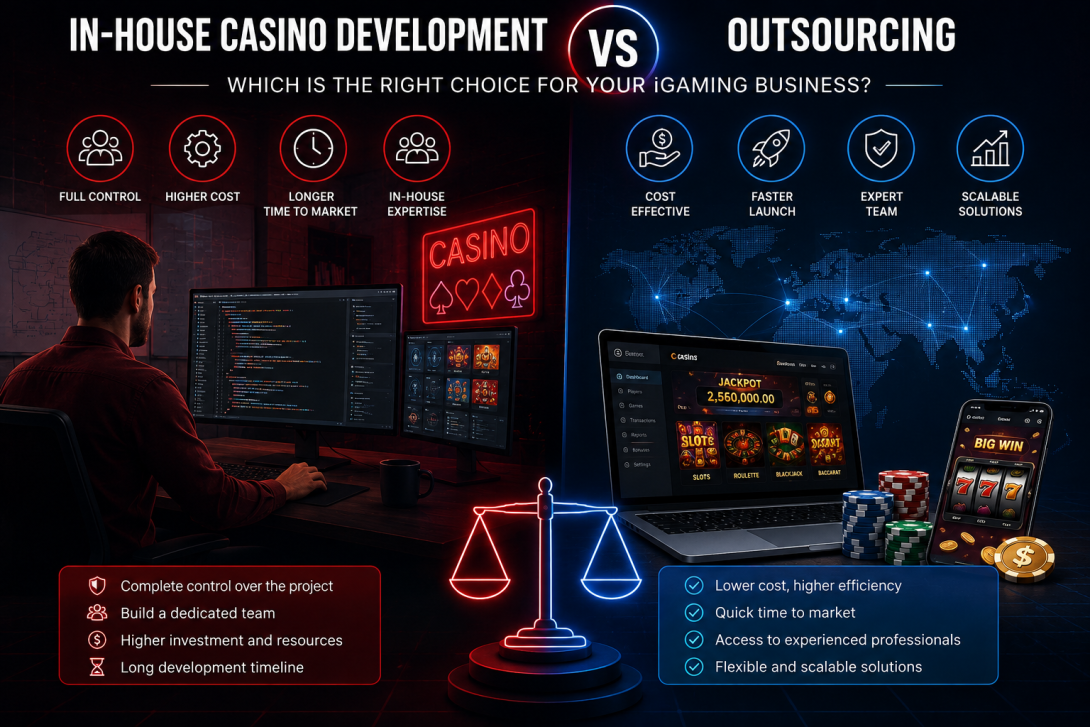
When launching or upgrading an online casino, one of the biggest technology decisions is whether to build the platform in-house or outsource development to an experienced casino technology provider.
In-house casino development means building and maintaining the platform with your own technical team.
Outsourcing means using an external provider for some or all of the technology required to operate the casino.
Both approaches can work.
The better choice depends on your budget, launch plans, technical resources, target markets and the level of control your business requires.
For many LATAM operators, the decision becomes a balance between complete technical ownership and the speed of using technology that has already been developed and tested.
Quick Answer: Is In-House Development or Outsourcing Better?
Neither model is automatically better for every operator.
In-house development can provide greater control over technology, product priorities and customisation. However, it requires experienced developers, ongoing investment, infrastructure management and long-term technical responsibility.
Outsourcing can reduce the amount of technology an operator needs to build independently. A suitable provider may already offer casino management tools, games, payments, customer management, bonuses and back-office functions.
For operators that want to enter a LATAM market quickly, outsourcing is often the more practical starting point.
For established businesses with large technical teams, significant budgets and highly specialised requirements, in-house development may make more sense.
In-House vs Outsourced Casino Development at a Glance
Area
In-House Development
Outsourced Development
Technology control
Very high
Depends on provider
Initial development work
High
Lower
Internal technical team
Large team usually required
Smaller team may be sufficient
Launch preparation
More development required
Core technology may already exist
Customisation
High
Depends on platform flexibility
Maintenance
Operator responsibility
Usually shared with or handled by provider
Integrations
Operator builds and maintains them
Many may already be available
Technical support
Internal team
Provider support
Scaling
Operator must plan and build it
Depends on provider infrastructure
Market expansion
Requires additional development
Can be easier with multi-market support
Technology ownership
Greater
Contract and provider dependent
Operational responsibility
Mainly operator
Shared with technology provider
The table is useful for an initial comparison, but operators should look more closely at what each model involves before making a long-term decision.
What Is In-House Casino Development?
In-house development means your business builds the core technology used to operate the casino.
Your organisation may employ its own:
- Software developers.
- Front-end developers.
- Back-end developers.
- Database specialists.
- Security specialists.
- Quality assurance testers.
- Product managers.
- User experience designers.
- Infrastructure engineers.
- Technical support staff.
The exact team depends on how much of the casino technology you plan to build yourself.
Even an in-house casino will normally still need external relationships.
For example, most operators do not create every slot or live casino game themselves. They connect games supplied by specialist providers.
The same may apply to payment services, identity verification tools and other specialist services.
Therefore, "in-house" does not always mean that every part of the business is built internally.
It usually means the operator owns and manages the main platform architecture and technical roadmap.
What Is Casino Development Outsourcing?
Casino development outsourcing means working with an external technology company to provide some or all of the software required for your casino.
The level of outsourcing can vary.
One operator may outsource only website development.
Another may use a complete casino platform containing:
- Player account management.
- Casino games.
- Payment integrations.
- Customer management tools.
- Content management.
- Bonus tools.
- Affiliate management.
- Reporting.
- Back-office administration.
- Security controls.
A complete solution of this type is often called a turnkey casino platform.
Turnkey simply means that much of the core technology is already prepared and integrated, so the operator does not have to build the entire system from the beginning.
1. Development Cost
Cost is usually one of the first differences operators consider.
In-House Development Costs
Building an online casino internally is not simply a matter of paying developers to create a website.
The business may need to fund:
- Developer salaries.
- Technical management.
- Testing.
- Infrastructure.
- Security.
- Platform monitoring.
- Database management.
- Integrations.
- Software licences.
- Maintenance.
- Updates.
- Technical support.
These costs continue after launch.
A casino platform is an ongoing technology product. New features, payment methods, games, security requirements and market changes create continuous development work.
Outsourcing Costs
An outsourced platform normally follows a commercial agreement with the technology provider.
Depending on the provider, this may involve setup costs, monthly fees, revenue-based fees or another commercial model.
The important comparison is therefore not simply:
Which option is cheaper today?
Operators should ask:
What will each option cost to build, operate, maintain and scale over several years?
A lower initial development cost can become expensive later if the platform requires constant technical fixes or additional third-party systems.
2. Speed to Market
Speed can matter when entering a competitive LATAM market.
Building In-House
An in-house team needs to design, develop, integrate and test the required technology.
This can include:
- Registration.
- Player accounts.
- Payments.
- Games.
- Casino lobby.
- Bonus systems.
- Back-office tools.
- Reporting.
- Security.
- Responsible gambling controls.
- Mobile optimisation.
Every integration must also work correctly with the rest of the platform.
The more features required at launch, the more development work the team must complete.
Outsourcing
A mature outsourced platform can already have many core functions integrated.
Instead of building each component from the beginning, the operator focuses more heavily on configuration, branding, content, market setup, integrations and launch testing.
PlayAge Gaming, for example, states that its platform combines areas such as games, payments, customer management, content management and back-office tools within one technology environment.
This type of model can reduce the amount of development required before launch.
3. Technical Control
Control is one of the strongest arguments for in-house development.
When your business owns the platform architecture, your technical team can decide:
- Which features to develop.
- How features should work.
- When updates are released.
- How databases are structured.
- Which services are integrated.
- How the product roadmap develops.
This freedom can be valuable for businesses building a highly differentiated casino product.
However, control also creates responsibility.
If the registration system fails, your team must fix it.
If an integration breaks, your team must investigate it.
If the platform struggles under higher traffic, your infrastructure team must solve the problem.
With outsourcing, some of this responsibility moves to the technology provider.
The trade-off is that your level of control depends heavily on the provider and contract.
4. Customisation
Operators sometimes assume that in-house development is customisable and outsourced platforms are not.
The reality is more nuanced.
In-house development does provide the greatest theoretical freedom because your team controls the code.
However, a flexible outsourced platform can still allow substantial customisation.
Operators should ask whether they can customise:
- Website design.
- Casino lobby.
- Navigation.
- Promotions.
- Player journeys.
- Languages.
- Payment options.
- Game categories.
- Customer communication.
- Reporting.
- Market-specific content.
The important question is not whether the platform is outsourced.
The important question is how much control the provider gives the operator.
5. Technical Talent
An online casino requires more than general web development knowledge.
Your technical team needs to understand systems involving player accounts, financial transactions, game integrations, security, reporting and continuous availability.
Building a strong internal team can therefore be a major commitment.
You also need to consider what happens if key employees leave.
If only one or two developers understand an important part of the platform, staff turnover can create operational risk.
An external provider can reduce this dependency because the provider maintains its own specialist technology team.
However, operators should still keep internal people who understand the platform and can manage the relationship with the supplier.
Outsourcing technology does not mean outsourcing responsibility for your entire business.
6. Maintenance and Updates
Casino technology does not stop changing after launch.
The platform may need regular work involving:
- Security improvements.
- New games.
- Payment integrations.
- New devices and browsers.
- Website performance.
- Reporting changes.
- New market requirements.
- Player management tools.
- Promotional features.
With in-house development, these updates become part of the operator's technical workload.
With outsourcing, the provider usually manages much of the core platform development and maintenance.
This can allow the operator's internal team to focus more on commercial priorities rather than maintaining every technical component.
7. Security and Player Data
Online casinos handle sensitive information and financial activity.
Security must therefore be considered when comparing development models.
In-house development gives an operator direct control over its security architecture, but the business must also maintain the expertise needed to protect that architecture.
This includes areas such as:
- Access control.
- Data protection.
- System monitoring.
- Secure integrations.
- Software updates.
- Incident management.
- Backup processes.
With an outsourced platform, operators should investigate how the provider manages these areas.
Do not accept a general statement such as "our platform is secure".
Ask specific questions about how player information is protected, how access is controlled and how incidents are handled.
8. Compliance in LATAM
LATAM should not be treated as one regulatory market.
The requirements that apply to an operator can change from one country to another.
Brazil's Secretariat of Prizes and Betting is responsible for authorising, regulating, supervising and enforcing the country's federal fixed-odds betting framework.
Colombia uses a separate framework through Coljuegos. Its operator process includes legal, financial and technical requirements, including certification of technical systems by an authorised laboratory.
This matters when choosing between in-house and outsourced technology.
An in-house operator must ensure its own platform can support the technical requirements of each target jurisdiction.
An outsourced provider may already have relevant technical capabilities, but operators must verify this rather than assume that a platform suitable for one LATAM country is automatically suitable for another.
The operator remains responsible for understanding the requirements that apply to its business.
9. Localisation for LATAM Markets
Localisation means adapting the casino to the market rather than simply translating the website.
A LATAM operation may need different:
- Languages.
- Currencies.
- Payment methods.
- Promotions.
- Customer communication.
- Website content.
- Responsible gambling information.
- Market settings.
For example, an operator targeting Brazil will normally require Portuguese content, while operators entering many other LATAM markets will primarily work with Spanish.
The platform should make these differences manageable.
With an in-house system, your team can build localisation directly into the product.
With outsourcing, you should confirm that the provider supports market-level configuration rather than offering the same setup everywhere.
10. Payment Integrations
Payment experience can have a major effect on casino operations.
An in-house team may choose and integrate payment providers directly.
This offers control, but every integration requires development, testing and maintenance.
An outsourced platform may already have payment connections available.
That can reduce integration work, particularly when expanding into additional markets.
However, operators should not simply ask:
How many payment methods do you have?
Ask:
Which payment methods are available in the exact countries we plan to target?
Regional relevance is more useful than a large global number.
11. Game Integration
The same principle applies to casino games.
An in-house operator needs technology that can connect with different game suppliers and manage the resulting content.
This can involve:
- Game launches.
- Player balances.
- Game sessions.
- Transaction records.
- Reporting.
- Game availability.
- Provider updates.
Using several direct integrations can give the operator control over commercial relationships, but it also increases technical work.
An outsourced platform may already provide access to game suppliers through existing integrations or aggregation.
Operators should check which games and providers are actually available for their intended markets.
12. Scalability
Scalability means the ability of a platform to handle business growth without becoming unstable or requiring a complete rebuild.
An operator might launch with one casino brand and later add:
- More players.
- New countries.
- Additional languages.
- More payment providers.
- More casino games.
- A sportsbook.
- Another casino brand.
An in-house platform can be designed around this strategy from the beginning.
The challenge is ensuring the technical architecture and team can actually support that growth.
With outsourcing, the operator depends on the provider's platform capacity and product roadmap.
This is why platform selection should consider where the business plans to be several years from now, not only what it needs at launch.
13. Accountability When Something Goes Wrong
This is an area operators sometimes overlook during platform selection.
Imagine that deposits suddenly stop appearing correctly.
If your setup uses one provider for payments, another for the casino platform and another for player management, several companies may need to investigate the issue.
The operator can end up coordinating between suppliers.
A more integrated outsourcing model can provide a clearer point of responsibility.
PlayAge Gaming describes this as one of the reasons operators choose a single-platform provider, particularly when games, payments, customer management and back-office systems are managed within one environment.
If you are considering this type of setup, read more about why operators choose PlayAge Gaming.
What Are the Main Advantages of In-House Casino Development?
In-house development can be attractive when an operator wants maximum technical independence.
The main advantages include:
Greater Product Control
Your business determines the development roadmap and platform priorities.
Deep Customisation
Your team can create features specifically around your business model.
Direct Technology Ownership
You are less dependent on a single external platform provider for core development.
Internal Knowledge
Your own team develops detailed knowledge of the technology.
Long-Term Differentiation
A unique technology stack can become an important competitive asset for a large operator.
These benefits are strongest when the business has enough capital and technical expertise to maintain the system properly.
What Are the Main Disadvantages of In-House Development?
The main challenges include:
High Technical Responsibility
Your team owns the problems as well as the technology.
Recruitment Requirements
Specialist developers and infrastructure staff can be difficult and expensive to build into one team.
Longer Development Process
Core systems and integrations must be developed and tested before they can be used.
Continuous Maintenance
Development costs continue after launch.
Integration Complexity
Games, payments and other external services need reliable technical connections.
Expansion Work
Entering another LATAM market may require additional technical and operational changes.
For a new operator, these demands can take attention away from marketing, player acquisition, partnerships and other commercial work.
What Are the Main Advantages of Outsourcing Casino Development?
Outsourcing can simplify the technology side of launching and operating a casino.
Potential advantages include:
Less Development From Scratch
Core technology may already be available.
Faster Implementation
Existing modules and integrations can reduce the amount of work required before launch.
Specialist Expertise
The provider maintains teams focused on casino technology.
Existing Integrations
Games, payments and operational tools may already connect with the platform.
Ongoing Maintenance
The provider can manage much of the core platform maintenance.
Easier Expansion
A flexible multi-market platform can make regional growth easier to manage.
The quality of these benefits depends on the provider.
Poor outsourcing can create just as many problems as poor in-house development.
What Are the Risks of Outsourcing?
Operators should also understand the disadvantages.
Provider Dependence
Your casino becomes dependent on another company's technology.
Limited Customisation
Some platforms restrict what operators can change.
Commercial Restrictions
Contracts may contain limits around integrations, markets or product access.
Migration Risk
Leaving the provider later can involve moving player information, balances, integrations and operational systems.
Support Quality
Slow technical support can affect your business when urgent problems occur.
Limited Visibility
Some providers give operators less access to data or platform controls than expected.
This is why due diligence before signing a platform agreement is important.
When Does In-House Development Make Sense?
In-house development is usually more suitable when the operator:
- Has significant development resources.
- Already employs an experienced technical team.
- Requires unusual or highly specialised features.
- Wants deep control over the product roadmap.
- Has enough capital for ongoing development.
- Plans to treat technology as a core business asset.
- Can manage infrastructure, security and integrations internally.
- Accepts the long-term responsibility of maintaining the platform.
A large established gaming group may reasonably choose this route.
A first-time operator with a small technical team may find the same approach unnecessarily complex.
When Does Outsourcing Make More Sense?
Outsourcing can be more practical when the operator:
- Wants to reduce development work.
- Needs an established casino technology base.
- Wants access to existing integrations.
- Has a smaller internal technical team.
- Plans to enter several markets.
- Wants one provider to manage more of the technology.
- Prefers to focus internal resources on operations and growth.
- Does not need complete ownership of every part of the platform.
For many new LATAM operators, these conditions make outsourcing attractive.
However, the provider still needs to be evaluated carefully.
Can You Use a Hybrid Development Model?
Yes.
The choice does not have to be completely in-house or completely outsourced.
A hybrid model combines both.
For example, an operator may use an outsourced core casino platform while developing its own:
- Website experience.
- Mobile interface.
- Data tools.
- Customer features.
- Marketing technology.
- Business intelligence systems.
This approach can give the operator control over areas that differentiate the brand while avoiding the need to build every casino system independently.
For some businesses, this is the most balanced model.
What If You Already Have a Casino Platform?
The decision can become more complicated for an established operator because changing technology may require migration.
Casino platform migration means transferring an existing operation from one technology platform to another.
This may involve player profiles, account balances, transaction records, payments, game integrations and customer management tools.
The existing operation cannot simply disappear while the new system is being prepared.
Data transfer, testing and business continuity therefore need careful planning.
If you are considering changing providers, this online casino platform migration guide provides a useful overview of the process.
A migration should be treated as a business project, not simply a website redesign.
Questions to Ask Before Outsourcing Casino Development
Before selecting a provider, ask clear questions.
Platform Ownership
Who develops and maintains the core technology?
Player Data
Who controls the player information, and how can it be exported if required?
Integrations
Which games, payment providers and other services are already connected?
Customisation
What can we change ourselves, and what requires provider development?
LATAM Coverage
Which of our target countries does the platform currently support?
Languages
Can Portuguese and Spanish content be managed separately?
Payments
Which relevant local payment options can be integrated?
Compliance
What technical tools are available to support our jurisdictional requirements?
Reporting
What operational and financial data can our team access?
Support
Who responds when a critical technical problem occurs?
Scalability
Can the platform support more players, brands and countries without replatforming?
Exit Process
How is data handled if we decide to leave the platform?
The answers should be clear before the contract is signed.
How Should LATAM Operators Make the Final Decision?
Start with your business model rather than the technology.
Ask five questions.
1. How quickly do we need to enter the market?
If speed matters, existing technology may have an advantage.
2. How much technical expertise do we already have?
Building a platform without the right team creates long-term risk.
3. How different does our product need to be?
Highly specialised products may justify more internal development.
4. How many markets do we plan to enter?
Multi-country growth increases the importance of flexible configuration.
5. How much technology responsibility do we want to carry?
Greater control brings greater responsibility.
Once these questions are answered, the right development model becomes much easier to identify.
Frequently Asked Questions
Is it cheaper to build a casino platform in-house or outsource it?
It depends on the business. In-house development requires internal staff, infrastructure, testing, integrations and continuous maintenance. Outsourcing normally replaces some of these costs with provider fees. Operators should compare long-term total costs rather than initial setup costs alone.
What is outsourced casino development?
Outsourced casino development means using an external technology provider to develop or supply part or all of the software used by an online casino.
What is an in-house casino platform?
An in-house casino platform is primarily developed and maintained by the operator's own technical team rather than relying on an external company for the core platform.
Is a turnkey casino an outsourced solution?
Yes, in most cases. A turnkey casino solution provides core technology and operational tools that have already been developed by a specialist supplier.
Can an outsourced casino still have a custom design?
Yes. Many platforms allow operators to customise branding, layouts, content and player journeys. The exact level of flexibility depends on the provider.
Is outsourcing suitable for LATAM casino operators?
It can be. A suitable provider can reduce development requirements and support regional expansion. Operators should still verify language, payment, technical and compliance capabilities for each specific target country.
Is in-house development better for large operators?
It can be appropriate for larger organisations that have strong technical teams, sufficient capital and a strategic reason to control their own technology. Size alone does not make in-house development the better option.
Can an operator switch from an outsourced platform later?
Yes, but the process requires careful migration planning. Player accounts, balances, transaction records, integrations and other data may need to be moved securely to the new platform.
What is the biggest risk of outsourcing?
Provider dependence is one of the main risks. Operators should examine platform control, data access, support, customisation and exit conditions before signing an agreement.
What is the biggest risk of in-house development?
The operator takes responsibility for building, maintaining, securing and scaling the technology. If the internal team or budget is insufficient, the platform can become difficult to maintain.
Final Thoughts
In-house casino development gives operators greater control, but that control comes with significant technical responsibility.
Outsourcing reduces the amount of technology an operator needs to build independently, but it creates a long-term relationship with the platform provider.
For many LATAM operators, the decision should come down to four areas:
control, cost, speed and scalability.
If your organisation already has a strong technical team, significant resources and unique product requirements, building more technology internally may be justified.
If your priority is entering the market with an established technology base, existing integrations and a smaller internal development burden, outsourcing may be the more practical route.
A hybrid model can also provide a useful middle ground.
Whatever approach you choose, evaluate the technology around your real operating requirements rather than a feature list.
Your platform needs to support your players today, your target LATAM markets tomorrow and the wider business you plan to build over the next several years.
If you are currently comparing technology partners, read why operators choose PlayAge Gaming for casino launches for a closer look at the platform, operational tools and single-provider model.