

Fix Bump Steer Lifted Chevy K5: The Ultimate Crossover Steering Guide
If you've recently lifted your classic square body, you’ve likely discovered the hard way that factory engineering wasn't meant for big tires and tall suspension. When you hit a rut or speed bump, does your steering wheel jerk in your hands? Does the truck dart across the lane without your input? That is "bump steer," and it is the most common symptom of poor steering geometry on a lifted K5 Blazer or K10 pickup. To Fix Bump Steer Lifted Chevy K5 owners deal with, you have to move beyond temporary "band-aid" fixes and address the root cause: the factory push-pull linkage angle.
Why Your Lifted K5 Blazer Suffers from Bump Steer
The factory steering system on your square body uses a "push-pull" setup. At stock ride height, this works fine. But once you add 4+ inches of lift, the distance between your frame and axle increases significantly. This stretches the drag link, forcing it into a steep, downward slope.
The Geometry Problem
Because of this steep angle, any vertical movement of your suspension—like hitting a pothole—physically pushes or pulls on the steering arm. Essentially, your suspension is trying to steer the truck for you. As long as that drag link remains at an angle, you will struggle with a "twitchy" or unpredictable front end.
The Solution: Upgrading to Crossover Steering
To permanently resolve these handling issues, you need a Chevy 10 Bolt Crossover Steering Kit. This setup fundamentally changes your geometry by relocating the steering linkages entirely.
How Crossover Steering Works
Instead of a short, angled drag link connected to the driver’s side, crossover steering runs a long, flat drag link horizontally across the front axle to the passenger side. By mounting this link to an elevated steering arm on the passenger-side knuckle, the linkage remains perfectly parallel to the axle throughout the suspension's travel. When your wheels move up and down, the steering stays centered, and your truck tracks straight.
Build Your Rig Right with EWO
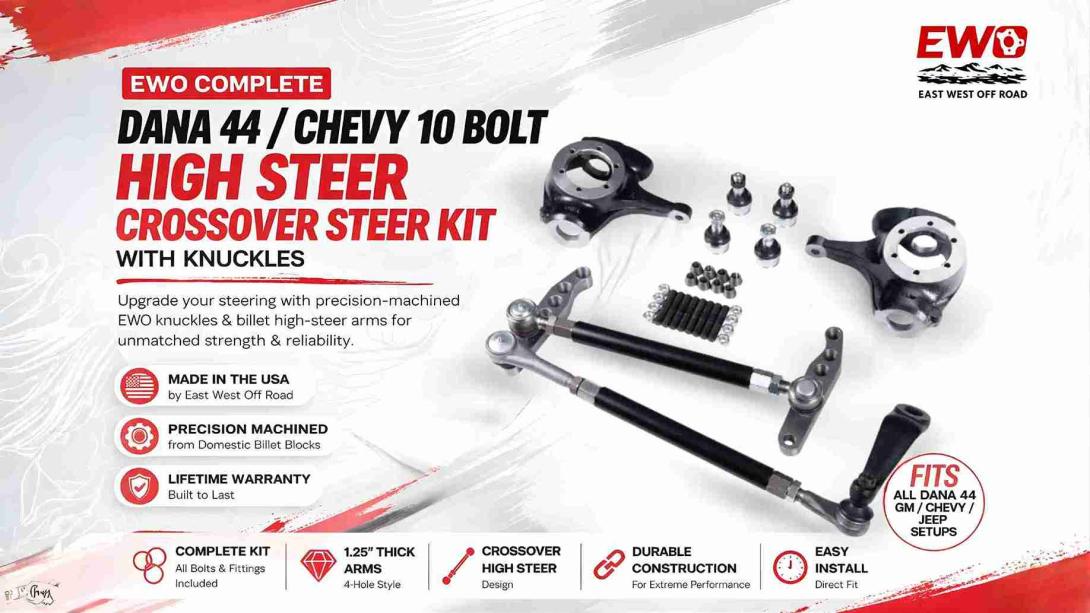
When it comes to steering, reliability is non-negotiable. The EWO complete Dana 44 high steer kit is engineered for the rigors of off-road life, replacing weak factory parts with American-made strength.
The "No-Fabrication" Advantage
Historically, performing a Dana 44 Flat Top Knuckle Conversion meant finding rare vintage knuckles and paying a machine shop to mill, drill, and tap them. This kit eliminates that bottleneck. It comes with pre-machined, flat-top knuckles featuring a proprietary "Bottom Down" taper, making this a true K10 Crossover Steering Kit No Reaming required. It’s the ultimate Bolt-On High Steer Kit GM 10 Bolt solution that saves you weeks of downtime.
Heavy-Duty Components for Hardcore Wheeling
Every piece of the Complete Dana 44 Crossover Steering System is built for abuse:
- 1.25 inch billet high steer arms: CNC-machined from domestic billet blocks for extreme rigidity.
- 1.50 x .250 DOM tubing steering kit: Thick-walled steel that shrugs off direct boulder impacts.
- Premium Rod Ends: Includes ES2026R ES2027L drag link ends and ES2234L ES2234R tie rod ends for long-lasting, smooth articulation.
- Geometry Correctors: Comes with a 3 inch dropped pitman arm 32 spline and a Dana 44 upper lower ball joints kit to ensure your front end is tight and dialed in.
Crucial Requirement: The 2WD Steering Box
For your crossover setup to function, you must perform a 2wd steering box crossover setup. A standard 4WD box sweeps side-to-side, which won't work for a horizontal drag link. A 2WD box provides the necessary front-to-back motion to push and pull your new linkage properly.
Frequently Asked Questions (FAQs)
Will this kit work on my factory Corporate 10 Bolt axle?
Yes! The outer knuckle architecture and ball joint tapers are identical between the GM Corporate 10 Bolt and the Dana 44. This kit functions as a direct, heavy-duty upgrade for both.
Do I need to take these knuckles to a machine shop?
No. This kit provides brand-new, pre-machined flat top knuckles. They are ready to bolt on, saving you the expense and delay of professional machine work.
Is professional welding required?
Yes. The 7/8–18 tube adapters (weld bungs) for your DOM steering tubes must be professionally welded into place to ensure your steering linkages are indestructible.
Why do I need a 2WD steering box?
A 4WD steering box operates with a side-to-side stroke, which is incompatible with a crossover drag link. A 2WD box operates with a front-to-back stroke, which is the mechanical motion required to actuate the crossover linkage correctly.
Are the steering arms guaranteed to last?
Absolutely. The EWO billet arms are machined in the USA from solid domestic steel and are backed by a lifetime warranty against breakage.