

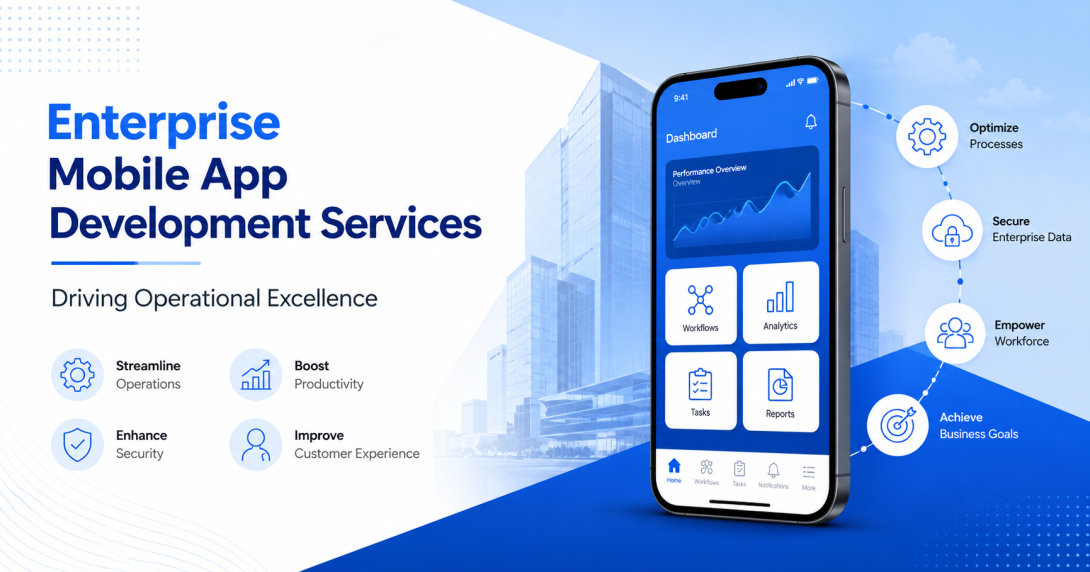
Running a business today means competing against companies that move faster, decide quicker, and serve customers without friction. The gap between organizations that thrive and those that stagnate often comes down to one thing: how well their internal systems and customer touchpoints work together. This is exactly where Enterprise mobile app development services step in, not as a trendy add-on, but as the backbone of how modern companies operate, scale, and respond to market shifts in real time.
For business owners, the conversation has moved past "should we build an app?" to "how do we build the right one, the right way, with a partner who understands our industry?" That shift in mindset is what's pushing more leadership teams toward dedicated enterprise app partners rather than generic freelance developers or in-house quick fixes.
Why Operational Excellence Starts With the Right Mobile Strategy
Operational excellence isn't about doing more — it's about doing the right things with less waste, fewer delays, and better visibility across every department. Mobile applications, when built with enterprise-grade architecture, become the connective tissue between your warehouse floor, your sales team, your finance department, and your customers. A well-designed app removes the manual handoffs that slow teams down and replaces them with automated, trackable workflows that leadership can actually monitor.
Business owners who have tried to retrofit consumer-grade apps into enterprise workflows usually learn the hard way that scale breaks things. Security gaps appear, integrations fail under load, and support becomes a guessing game. This is the core reason enterprises increasingly look for specialized development partners rather than treating mobile as a side project.
- Centralized control over data, permissions, and compliance across departments
- Reduced dependency on manual processes that introduce human error
- Faster decision-making through real-time visibility into operations
- Scalable infrastructure that grows with your headcount and transaction volume
Choosing the Right Enterprise Mobile App Development Company
Picking a development partner is less about who can write code and more about who understands your business model deeply enough to translate it into software that actually fits. An Enterprise mobile app development company worth hiring will ask hard questions before writing a single line of code — about your org structure, your compliance obligations, your customer journey, and your five-year growth plan. That discovery phase is often the difference between an app that gets adopted company-wide and one that quietly dies after a few months of half-hearted use.
What separates a genuinely capable partner from a vendor chasing contracts is their willingness to push back. A good development company will tell you when a feature you want isn't worth the engineering cost, or when a simpler workflow will save your team hours every week. They bring battle-tested frameworks, prior industry experience, and a process that doesn't reinvent the wheel for every client.
- Proven track record across industries similar to yours, not just generic portfolios
- Transparent communication about timelines, costs, and technical trade-offs
- Post-launch support models that include monitoring, patching, and iteration
- Architecture decisions made with long-term scalability in mind, not just MVP speed
Many business owners underestimate how much the wrong partner can cost them — not just in dollars, but in months of lost productivity while teams work around a broken system. Choosing carefully here pays dividends for years.
UI and UX Design: The Difference Between Adoption and Abandonment
Here's something most leadership teams don't realize until it's too late: an app can be technically flawless and still fail completely because nobody wants to use it. UI and UX Design is not a cosmetic layer added at the end of development — it's the single biggest factor determining whether your employees, partners, and customers actually adopt the tool you spent months and a serious budget building. If a warehouse worker needs three extra taps to log inventory, or a field technician can't find a button under bright sunlight, the app becomes shelfware no matter how powerful the backend is.
Good design in an enterprise context looks different from consumer apps. It's not about flashy animations; it's about clarity, speed, and minimizing cognitive load for people who are using the app under pressure, often on the move, sometimes with gloves on or in low connectivity zones. Designers who specialize in enterprise UX understand that every screen has to earn its place by reducing friction, not adding to it.
- Interfaces tailored to actual user environments — factory floors, retail counters, delivery vehicles
- Accessibility considerations for varied literacy levels and physical conditions
- Consistent design language across modules so training time drops significantly
- Iterative testing with real employees before company-wide rollout, not just internal QA
When design is treated as an afterthought, adoption rates suffer and the ROI on the entire project collapses. When it's treated as a core deliverable, the app becomes something employees actively want to use because it makes their job easier, not harder.
Bringing Intelligence Into Operations Through AI Agents
Mobile apps are no longer just digital forms and dashboards — they're becoming active participants in how work gets done. Enterprise AI Agent Development is changing what's possible inside business applications by embedding agents that can handle repetitive decision-making, flag anomalies before they become problems, and act on data without waiting for a human to notice patterns buried in spreadsheets. For business owners, this means operations that used to require constant supervision can now run with intelligent oversight baked directly into the tools your team already uses.
Think about a logistics company where an AI agent inside the mobile app automatically reroutes deliveries when it detects traffic delays, or a retail chain where an agent flags inventory discrepancies the moment they appear instead of during a monthly audit. These aren't futuristic concepts anymore — they're being deployed today by companies that invested in agent-driven architecture early.
- Automated anomaly detection that surfaces issues before they escalate
- Conversational agents that let employees query data in plain language instead of running reports
- Predictive task assignment based on historical patterns and current workload
- Continuous learning loops that improve recommendations as more data flows in
The companies pulling ahead aren't necessarily the ones with the biggest budgets — they're the ones willing to integrate intelligent agents into their core mobile workflows early, while competitors are still manually reviewing spreadsheets.
Turning Raw Data Into Decisions With Analytics
None of this matters if the data flowing through your mobile ecosystem isn't being turned into something actionable. Enterprise Data Analytics Services sit at the center of every operational decision a business owner makes, whether that's deciding which product line to expand, which region is underperforming, or which customer segment is about to churn. Mobile apps generate enormous volumes of behavioral and operational data every single day, and without a proper analytics layer, that data just sits there, unused and silently losing value.
The businesses that treat analytics as a strategic function rather than a reporting afterthought tend to spot problems weeks before competitors even notice something is wrong. Dashboards that update in real time, segmented by role so that a regional manager sees different metrics than a CFO, turn raw numbers into a daily decision-making habit rather than a quarterly review exercise.
- Real-time dashboards customized by role, department, and seniority level
- Predictive analytics that flag trends before they become visible in financial statements
- Integration with existing ERP and CRM systems for a unified data picture
- Custom reporting that aligns with the specific KPIs your business actually tracks
When analytics is built into the mobile experience from day one, employees stop asking "what happened last month" and start asking "what should we do next," which is a fundamentally different and more valuable conversation to be having inside any organization.
Bringing It All Together for Long-Term Operational Gains
None of these pieces — strategy, design, intelligence, and analytics — work well in isolation. The real value shows up when a development partner weaves them together into a single, coherent system that employees trust and customers barely notice working in the background because it just works. Business owners who approach mobile development this way tend to see compounding returns: faster onboarding, fewer support tickets, better forecasting, and teams that spend more time on judgment calls instead of repetitive busywork.
The companies that will define the next decade of their industries are already building this infrastructure now, not waiting until competitors force their hand. If your current systems feel like they're held together with workarounds and spreadsheets, that's usually the clearest signal that it's time to invest in a proper enterprise mobile foundation — one built with the right partner, the right design philosophy, and the right intelligence layered in from the start.
Operational excellence isn't a one-time project with a finish line. It's an ongoing commitment to building systems that adapt as your business grows, and mobile technology, done right, is one of the most reliable ways to get there.