

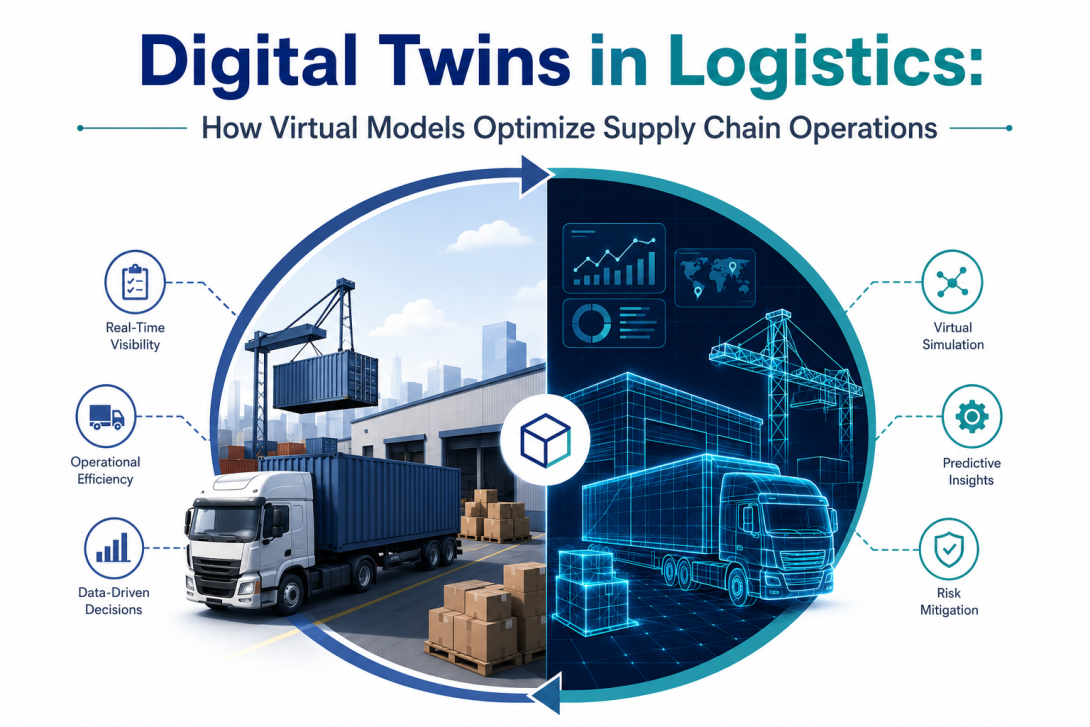
Digital twins in logistics are transforming how supply chain operators plan, monitor, and optimize physical operations by mirroring real-world assets inside virtual models.
From warehouses to delivery fleets, these digital replicas process live sensor data to simulate outcomes before they happen in the real world.
This blog breaks down the architecture, technologies, use cases, and implementation steps behind building a logistics digital twin that delivers measurable operational gains.
How a Digital Twin Works in a Logistics Ecosystem
A logistics digital twin is a live virtual replica of a physical system, connected through continuous data feeds from sensors, telematics devices, and enterprise software.
It ingests real-time signals from warehouses, vehicles, and shipments, then updates its virtual state to match physical conditions. Partnering with an experienced logistics software development company helps businesses design this connected feedback loop correctly from day one.
Unlike static dashboards, a digital twin runs continuously, recalculating routes, capacity, and risk as conditions shift. It compares live data against historical patterns to flag anomalies, such as a delayed shipment or an overheating cold chain container, well before the disruption affects downstream operations, giving planners a genuine head start on corrective action.
Digital Twin Architecture for Logistics Systems
A logistics digital twin is built from five interdependent layers that move data from physical assets into actionable intelligence.
Each layer handles a distinct function, from raw sensor capture to visual decision-making tools. Understanding this stack helps supply chain management software development teams design systems that scale without creating brittle integration points.
Data Acquisition Layer
This layer captures raw signals from IoT sensors, RFID tags, GPS trackers, and barcode scanners attached to vehicles, pallets, and warehouse equipment.
It records location, temperature, humidity, vibration, and load status at frequent intervals. Reliable acquisition depends on consistent sensor calibration and network coverage across distribution centers, ports, and long-haul transit routes.
Data Processing & Integration Layer
Raw signals are cleaned, normalized, and merged with data from ERP, WMS, and TMS systems in this layer.
Duplicate readings are filtered, timestamps are synchronized, and units are standardized so downstream models receive consistent, structured inputs regardless of which device or system originally generated the data.
Digital Twin Modeling Layer
This is where the virtual replica actually lives, mapping physical assets like trucks, warehouses, and shipments to digital objects with matching attributes and relationships.
The model reflects current state and historical behavior, forming the foundation for simulations described further in our guide to digital twin product development.
Analytics and Intelligence Layer
Machine learning models sit here, analyzing twin data to predict delays, equipment failures, and demand shifts. This layer runs optimization algorithms for routing and inventory allocation, drawing on patterns that would be impossible to spot manually across thousands of concurrent shipments and warehouse transactions.
Visualization & Control Layer
The final layer presents twin data through dashboards, 3D warehouse renderings, and control interfaces that let planners intervene directly.
Alerts, what if scenario views, and drill down reports translate the underlying model into decisions operations teams can act on within seconds, not hours.
Technologies Behind Logistics Digital Twins
Building a functional digital twin requires a coordinated technology stack, not a single tool. Each component below plays a specific role in keeping the virtual model synchronized with physical operations.
- IoT: Sensors attached to vehicles, containers, and warehouse equipment stream location, temperature, and condition data continuously, forming the real time and environmental backbone of the twin.
- Cloud computing: Cloud platforms host the twin's compute and storage layers, scaling automatically as data volume and model complexity grow across the digital twin infrastructure.
- Edge computing: Edge nodes process time sensitive data near the source, reducing latency for safety critical alerts such as collision risk on connected assets.
- AI/ML: Machine learning models forecast delays and optimize routes, extending the benefits of AI in logistics into daily planning decisions.
- Stream processing: Stream processing frameworks handle high velocity event data, updating the twin's state within seconds of a physical change on the ground.
- APIs: APIs connect the twin to ERP, WMS, TMS, and third party systems, keeping inventory, order, and transport records synchronized across platforms.
- 3D engines: 3D rendering engines convert twin data into navigable warehouse and fleet visualizations that operational teams can explore in real time.
- Digital twin platforms: Dedicated platforms manage the relationships between thousands of digital objects, versioning models as physical assets and relationships change.
How Data Synchronization Works Between Physical and Digital Systems
Synchronization keeps the digital twin's state aligned with its physical counterpart through continuous, bidirectional data exchange. Sensors push updates to the twin, while the twin can push commands back to connected systems, such as adjusting a warehouse robot's path based on updated inventory positions.
Latency and data quality determine how closely the twin mirrors reality. Systems typically use a combination of streaming updates for critical events and scheduled batch syncs for less time sensitive data, balancing computational cost against the need for near real time accuracy across large fleets and facilities.
Technical Use Cases of Digital Twins in Logistics
Digital twins support a wide range of operational functions across the supply chain. The following use cases show where logistics teams see the clearest returns from twin based modeling.
Warehouse Optimization
A warehouse twin models storage layouts, picking paths, and equipment placement to identify bottlenecks before they occur. Teams can simulate layout changes virtually, testing how a new pallet configuration affects throughput without disrupting live operations, an approach supported by dedicated warehouse management software.
Fleet and Route Optimization
Fleet twins track vehicle location, fuel consumption, and driver behavior to recommend optimal routes in real time. By simulating traffic and weather conditions against live GPS data, dispatchers using fleet management software development tools can reroute shipments proactively rather than reacting after delays occur.
Predictive Maintenance
Equipment twins monitor vibration, temperature, and usage patterns on trucks, forklifts, and conveyor systems to predict component failures before breakdowns happen. This shifts maintenance from fixed schedules to condition based triggers, reducing unplanned downtime and extending the operational life of high value logistics assets.
Shipment and ETA Prediction
Shipment twins combine carrier data, traffic patterns, and historical transit times to generate dynamic ETAs that update as conditions change. Customers and planners receive accurate delivery windows instead of static estimates, reducing the manual follow up calls that typically consume dispatch team bandwidth.
Supply Chain Scenario Simulation
Network level twins model entire supply chains, letting planners simulate disruptions like port closures or supplier delays before they happen. Running these scenarios virtually reveals which contingency plans hold up, helping teams make sourcing and inventory decisions with far more confidence than spreadsheet based forecasting.
Building a Logistics Digital Twin: Technical Implementation
Implementing a logistics digital twin follows a structured technical path. These seven steps outline the core build process from system definition through to decision automation.
Step 1: Define the Physical System
Start by scoping which physical assets the twin will represent, whether a single warehouse, a regional fleet, or an end to end distribution network. This scope determines data requirements, sensor placement, and the complexity of the modeling layer built later in the process.
Step 2: Design the Data Model
Map each physical asset to a digital object with defined attributes, relationships, and states. A well structured data model prevents downstream integration problems, since every sensor feed and enterprise record must map cleanly onto this schema for the twin to remain accurate.
Step 3: Build the Data Pipeline
Construct pipelines that ingest, clean, and route data from sensors and enterprise systems into the twin's storage layer. This includes handling missing data, deduplicating sensor noise, and establishing consistent timestamp formats across every connected data source.
Step 4: Develop the Digital Twin Model
Build the virtual representation using a digital twin platform or custom modeling framework, linking real-time data streams to each digital object. The model should reflect both current state and enough historical context to support pattern recognition and forecasting.
Step 5: Add Analytics and Simulation
Layer in machine learning models and simulation engines that use twin data to predict outcomes and test scenarios. This is where the twin moves from passive monitoring to active decision support, generating recommendations rather than just reflecting current conditions.
Step 6: Build the Operational Interface
Design dashboards and visualization tools that translate twin data into a format planners can act on quickly. Effective interfaces highlight exceptions and anomalies first, rather than burying critical alerts under routine operational metrics that don't require immediate attention.
Step 7: Connect the Decision Layer
Finally, connect the twin's outputs to systems that can act automatically, such as triggering a reroute, adjusting warehouse staffing, or flagging a shipment for manual review. This closes the loop between insight and action, the defining trait of a mature digital twin deployment.
Key APIs and Integrations Required
A logistics digital twin depends on stable integrations with both operational systems and external data providers. These are the key connection points to plan for during implementation.
- GPS and telematics APIs: Provide real-time vehicle location, speed, and diagnostic data from fleet hardware and mobile devices.
- Mapping and traffic APIs: Supply live traffic conditions and route calculations used for dynamic ETA and rerouting decisions.
- ERP integration: Synchronizes order, inventory, and financial data so the twin reflects accurate business context, not just asset location.
- WMS integration: Feeds warehouse inventory positions, pick paths, and stock levels directly into the modeling layer.
- TMS integration: Connects transportation planning and carrier data, keeping shipment status aligned across the digital twin.
- IoT device APIs: Standardize how sensor hardware from different manufacturers reports data into the acquisition layer.
- Weather APIs: Supply forecast data used to simulate weather related delays across routes and distribution regions.
- Fleet maintenance systems: Share equipment health records that feed predictive maintenance models within the twin.
- Payment and freight platforms: Connect billing and freight settlement data for end-to-end shipment cost visibility.
Challenges in Implementing Logistics Digital Twins
Poor quality sensor data undermines twin accuracy from the start, since inconsistent calibration or dropped readings create gaps the model must estimate around. Legacy system integration compounds this problem, as older ERP and WMS platforms often lack modern APIs, requiring custom middleware to bridge decades old infrastructure with real-time data pipelines the twin depends on.
Data silos across departments and partner networks limit how complete a twin's view can be, since fleet, warehouse, and supplier data frequently live in disconnected systems. Keeping digital twin synchronization accurate at scale is equally demanding, as thousands of assets updating simultaneously strain both network bandwidth and processing infrastructure.
Cybersecurity risks grow alongside connectivity, since every sensor and API represents a potential entry point into operational systems. Securing device authentication, encrypting data in transit, and monitoring for anomalous access patterns are essential steps that logistics teams cannot treat as optional once a twin goes live.
How to Measure Digital Twin ROI
Fleet utilization and fuel consumption are among the clearest early indicators, since route optimization directly reduces idle time and wasted mileage. Warehouse throughput improves as layout and picking simulations remove physical bottlenecks, while delivery accuracy rises as dynamic ETA predictions replace static estimates that rarely matched real conditions.
Downtime reduction from predictive maintenance offers some of the most measurable savings, since preventing a single major breakdown often offsets significant implementation costs. Inventory efficiency and order fulfillment time round out the picture, both improving as the twin's real-time visibility replaces manual stock checks and delayed order status updates across the network.
Future of Digital Twins in Logistics
AI-native digital twins are emerging as the next stage, with agentic AI systems acting on twin data directly rather than simply surfacing recommendations for human review. This shift supports autonomous warehouses and autonomous fleet optimization, where robots and vehicles adjust behavior based on live model outputs without manual intervention, a trend tracked closely in current logistics technology trends.
Real-time supply chain simulation is becoming standard practice rather than a periodic planning exercise, letting teams test disruption scenarios continuously. Edge based digital twins push more processing to local hardware for faster response times, while multi-enterprise supply chain twins extend visibility across suppliers, carriers, and partners on a shared model.
Conclusion
Digital twins in logistics give supply chain teams a live, data-driven view of physical operations that static systems simply cannot match.
From warehouse layout testing to predictive fleet maintenance, virtual models turn raw sensor data into decisions that reduce cost and downtime.
As AI-native and multi-enterprise twins mature, businesses that build this capability now will hold a lasting operational advantage over those still relying on retrospective reporting.