

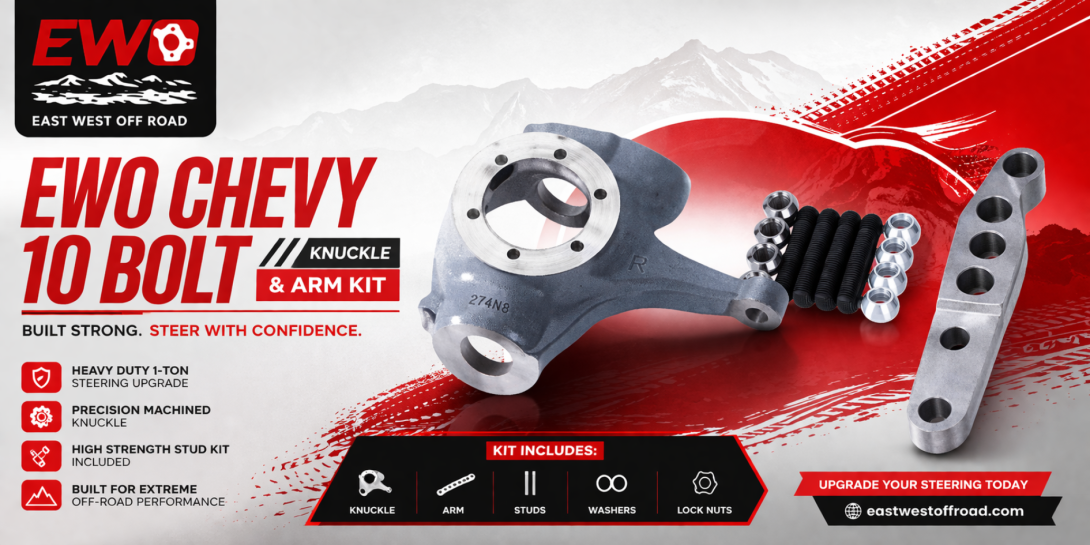
Buy Now: https://www.eastwestoffroad.com/product/ewo-chevy-10-bolt-knuckle-and-arm-kit
If you own a classic GM square body truck, K5 Blazer, or Suburban, you are likely familiar with the dreaded steering wander, vague handling, and terrifying bump steer that plagues these legendary rigs when they are lifted. Finding a reliable Dana 44 Flat Top Knuckle Passenger Side is the holy grail for off-road enthusiasts looking to fix these issues. When you increase the ride height on a vintage leaf-sprung Chevrolet or GMC 4x4, the factory steering configuration quickly reaches its mechanical limitations.
To achieve true directional stability, precise trail feedback, and unmatched durability on 35-inch or larger tires, modifying your axle with an engineered Dana 44 4-Stud Knuckle Upgrade is an absolute necessity. By converting your old, restrictive layout into a modern high-clearance setup, you completely transform how your truck handles both on the highway and over rugged terrain.
The Root Problem: Lifted Chevy Steering Geometry and Factory Limitations
To understand why upgrading your passenger-side knuckle is so critical, you must first analyze the inherent design flaws of the factory configuration. Standard GM square body trucks utilize what is known as a push-pull steering system. In this layout, the steering box drag link runs forward-to-back, connecting directly to the driver-side steering knuckle.
Crossover Steering vs Push Pull
When evaluating Crossover Steering vs Push Pull systems, the differences in geometry and physical dynamics are staggering. The factory push-pull setup works adequately at stock ride height because the drag link remains relatively horizontal. However, as soon as you install a suspension lift, the angle of the drag link becomes highly steep.
When the front leaf springs compress or extend over bumps, the axle moves slightly back and forth. Because the drag link is angled sharply, this suspension movement physically forces the steering knuckle to turn without any input from the steering wheel. This dangerous phenomenon is known as bump steer. A true Square Body Bump Steer Fix requires abandoning the push-pull setup entirely and replacing it with a crossover steering configuration, where the drag link runs transversely across the vehicle from the pitman arm to the passenger-side knuckle.
The Infamous Chevy 10 Bolt and Dana 44 Paradox
From the factory, GM utilized both the Dana 44 front axle and the corporate GM 10-bolt front axle interchangeably throughout the 1970s and 1980s. While these axles are remarkably durable for stock applications, neither came from the factory with a passenger-side knuckle machined to accept a steering arm. The driver-side knuckle has a cast-in arm to accept the push-pull drag link, but the passenger side is completely blank on top.
To convert to a high-strength crossover system, you cannot simply bolt an arm onto a stock passenger knuckle. You need a dedicated Chevy 10 bolt steering knuckle machined to precise tolerances, featuring a perfectly flat, milled top surface with high-strength mounting studs. This allows the new drag link to cross over from the driver-side steering box to the passenger side, aligning the steering geometry perfectly parallel with the track bar or axle centerline.
The Solution: The East West Off Road Knuckle and Arm Kit
For years, off-road builders had to scour junk yards searching for rare, vintage flat-top knuckles from specific early-70s vehicles, then send them to a machine shop to be manually milled, drilled, and tapped. Fortunately, the East West Off road knuckle and arm kit eliminates the guesswork, core charges, and machining delays by delivering a comprehensive, heavy-duty solution right to your garage.
This premium kit is specifically engineered for enthusiasts demanding a bulletproof Chevy 10 Bolt Crossover Steering Kit that installs seamlessly and handles extreme off-road abuse. It bridges the gap between vulnerable stock components and hardcore, one-ton trail reliability.
What’s Inside the Box?
The EWO kit is a complete, uncompromised system featuring premium components manufactured to withstand immense torsional loads:
- 1 - Dana 44 Chevy 10 Bolt Knuckle: Expertly machined, pre-drilled, and ready to install. This knuckle features a distinct Dana 44 bottom up tapered knuckle tie rod configuration for traditional steering link integration.
- 1 - Slit Tapered Insert: A brilliant engineering addition that gives you ultimate flexibility. If your specific build requires a "Bottom Down" tie rod orientation for clearance or custom geometry, this insert allows you to change the taper direction instantly.
- 1 - Dana 44 Passenger Arm: A massive, Chevy 10 bolt passenger arm 1.25 thick heavy-duty component machined from solid steel. This ultra-thick arm prevents flex and eliminates the risk of structural failure under load.
- 4 - 9/16-18 High Strength Studs: Superior to standard hardware, these 9/16-18 high strength studs Dana 44 fasteners ensure maximum clamping force between the knuckle and the steering arm.
- 4 - Conical Washers: Essential for centering the steering arm perfectly on the studs and distributing torque evenly.
- 4 - Lock Nuts: Heavy-duty, vibration-resistant nuts to lock the entire assembly down permanently.
Maximizing Trail Strength: The GM 1 Ton Tie Rod Conversion
When upgrading to a high-clearance crossover system, it is foolish to reuse weak, skinny factory tie rods and small, low-strength tie rod ends. The integration of a EWO Chevy 10 bolt knuckle kit opens up the perfect opportunity to perform a comprehensive GM 1 Ton Tie Rod Conversion.
By utilizing larger, heavy-duty 1-ton tie rod ends (such as the legendary ES2234R and ES2233L ends), you gain massive ball studs, increased articulation angles, and vastly superior shear strength. Combined with a thick-walled DOM steel tie rod link, a hd crossover steering kit ensures that slamming your front tires into boulders or logs won't bend your alignment into a taco shape, leaving you stranded on the trail.
Advanced Steering Configurations: High Steer vs Crossover
As you plan your axle rebuild, it is important to distinguish between standard crossover steering and a full high steer conversion.
Crossover Steering Explained
In a pure crossover steering setup, the tie rod remains in its low, factory location (connecting the driver and passenger knuckles via the lower cast eyes), while the drag link moves up to the newly installed HD passenger arm Dana 44. This fixes your steering geometry and eliminates bump steer entirely, making it ideal for trucks with 4 to 6 inches of suspension lift.
K5 Blazer High Steer Conversion
For hardcore rock crawling, maximum ground clearance is paramount. A full K5 Blazer High Steer Conversion moves both the drag link and the tie rod completely up and out of harm's way. This is achieved by installing a high-steer arm on both the driver and passenger flat-top knuckles. The tie rod then runs above the leaf springs rather than below them. Whether you choose standard crossover or full high steer, having a precision-machined Dana 44 1-ton crossover high steer arm on the passenger side is the non-negotiable foundation required to make either system work.
Step-by-Step Technical Guidelines for Installation
Installing the EWO complete kit requires mechanical competence, standard shop tools, and a strict adherence to torque specifications to ensure on-road safety and off-road dependability.
Step 1: Vehicle Preparation and Disassembly
- Securely elevate the front axle on heavy-duty jack stands and remove the front passenger wheel.
- Disconnect the factory drag link and tie rod from the passenger knuckle.
- Remove the brake caliper, rotor, spindle, wheel bearings, and outer axle shaft from the passenger side assembly.
- Remove the upper and lower ball joint nuts, and use a separator tool to free the stock passenger knuckle from the inner C-axle housing.
Step 2: Prepping the New EWO Flat Top Knuckle
- Thoroughly clean the inner C-yoke and clean any shipping oil off the new machined knuckle.
- Install new, high-quality upper and lower ball joints into the EWO knuckle using a dedicated ball joint press.
- Determine your tie rod orientation. Out of the box, the knuckle features a Dana 44 bottom up tapered knuckle design. If your steering geometry dictates a top-down approach, utilize the included slit tapered insert bottom down component to reverse the taper profile cleanly.
Step 3: Mounting the Knuckle and High Strength Studs
- Fit the new knuckle onto the axle housing's inner C and torque the ball joints to factory specifications (typically 80-100 ft-lbs for the lower, and 70 ft- lbs for the upper, ensuring correct split-runner adjustment if applicable).
- Thread the four 9/16-18 high strength studs Dana 44 into the top flat surface of the passenger knuckle. Ensure they are fully seated and bottomed out in the tapped holes. Double-nutting the studs is an effective method for achieving full seating.
Step 4: Installing the 1.25" Thick Passenger Arm
- Slide the Chevy 10 bolt passenger arm 1.25 thick steering arm down over the four installed studs.
- Drop the four conical split washers over the studs. These washers are absolutely vital as they wedgingly lock the arm into a perfectly centered, zero-movement position on the studs.
- Thread the lock nuts onto the studs. Cross-torque the nuts in stages, finishing at a final torque rating of 90-110 ft-lbs to ensure total geometric clamping lock.
Step 5: Final Reassembly and Steering Alignment
- Reinstall your outer axle shaft, spindle, wheel bearings, hubs, brake rotors, and calipers using fresh seals and grease.
- Connect your new heavy-duty crossover drag link to the newly installed passenger arm.
- Reattach your tie rod using your preferred taper orientation.
- Set the vehicle back on its own weight and perform a comprehensive alignment, adjusting the toe-in to approximately 1/16" to 1/8" and centering the steering wheel.
Frequently Asked Questions (FAQs)
What is the advantage of flat top knuckles?
Flat top knuckles feature a flat, cast iron surface on the upper section of the knuckle body that can be machined with mounting holes to accept an aftermarket steering arm. Standard stock knuckles have an irregular, unmachined surface that cannot safely support a steering arm. Flat top knuckles are the baseline component required to convert a front axle to high-clearance crossover steering or a high-steer configuration.
Can I use a Dana 44 flat top knuckle on a GM Corporate 10-bolt axle?
Yes! The GM Corporate 10-bolt front axle and the open-knuckle Dana 44 front axle share identical outer components from the inner C-housings outward. This means that spindles, hubs, rotors, brake calipers, and steering knuckles are completely interchangeable between a Chevy 10-bolt and a Dana 44 axle. The EWO kit is engineered to fit perfectly across both axle platforms.
Why is a 4-stud arm configuration superior to a 3-stud setup?
Early factory flat-top knuckles that were modified by aftermarket shops typically used a 3-stud mounting pattern because that mirrored old factory layouts. However, under high stress—such as turning large tires through deep mud or binding against rocks—the rotational leverage placed on a 3-stud arm can stretch the hardware, leading to loose steering or sheared studs. A Dana 44 4-Stud Knuckle Upgrade adds a fourth mounting point, increasing clamping surface area by over 33% and distributing stress evenly to eliminate component failure.
What is the difference between bottom-up and bottom-down tapering?
This refers to the direction from which the tapered ball joint end of a tie rod or drag link inserts into the steering arm or knuckle eye. A "Bottom Up" taper means the tie rod end inserts from underneath the knuckle and points upward, keeping the link lower. A "Bottom Down" taper means the tie rod inserts from the top pointing downward. The included slit tapered insert gives you the freedom to choose whichever configuration provides the straightest, most bind-free linkage angle for your specific lift height.