

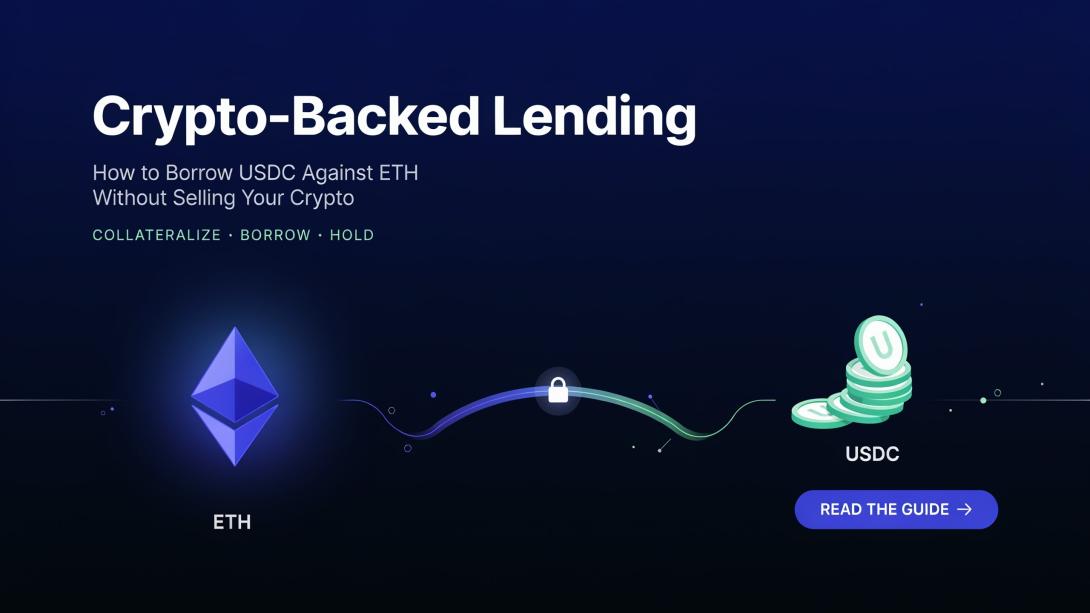
The growth of decentralized finance (DeFi) has introduced new ways for cryptocurrency holders to access liquidity without selling their digital assets. One increasingly popular option is crypto-backed lending, which allows users to deposit cryptocurrency as collateral and borrow stablecoins against its value. For Ethereum (ETH) holders who want to cover expenses, manage short-term cash flow, or pursue other investment opportunities, this approach can provide access to funds while maintaining exposure to ETH.
However, borrowing against cryptocurrency is not risk-free. Collateral requirements, interest charges, repayment deadlines, blockchain transaction fees, and market volatility all influence the true cost of a loan. Understanding these factors is essential before committing digital assets to a lending arrangement.
Wallet-based lending platforms have made the process more accessible by allowing users to connect their wallets, deposit ETH, and access USDC credit lines through supported lending mechanisms. Platforms such as xq finance documentation offer an example of this model, providing ETH-backed USDC credit lines on the Base network, with 0% interest when a loan is repaid within a 14-day grace period, according to the stated offering.
This guide explains how crypto-backed lending works, what borrowers should evaluate, and how to approach an ETH-backed USDC credit line responsibly.
What Is Crypto-Backed Lending?
Crypto-backed lending is a financing arrangement in which a borrower uses cryptocurrency as collateral to secure a loan. Instead of selling ETH to obtain cash, the borrower pledges eligible ETH and receives another asset, commonly a stablecoin such as USD Coin (USDC).
USDC is designed to maintain a value close to one US dollar. Although its value can fluctuate slightly and it carries issuer-related risks, it is commonly used in DeFi because its relatively stable price makes it useful for payments, trading, and short-term financial planning.
The basic lending process involves four stages:
- Deposit collateral: The borrower supplies ETH to a lending protocol or other supported collateral arrangement.
- Establish borrowing capacity: The platform calculates the amount that can be borrowed based on the collateral's value and applicable loan limits.
- Receive USDC: Once the borrowing conditions are satisfied, the borrower receives USDC in their wallet or through the platform's supported mechanism.
- Repay the loan: The borrower returns the principal and any applicable interest or fees to satisfy the loan terms and recover access to the collateral.
The primary appeal is that the borrower can obtain spending power without immediately disposing of their ETH. If ETH appreciates while the loan remains open, the borrower may retain the benefit of that price increase, subject to the loan's collateral and liquidation rules.
Nevertheless, borrowing does not eliminate the financial consequences of owning a volatile asset. The borrower remains exposed to ETH price movements and takes on an additional repayment obligation.
Why Borrow USDC Instead of Selling ETH?
Selling ETH is straightforward, but it permanently reduces the amount of ETH a person owns. Depending on the jurisdiction, selling may also trigger a taxable event. Borrowing against ETH offers an alternative for people who want liquidity without immediately selling their holdings.
Common use cases include:
- Short-term expenses: Accessing funds for an unexpected bill or temporary cash-flow gap.
- Portfolio flexibility: Obtaining stablecoins while maintaining exposure to potential ETH price appreciation.
- DeFi participation: Using USDC for supported decentralized applications, subject to the additional risks involved.
- Avoiding a forced sale: Accessing liquidity when a holder would prefer not to sell ETH at the prevailing market price.
These advantages should not be confused with guaranteed savings or profits. Borrowing introduces costs and risks that selling would not create. If ETH falls sharply, the borrower may face collateral liquidation even if their long-term view of the asset remains positive.
A responsible borrower should therefore have a clear repayment plan rather than relying on a future increase in ETH's price.
Understanding Collateral Requirements and Loan-to-Value Ratios
Most crypto-backed lending arrangements require borrowers to provide more collateral value than the amount they borrow. This is known as overcollateralization, and it helps protect the lending system against fluctuations in cryptocurrency prices.
The key measurement is the loan-to-value ratio, or LTV.
LTV=Outstanding debtCollateral market value×100\text{LTV}=\frac{\text{Outstanding debt}}{\text{Collateral market value}}\times100
For example, suppose a borrower deposits 10 ETH, with ETH valued at $3,000 per coin. The total collateral value is $30,000. If the borrower takes out a $9,000 USDC loan, the initial LTV is 30%.
Borrowing $6,000 against the same collateral would produce an LTV of 20%, while borrowing $15,000 would produce an LTV of 50%. A $21,000 loan would raise the ratio to 70%.
These examples illustrate why the amount borrowed matters. A lower LTV generally provides a larger safety buffer if ETH prices decline. A higher LTV allows the borrower to access more stablecoins relative to their collateral but leaves less room for adverse price movements.
Platforms can also impose minimum collateral amounts, maximum credit limits, eligible-asset restrictions, and wallet screening requirements. Borrowers should review these conditions before depositing funds.
For example, XQ Finance describes a model that supports ETH on Ethereum, native ETH on Base, and wrapped ETH (wETH) on Base for its planned credit-line product. The final borrowing limit depends on collateral valuation, applicable LTV rules, and conditions at the time the transaction executes. See the XQ Finance credit-line opening guide for details.
What Happens If ETH Loses Value?
Consider the earlier example, where a borrower has $9,000 in debt backed by $30,000 of ETH. If the collateral value falls to $15,000, the LTV increases from 30% to 60%, assuming the debt remains unchanged.
This can trigger restrictions or liquidation if the applicable thresholds are reached. Liquidation occurs when the platform sells some or all of the collateral under its rules to recover the outstanding obligation.
The precise consequences vary between lending platforms. Some may restrict additional borrowing before liquidation becomes necessary, while others use automated liquidation mechanisms once a defined threshold is crossed.
The important lesson is that borrowers should not treat the maximum available credit as a recommended borrowing amount. Maintaining a substantial collateral buffer can help reduce the likelihood of liquidation, although it cannot eliminate that risk.
How USDC Credit Lines Work
A traditional loan often provides a fixed sum upfront. A credit line works differently: it establishes a borrowing limit that the user can draw from as needed.
This distinction can be useful when expenses are uncertain or liquidity needs change over time.
For instance, a user might qualify for a 10,000 USDC credit line but initially use only 2,000 USDC. The unused 8,000 USDC represents available borrowing capacity rather than money already borrowed. Interest, where applicable, is generally calculated on the outstanding amount according to the platform's terms.
After repaying principal, the user may regain access to the repaid portion of the limit, subject to collateral conditions and other restrictions.
XQ Finance describes this reusable credit-line structure in its crypto-backed credit-line documentation . The product is designed to let eligible users access USDC against ETH without immediately selling their holdings.
Its published product materials also describe USDC credit lines on Base and a 14-day grace period during which eligible borrowing can incur 0% interest if repaid within the applicable period. However, the documentation identifies the product as under development, so prospective users should verify launch status, availability, and final terms rather than assuming that every advertised feature is currently available.
How Interest Is Calculated
Interest is one of the most important factors when evaluating the affordability of a crypto-backed credit line. A low advertised rate may be attractive, but borrowers need to understand when interest begins, which balance it applies to, and what happens if repayment is delayed.
For a simple-interest loan, an illustrative calculation is:
I=P×r×d365I=P\times r\times\frac{d}{365}
Here, II represents the interest charged, PP is the outstanding principal, rr is the annual interest rate expressed as a decimal, and dd is the number of days the balance accrues interest.
Suppose someone borrows 5,000 USDC at an illustrative annual rate of 12% for 30 days. Using simple interest and a 365-day year, the interest would be approximately 49.32 USDC, excluding other charges.
Actual platforms may use different day-count conventions, compounding rules, payment allocations, or rate structures. This example demonstrates the calculation rather than representing a quoted rate from a specific provider.
Understanding a 14-Day, 0% Interest Grace Period
Some credit products offer a limited grace period during which borrowers can repay without paying interest on eligible borrowing. This can make a credit line useful for short-term liquidity needs, provided the user can repay on time.
XQ Finance advertises 0% interest when the used credit is repaid within its 14-day grace period. Its documentation explains that this benefit applies to interest on the eligible borrowed amount, rather than eliminating every possible cost.
That distinction matters. A borrower may still face an origination fee, blockchain gas costs, bridge expenses, or other charges specified in the applicable terms. Missing the grace period can also lead to interest accrual and potentially additional payment obligations.
Before drawing USDC, users should establish:
- When the grace period begins and ends.
- Whether each additional draw has its own repayment deadline.
- What annual percentage rate applies after the grace period.
- Whether a minimum payment is required.
- How payments are allocated between fees, interest, and principal.
- Whether penalties apply to overdue amounts.
A 0% interest offer should be evaluated as one part of the total borrowing cost, not as a guarantee that using the credit line is free.
Repayment Terms: What Borrowers Need to Know
Repayment is central to managing any crypto-backed loan. Before borrowing, users should understand whether the platform requires a fixed repayment date, recurring minimum payments, full repayment within a grace period, or some combination of these conditions.
A well-managed credit line starts with a realistic repayment plan. Borrowers should ideally identify the source of repayment before taking out USDC, such as expected income, available cash reserves, or funds from a planned transaction.
For a reusable credit line, repaying principal may restore available credit. However, a payment does not necessarily reduce principal by its full amount if interest, fees, or penalties remain outstanding.
According to XQ Finance's published documentation, repayments are allocated first to penalties, then accrued interest, unpaid fees, and finally principal. This means borrowers should check the outstanding balance after each payment rather than assuming that the entire payment reduces the amount borrowed.
Users should also distinguish between keeping a credit line open and closing it entirely. A borrower who wants to recover their collateral generally needs to clear all required obligations and follow the platform's collateral withdrawal process.
For cross-network arrangements, closing a position may involve additional transactions and processing time. The exact requirements depend on where the collateral was deposited and the platform's supported return mechanism.
Blockchain Fees and the Cost of Borrowing
Crypto-backed lending involves blockchain transactions, which can add costs beyond interest and lender fees.
On networks such as Ethereum and Base, users generally pay gas fees to execute transactions. These fees compensate the network infrastructure for processing and recording activity, and their amounts can change with network demand.
Potential costs include:
- Collateral deposit fees: The gas required to deposit or lock ETH.
- Credit-line opening fees: Any platform-specific origination charge, plus transaction costs.
- Borrowing and repayment fees: Gas costs associated with drawing USDC and returning it.
- Bridge fees: Additional costs when collateral or assets move between networks.
- Closing and withdrawal fees: The transaction costs involved in releasing collateral.
- Liquidation fees: Charges or penalties that may apply if the platform liquidates a position.
Base is an Ethereum Layer 2 network designed to support onchain applications with lower transaction costs than many comparable operations on Ethereum mainnet. This can make frequent borrowing and repayment more practical, but it does not mean that every transaction is free.
XQ Finance describes its USDC credit-line activity as operating on Base, with Ethereum-originated collateral following a cross-network process. Borrowers considering this approach should account for the possibility of additional costs and delays when moving collateral between networks.
A useful way to evaluate a loan is to calculate its total cost by adding interest, platform fees, blockchain fees, bridge costs, and any applicable penalties.
For example, even if a borrower qualifies for 0% interest during a grace period, transaction fees and any applicable origination charge can still make the overall cost greater than zero.
Key Risks of Crypto-Backed Lending
Borrowing against cryptocurrency can provide flexibility, but it introduces several risks that deserve careful consideration.
1. ETH Price Volatility
ETH prices can move sharply over short periods. A significant decline can increase the LTV of an open credit line and trigger borrowing restrictions or liquidation.
Borrowers should consider whether they could repay the debt if ETH fell substantially, without depending on a market recovery.
2. Automatic Liquidation
Smart contracts may automatically sell collateral when a position reaches its liquidation threshold. This process can happen during periods of market volatility, potentially leaving the borrower with less ETH than expected.
Liquidation may also involve additional fees or penalties. Keeping LTV well below the applicable threshold can provide a buffer, but no buffer guarantees protection against every market event.
3. Smart-Contract Vulnerabilities
DeFi lending platforms rely on software to manage collateral, calculate balances, process repayments, and enforce financial rules. A coding vulnerability, exploit, or unexpected contract interaction can result in financial losses.
Users should investigate available audits, contract verification, security disclosures, and the platform's incident-response procedures. An audit is useful evidence, but it is not a guarantee that a protocol is secure.
4. Oracle and Network Risks
Lending protocols may rely on price oracles to estimate ETH's market value and determine borrowing limits. Stale, inaccurate, or unavailable price data can interfere with risk controls.
Network congestion, outages, and cross-network messaging failures can also delay transactions or complicate the opening and closing of positions.
5. Stablecoin and Liquidity Risks
USDC is designed to maintain a value close to one US dollar, but its market price is not guaranteed to remain exactly at that level in every circumstance. Issuer, reserve, regulatory, and market risks remain relevant.
Additionally, a lending platform may depend on available USDC liquidity to fund withdrawals or credit draws. A credit limit should not be assumed to guarantee that every transaction will always be available under all conditions.
6. Wallet and Operational Risks
Wallet-based lending can reduce reliance on traditional custodial intermediaries, but users remain responsible for securing their private keys and reviewing transaction approvals.
A compromised wallet, phishing attack, malicious approval, or accidental transfer can lead to irreversible losses. Never share a seed phrase or private key with a lending platform or another person.
7. Regulatory and Tax Considerations
Borrowing against ETH may have different tax and legal implications depending on the borrower's jurisdiction. Although a collateralized loan may be treated differently from a sale, fees, liquidation, or other transactions can have tax consequences.
Users should consult a qualified professional when the potential amounts or legal implications are significant.
How to Evaluate a Wallet-Based Lending Platform
Choosing a lending platform requires more than comparing interest rates. A thorough evaluation should include the product's legal terms, technical architecture, collateral policies, and repayment mechanics.
Before opening a credit line, consider the following checklist:
- Verify that the product is live and available in your jurisdiction.
- Confirm which collateral assets and blockchain networks are supported.
- Review the opening LTV, restriction thresholds, and liquidation rules.
- Check the full fee schedule, including origination and liquidation charges.
- Understand when interest begins and how it is calculated.
- Confirm repayment deadlines, minimum-payment requirements, and grace-period conditions.
- Investigate smart-contract audits and available security documentation.
- Verify how collateral is returned when the credit line is closed.
- Keep enough ETH or the network's required native token available for gas.
- Borrow only an amount you can realistically repay.
For readers researching the mechanics of ETH-backed lending, the xq finance documentation provides a contextual example of a wallet-based platform designed around USDC credit lines secured by ETH on Base. Its published materials describe reusable credit limits, collateral valuation, repayment allocation, and a 14-day grace period offering 0% interest when eligible borrowing is repaid within the required period.
Because the documentation describes XQ as under development, users should confirm the current product status and review the final contractual terms before relying on any advertised feature. The platform's stated design and published documentation should not be interpreted as a guarantee of security, availability, or financial outcomes.
Conclusion
Crypto-backed lending gives ETH holders another way to access liquidity without selling their assets immediately. By pledging ETH as collateral, borrowers can obtain USDC for short-term expenses, cash-flow management, or other planned uses while maintaining exposure to cryptocurrency price movements.
The benefits depend on understanding the mechanics. Collateral requirements determine how much a user can borrow, LTV measures exposure to falling ETH prices, and interest and repayment terms determine the financial obligations. Blockchain gas fees, platform charges, liquidation rules, and smart-contract risks also influence whether a credit line is suitable.
Wallet-based platforms such as XQ Finance illustrate how ETH-backed USDC credit lines on Base can combine reusable borrowing capacity with a stated 14-day, 0% interest grace period. However, a limited interest-free window does not eliminate transaction costs, collateral volatility, or repayment risk.
Ultimately, the most responsible approach is to borrow conservatively, read the current terms carefully, maintain a sufficient collateral buffer, and establish a credible repayment plan before using crypto-backed credit. When used with a clear understanding of its costs and limitations, this type of financing can offer flexibility without requiring an immediate sale of ETH.