

Buy Now: https://www.eastwestoffroad.com/product/ewo-chevy-10-bolt-knuckle-and-arm-kit
When you build a serious off-road rig, ensuring your front-end geometry can handle the terrain is absolutely critical. Installing a premium Chevy 10 Bolt Crossover Steering Kit is one of the most transformative upgrades you can perform on a classic GM solid-axle square body truck, K5 Blazer, or Suburban. From the factory, these vehicles utilized a push-pull steering design that works decently at stock heights but becomes notoriously problematic once a suspension lift is introduced. By converting to a modern crossover system, you completely separate the steering linkages from the vertical movement of the suspension, unlocking unparalleled trail articulation, precise highway handling, and peace of mind on the rocks.
Understanding the fundamental mechanics of your front axle layout helps explain why this upgrade is so vital. Many classic GM 4x4 trucks run either a corporate 10-bolt front axle or an open-knuckle Dana 44. To properly transition to a crossover system, sourcing a rugged Dana 44 Flat Top Knuckle Passenger Side is standard operating procedure. This allows an independent steering arm to mount directly above the passenger side knuckle, channeling the drag link across the vehicle rather than front-to-back. Let's dive deep into why your factory configuration fails under stress, how a high-clearance system resolves these geometric flaws, and why premium components make all the difference.
The Physics of Lifted GM Trucks: Understanding Steering Geometry Failures
To appreciate the benefits of a crossover conversion, you must first look at how the stock steering handles suspension articulation. In a traditional factory layout, the drag link runs parallel to the frame rail, connecting the pitman arm directly to the driver side steering knuckle. As the driver side wheel moves up and down over obstacles, the distance between the steering box and the knuckle changes drastically, forcing the wheels to turn slightly without any input from the steering wheel itself.
The Nightmare of Square Body Bump Steer
If you have ever driven an old square body over a set of railroad tracks or through a pothole at highway speeds and felt the truck violently yank to one side, you have experienced the textbook definition of mechanical instability. Implementing a permanent Square Body Bump Steer Fix requires altering the physical plane on which the drag link operates. When your truck is lifted, the angle of the factory push-pull drag link becomes incredibly steep. Every bump compresses the leaf springs, pushing the axle rearward and upward, fighting the rigid steering link and breaking your path of travel. A crossover setup levels this operating angle completely.
Crossover Steering vs Push Pull Configurations
When comparing Crossover Steering vs Push Pull systems, the operational differences are stark. A push-pull system works by moving the drag link forward and backward to rotate the driver side knuckle, which then pushes the passenger side via the tie rod. When you lift the vehicle beyond three inches, this geometry collapses; turning efficiency drops, your turning radius to the left is severely compromised, and the steering bind can tear the steering box off the frame.
Crossover steering, on the other hand, utilizes a longer drag link that runs across the chassis from a driver-side pitman arm to a passenger-side steering arm. This layout ensures that as the axle articulates, the drag link sweeps in a much wider, flatter arc that is perfectly synchronized with the suspension, delivering symmetric turning radiuses and zero feedback through the steering column.
Managing Lifted Chevy Steering Geometry
Properly managing Lifted Chevy Steering Geometry requires keeping the drag link and the track bar (if equipped) as flat and parallel as possible. On leaf-sprung square bodies, minimizing the operating angle of the drag link relative to the front axle housing prevents bind. By shifting the drag link mount from the low driver-side factory position to a dedicated high-mount arm on the passenger side, you restore a near-factory operating angle even on trucks with 4 to 8 inches of suspension lift. This stabilization prevents premature wear on your steering box sector shaft and protects vital frame points from cracking under heavy torque.
Upgrading to a High-Performance Crossover System
Transitioning away from weak factory components requires a total overhaul of your axle's steering connection points. For off-roaders looking to tackle technical trails, an all-inclusive Chevy K10/K20 Steering Upgrade is mandatory. This conversion not only resolves steering bind but heavily reinforces the entire knuckle structure to support larger tire sizes, such as 35-inch to 40-inch mud terrains.
The Foundation: Knuckle and High Steer Interfacing
The standard corporate 10-bolt front axle does not come equipped from the factory with a mounting pad for a passenger-side steering arm. To overcome this design limitation, using an EWO Chevy 10 bolt knuckle kit provides a fully engineered solution. This kit substitutes your stock, unmachined passenger knuckle with a heavy-duty, cast-iron unit that has been precision engineered to host an independent high-clearance steering arm. This setup forms a bulletproof foundation capable of transferring massive hydraulic or mechanical steering forces directly to the tires without deflection.
For vehicles navigating intense rock crawling trails or deep ruts, a comprehensive K5 Blazer High Steer Conversion takes optimization a step further. While a standard crossover setup relocates the drag link up high, a full high-steer conversion places both the drag link and the main tie rod above the leaf springs. This completely insulates your vital steering links from destructive impacts with stumps, boulders, and trail debris.
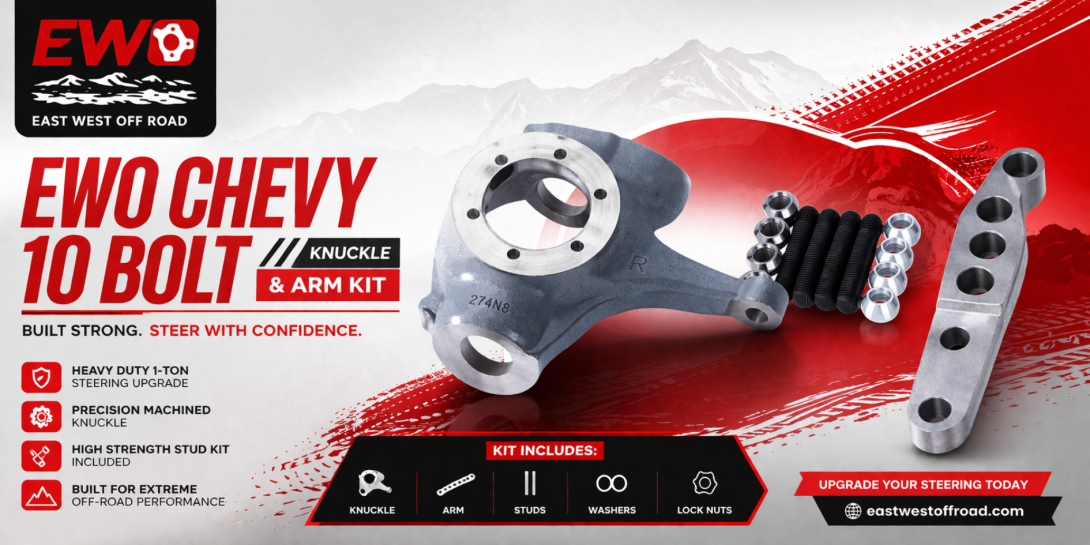
Product Focus: EWO Chevy 10 Bolt Knuckle and Arm Kit
Engineered in the USA for maximum durability and flawless trail performance, the Dana 44 Chevy 10 Bolt Complete 1-Ton Crossover High Steer Arm-Knuckle Kit includes everything needed to completely overhaul your front-end steering dynamics:
- 1 - Dana 44 Chevy 10 Bolt Knuckle: Precision machined, bored, and ready to install. Pre-tapered for a reliable "Bottom Up" tie rod configuration.
- 1 - Slit Tapered Insert: Included to give builders ultimate flexibility, allowing you to easily change the tie rod orientation to "Bottom Down" if your custom suspension clearance requires it.
- 1 - Dana 44 Passenger Arm: A massive 1 1/4" thick heavy-duty steering arm built to resist bending under extreme tire leverage.
- 4 - 9/16-18 High Strength Studs: Premium grade fasteners engineered to handle immense shear loads.
- 4 - Conical Washers: Ensures precise alignment and locks the arm securely to the knuckle face.
- 4 - Lock Nuts: High-grade locking nuts to ensure your critical hardware never backs out on the trail or highway.
Component Breakdown: Maximizing Strength and Reliability
When assembling a dependable crossover steering system, the devil is entirely in the details. Because off-road driving subjects your steering components to extreme multi-axial loads, every individual part must be overbuilt. Utilizing a heavy-duty hd crossover steering kit guarantees that your steering system will never be the weak link in your drivetrain.
Advanced Knuckle Engineering
The critical starting point of any steering conversion is a premium Chevy 10 bolt steering knuckle machined to exacting tolerances. Factory passenger knuckles lack the structural flat pad, as well as the drilled and tapped holes required to accept high steer hardware. Advanced aftermarket knuckles feature extra material casting around the top deck to accommodate a rock-solid Dana 44 4-Stud Knuckle Upgrade. Utilizing a 4-stud mounting pattern rather than an old-style 3-stud configuration increases the surface clamping area by over 33%, effectively eliminating the risk of the steering arm shearing off the knuckle under high-torque binding scenarios.
Heavy-Duty Steering Arms and Hardware
The steering arm itself bears the brunt of the leverage exerted by oversized off-road tires. Cheap, thin steering arms will flex under load, leading to a vague, unresponsive steering feel. Sourcing a Chevy 10 bolt passenger arm 1.25 thick guarantees zero structural deflection. This heavy-duty component provides the necessary leverage to turn large tires effortlessly while standing up to direct impacts from trail obstacles.
To safely secure this heavy-duty arm to your axle assembly, premium fastening hardware is non-negotiable. Standard grade-5 bolts will stretch and fail under shear loads. A professional-grade kit relies exclusively on 9/16-18 high strength studs Dana 44 specific hardware. Combined with matching conical split washers, these high-tensile studs seat deeply into the machined knuckle pad, creating a wedged, friction-locked interface that prevents the arm from loosening or shifting during aggressive wheeling.
Tie Rod Configurations and Tapered Alignment Options
Another major advantage of a high-end steering kit is its adaptability to different suspension setups. The main knuckle in the East West Off Road kit arrives machined as a Dana 44 bottom up tapered knuckle. Tapering the tie rod hole from the bottom up allows the tie rod end to sit higher up on the steering assembly, safely extracting it from harm's way. However, every truck layout is unique due to varying leaf pack thicknesses, custom axle offsets, and differential covers.
To maintain complete installation versatility, the inclusion of a specialized slit tapered insert bottom down component allows builders to modify the steering orientation on the fly. By inserting this custom sleeve into the machined taper, you can seamlessly switch the tie rod connection to a top-down configuration. This provides critical clearance around leaf spring plates or aftermarket diff covers without requiring you to purchase an entirely different, specialized steering knuckle.
Completing the Conversion: The GM 1 Ton Tie Rod Solution
Once your passenger knuckle and heavy-duty crossover arm are securely bolted down, the final piece of the puzzle involves upgrading your linkages. Standard 1/2-ton factory drag links and tie rods are thin-walled tubes equipped with small, fragile tie rod ends that wear out rapidly when paired with large tires. No crossover steering upgrade is truly complete without executing a robust GM 1 Ton Tie Rod Conversion.
This legendary upgrade utilizes massive, heavy-duty 1-ton tie rod ends (such as the famous ES2233L and ES2027L ends) coupled with thick-walled DOM steel tubing. The larger ball joints offer a vastly superior surface area, allowing them to absorb violent trail forces without binding or blowing out boots. The combination of a robust Dana 44 1-ton crossover high steer arm and 1-ton links yields an indestructible steering system that delivers crisp, immediate feedback whether you are driving on the interstate or navigating tight technical canyons.
Step-by-Step Installation & Alignment Framework
While installing an East West Off road knuckle and arm kit is a straightforward bolt-on process for an experienced mechanic, following a disciplined installation workflow ensures total safety and optimal performance. Below is the recommended professional implementation strategy:
- Teardown & Prep: Raise the front axle and secure it on heavy-duty jack stands. Remove the passenger-side wheel, brake caliper, rotor, and spindle assembly. Disconnect the factory tie rod and drag link.
- Knuckle Installation: Slide the old factory passenger knuckle off the inner C and clean the ball joint surfaces thoroughly. Inspect your upper and lower ball joints for play, replacing them if necessary. Install your new, precision-machined HD passenger arm Dana 44 compatible knuckle onto the ball joints, torquing them strictly to factory service manual specifications.
- Steering Arm Mounting: Thread the high-tensile 9/16-18 studs directly into the machined pad on top of the knuckle. Seat the 1.25-inch thick passenger arm over the studs. Drop the conical washers over the studs—these are vital as they center the arm and lock it down under lateral pressure. Thread on the lock nuts and torque them in a cross-pattern to 90 ft-lbs.
- Linkage Setup & Alignment: Install your new drop pitman arm onto your steering box. Measure and cut your heavy-wall DOM drag link to length, thread in your 1-ton tie rod ends, and connect the link from the pitman arm to your new crossover steering arm. Reinstall your brake components and wheels.
- Final Geometry Verification: Center your steering wheel and adjust the drag link sleeve until the tires are tracking perfectly straight. Perform a manual toe-in adjustment, setting your front toe between 1/16" and 1/8" inward for optimal highway stability. Cycle the steering fully from lock to lock to confirm that the drag link completely clears your frame rails, oil pan, and leaf springs throughout the entire suspension cycle.
Frequently Asked Questions (FAQs)
Can I install a crossover steering kit on a stock-height Chevy truck?
While mechanically possible, crossover steering is not recommended for stock-height trucks. At factory ride height, the engine crossmember and oil pan sit too low, leaving insufficient vertical clearance for the cross-over drag link to travel safely during suspension compression. This upgrade is specifically engineered for trucks with at least 3 inches or more of suspension lift, where the added clearance allows the drag link to operate flawlessly without frame interference.
What is the difference between an unmachined knuckle and a machined 10-bolt knuckle?
A standard factory passenger-side 10-bolt knuckle features a cast, rounded shape with no flat surface or mounting provisions on top. A machined knuckle has undergone precision industrial milling to create a perfectly flat, smooth mounting pad. It is then drilled, counter-bored, and tapped with high-precision threads to accept heavy-duty steering arm studs. Attempting to hand-drill a stock knuckle is highly dangerous and will result in catastrophic component failure.
Do I need to change my steering box when switching to crossover steering?
If you are converting a standard 4WD factory push-pull setup, your original steering box can typically be reused. However, you will need to replace the factory push-pull pitman arm with a dedicated crossover pitman arm that indexes side-to-side rather than front-to-back. Additionally, it is highly recommended to install a frame reinforcement weld-in plate or steering box brace around the frame sector shaft area, as crossover steering applies sideways leverage to the frame rails.
Will this kit work on both Corporate 10-Bolt and Dana 44 front axles?
Yes. The external casting profiles, spindle bolt patterns, and ball joint tapers are completely identical between the GM Corporate 10-Bolt front axle and the open-knuckle passenger side Dana 44 axle used in GM applications. This means the East West Off Road high steer knuckle and arm components interface perfectly with both axle platforms seamlessly.
Why are conical washers included instead of standard flat washers?
Conical washers are vital safety components in high-torque steering applications. They feature a split design and a tapered profile that wedges tightly into the matching counter-bored holes of the steering arm as the lock nuts are torqued down. This design eliminates any minute clearances or play between the stud and the arm, distributing lateral shear stresses across the entire pad surface rather than concentrating forces directly on the stud threads.