
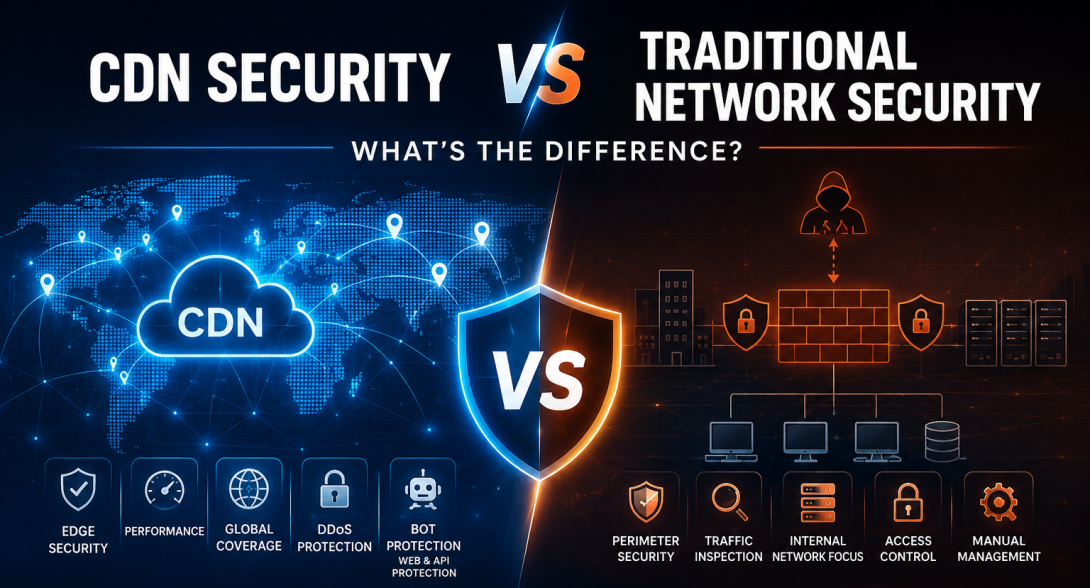
One of the most common conversations I have with IT leaders goes something like this: their organization has invested heavily in firewalls, intrusion detection systems, and network perimeter security over the years.
Then a distributed denial-of-service attack takes down their public website for four hours, or a bot farm quietly scrapes their pricing data overnight, and suddenly someone asks - "Shouldn't our CDN be handling that?"
The honest answer is: it depends on which problem you're trying to solve, and whether your security architecture was designed with modern attack surfaces in mind.
CDN security and traditional network security are not competing philosophies. But they operate at fundamentally different layers of your infrastructure, address different threat vectors, and perform very differently at scale.
What Traditional Network Security Is Designed to Do
Traditional network security, at its core, is built around the concept of the network perimeter. The model assumes that your infrastructure lives in a defined location - a data center, a corporate network, a private cloud environment. And that security controls at the boundary of that environment can inspect, filter, and block malicious traffic before it reaches internal systems.
The tools that power network perimeter security are well-established: next-generation firewalls, intrusion prevention systems (IPS), secure web gateways, network access control, and VPNs for remote access. These are mature technologies with decades of development behind them, deep traffic inspection capabilities, and strong integration with identity and access management systems.
Where traditional network security excels is in protecting internal infrastructure - east-west traffic between servers, access controls for internal applications, lateral movement detection, and enforcement of segmentation policies. If an attacker somehow gets inside your network perimeter, these tools are what contain the damage.
The limitation is structural. Traditional network security was designed for a world where applications lived inside the perimeter and users sat at desks on the corporate LAN. That world no longer exists for most enterprises.
What CDN Security Adds and Why It Matters Now
Content delivery network security operates at the edge, distributed points of presence (PoPs) positioned geographically close to end users around the world. Rather than routing all traffic back to a central data center for inspection, edge security intercepts, analyzes, and filters traffic at the network's perimeter before it ever reaches your origin infrastructure.
This architectural difference has significant implications for both security and performance.
A volumetric DDoS attack targeting a traditionally secured data center has to be absorbed or filtered at the point of ingress often overwhelming upstream bandwidth and on-premises mitigation hardware before defenses can fully engage.
CDN-based DDoS protection absorbs that traffic across a globally distributed scrubbing network with terabits of capacity. The attack never reaches your origin. I've watched this play out in real incidents: organizations with edge-based DDoS mitigation stay online through attacks that would have taken a data center offline in minutes.
Beyond DDoS, edge security introduces capabilities that traditional network security simply cannot deliver at scale:
- Web application security at the edge. Web application firewalls (WAFs) deployed at CDN PoPs inspect HTTP/HTTPS traffic for injection attacks, cross-site scripting, API abuse, and malicious payloads - and do so closer to the attacker than to your application, reducing both risk exposure and latency impact on legitimate users.
- Bot protection at the point of origin. Bot management systems deployed at the edge identify and classify automated traffic using behavioral signals, TLS fingerprinting, and machine learning models trained on massive traffic datasets. This is far more effective than IP blocklists or rate limiting applied at the application layer.
- API security for distributed microservices. As APIs have become the primary attack surface for modern applications, edge-based API security services enforce schema validation, authentication, and rate limiting before requests reach backend services, protecting microservices architectures that have no meaningful internal perimeter to defend.
- Performance as a security asset. Edge computing security removes the latency penalty that traditionally accompanies deep traffic inspection. Security controls execute at PoPs milliseconds from the end user, not at a central hub thousands of miles away. This eliminates the old trade-off between security depth and application performance.
Akamai as a Reference Point for Edge Security Maturity
When discussing CDN security at enterprise scale, Akamai is a meaningful reference point, not as a product endorsement, but because the platform illustrates how far edge-based security has matured.
Akamai edge security services, including Akamai App & API Protector, combine WAF, DDoS protection, bot management, and API security into an integrated edge platform that processes hundreds of terabits of traffic daily, generating threat intelligence that no individual organization could replicate internally.
Organizations that work with experienced implementation partners - firms like Evolvous, which provides Akamai security services and edge security consulting across enterprise environments - often discover that the platform's capabilities require ongoing configuration and tuning to reach their full potential.
Akamai CDN security and Akamai DDoS protection are powerful tools, but their effectiveness is directly tied to how well policies are aligned to an organization's specific traffic patterns and application behavior. That alignment is the work of experienced consultants, not a one-time deployment task.
Neither Replaces the Other - The Layered Reality
Here's the practical insight that doesn't always make it into vendor conversations: modern enterprises aren't choosing between CDN security and traditional network security. The organizations with the strongest security postures are running both, deliberately layered.
Traditional network security remains essential for protecting internal systems and enforcing segmentation between workloads that never touch the public internet. Your database servers, internal APIs, identity infrastructure, and corporate endpoints still need perimeter controls, access policies, and intrusion detection. Edge security doesn't address that attack surface.
What CDN security does is extend protection to the attack surface that traditional tools were never designed to cover at scale - public-facing web applications, external APIs, and any digital service that receives internet traffic. That surface has grown dramatically with cloud adoption, SaaS dependencies, and the end of the traditional network perimeter.
- When CDN security is clearly the right choice: protecting a high-traffic public website or e-commerce platform from DDoS and application-layer attacks; securing APIs consumed by mobile applications or third-party integrations; managing bot traffic across a distributed digital presence.
- When traditional network security remains essential: controlling access to internal infrastructure; detecting lateral movement after a breach; enforcing segmentation between sensitive internal workloads; meeting compliance requirements for internal system access.
- When the layered approach delivers the strongest posture: virtually every enterprise with both internal systems and internet-facing applications, which is to say, virtually every enterprise.
The Shift That's Already Happening
The organizations I work with that feel most confident in their security posture aren't the ones that have spent the most on any single tool. They're the ones that have been thoughtful about which security controls belong at which layer, and have built deliberate integration points between their edge security platform and their internal security tooling.
CDN security and traditional network security each evolved to solve real problems in specific contexts. Understanding those contexts, and designing an architecture that leverages both where they're strongest, is the work of modern enterprise security strategy.
That clarity rarely comes from vendor documentation alone. It comes from working with people who have built, broken, and rebuilt these architectures in production environments. That experience, whether developed internally or brought in through specialized consulting partners, is what separates organizations that are genuinely resilient from those that are simply well-equipped.