

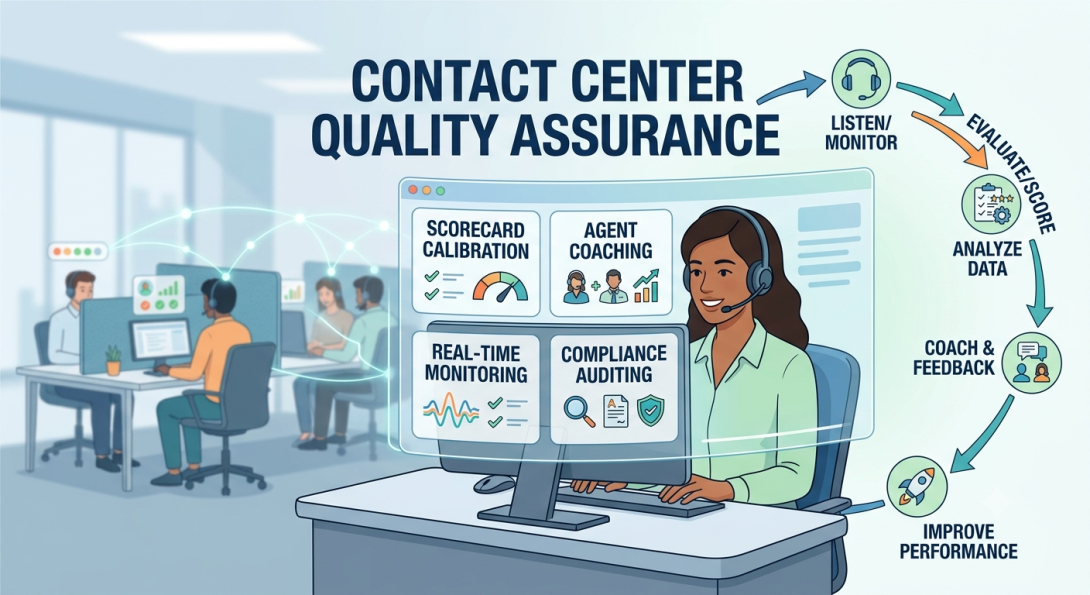
In today’s hyper-competitive business landscape, customer experience (CX) is the ultimate differentiator. For organizations that rely on contact centers to interact with customers, the frontline agents are the brand’s voice. However, ensuring that every customer interaction meets internal standards, regulatory requirements, and brand guidelines is a monumental task.
Traditionally, quality assurance (QA) teams could only manually review a tiny fraction—often less than 2%—of total customer interactions. This left a massive blind spot for compliance risks and missed opportunities for coaching.
Fortunately, the landscape is changing. By integrating smart audit management with advanced AI QMS (Quality Management System) tools, organizations can now monitor 100% of interactions, slash compliance risks, and elevate service quality.
The Evolution of Contact Center Quality Assurance
For years, quality monitoring in call centers followed a rigid, manual playbook. QA analysts would randomly pull a handful of recorded calls per agent each month, grade them against a static scorecard, and provide delayed feedback.
This legacy approach has critical flaws:
- Low Sample Size: Reviewing 2% of calls means 98% of potential compliance violations or unhappy customers go completely unnoticed.
- Human Bias: Manual scoring is subjective, leading to inconsistent evaluations across different QA team members.
- Delayed Feedback: By the time an agent is coached on a mistake made weeks ago, the learning moment has passed.
- High Costs: Manual auditing is labor-intensive and expensive to scale as call volumes grow.
To overcome these hurdles, modern enterprises are turning to a Quality Management Tool for call center operations that leverages artificial intelligence and automated auditing.
How AI QMS and Smart Audit Management Transform Operations
Smart audit management combined with AI redefines how contact centers approach compliance and performance. Here is how these tools drive measurable improvements:
1. 100% Interaction Coverage with Speech Analytics
Relying on random sampling is no longer acceptable in heavily regulated industries like finance, healthcare, and insurance. A robust speech analytics contact center solution automatically transcribes and analyzes every single voice call, chat, and email.
Instead of searching for a needle in a haystack, AI can instantly flag keywords, phrases, compliance disclosures (like "This call may be recorded for quality purposes"), and signs of customer frustration across the entire database of interactions.
2. Automated Compliance and Risk Mitigation
Compliance failures can result in massive fines, legal liabilities, and reputational damage. AI-driven call center quality software acts as a 24/7 digital safety net. It can automatically detect whether agents followed mandatory compliance scripts, read terms and conditions accurately, or engaged in abusive language. If a high-risk interaction occurs, the system can instantly alert supervisors, allowing for rapid remediation.
3. Objective Scoring and Smart Audits
Smart audit management tools streamline the evaluation process by replacing static spreadsheets with dynamic, customizable digital scorecards. AI pre-fills portions of these scorecards based on speech and text analytics. For instance, if an agent successfully verifies a customer's identity, the AI automatically checks that box on the scorecard. This eliminates human error, reduces grading time, and ensures fair, objective evaluations.
4. Data-Driven Coaching and Agent Empowerment
When QA analysts aren't bogged down by manual listening, they can spend their time where it matters most: coaching. Armed with insights from AI QMS tools, supervisors can pinpoint exact training needs for each agent. Whether an agent struggles with empathy, objection handling, or regulatory disclosures, supervisors can pull specific call clips to use as teachable moments. This targeted approach accelerates agent onboarding and boosts overall performance.
Key Features to Look for in Modern QA Tools
If you are looking to upgrade your contact center’s quality and compliance framework, ensure your chosen solution includes the following capabilities:
- Real-Time Guidance: Tools that not only analyze post-call data but also listen in real-time, prompting agents with suggested responses or compliance reminders during live calls.
- Omnichannel Analytics: The ability to audit voice calls, emails, SMS, and chat interactions through a single, unified dashboard.
- Advanced Sentiment Analysis: AI that goes beyond mere keyword spotting to understand the emotional tone of the customer, flagging calls where customer sentiment shifted from positive to negative.
- Customizable Workflows: Automated workflows that route failed audits directly to supervisors for review and trigger remedial training assignments for agents.
Conclusion
Achieving operational excellence in the contact center requires moving away from reactive, manual spot-checks toward proactive, data-driven strategies. By implementing a sophisticated Quality Management Tool for call center environments—powered by speech analytics contact center technology and smart audit workflows—organizations can finally unlock the full value of their customer data.
The result? Uncompromising regulatory compliance, significantly reduced operational risk, highly targeted agent coaching, and ultimately, exceptional customer experiences that build long-term loyalty.