
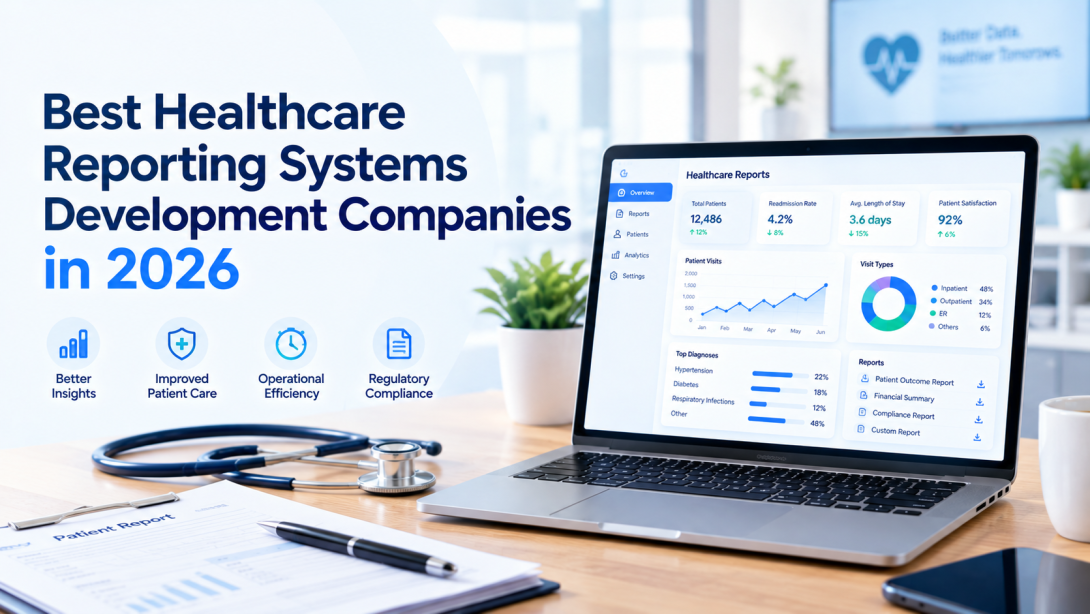
Healthcare organizations generate large volumes of clinical, operational, financial, and patient data every day. Turning that information into useful reports can become difficult as systems and data sources grow.
Healthcare reporting systems development companies help organizations build reporting platforms that bring this information together in a usable form. The right development partner should understand healthcare workflows, data security, interoperability, dashboards, analytics, and reporting requirements. Cost also matters, but it should not outweigh architecture, integration experience, testing, or long-term support.
This list highlights companies with relevant healthcare software and data engineering capabilities. It gives you a practical starting point for comparing vendors before discussing your reporting requirements with shortlisted teams.
How We Selected the Top Healthcare Reporting Systems
Healthcare reporting projects combine data engineering with sensitive clinical information and complex workflows. We considered the factors that can affect reporting accuracy, usability, security, and long-term reliability.
• Industry Experience: Healthcare experience matters because reporting platforms must reflect clinical, administrative, financial, and operational workflows rather than generic business reporting needs.
• Technical Expertise: We considered capabilities across data engineering, backend development, cloud platforms, dashboards, APIs, databases, and analytics that support reporting systems.
• Security & Compliance: Healthcare reports can contain protected information, making secure data handling, access controls, encryption, audit trails, and compliance practices essential.
• Client Reviews: Independent client feedback helps reveal how consistently a provider communicates, handles technical challenges, manages delivery, and supports complex software projects.
• Portfolio & Case Studies: Relevant healthcare, analytics, dashboard, and data platform projects provide stronger evidence of practical experience than broad technology claims.
• Pricing: Hourly rates provide a useful starting point for budgeting, while final project costs depend on data sources, integrations, reporting depth, security, and scope.
• Post-Launch Support: Reporting systems require maintenance as healthcare workflows, source systems, integrations, security requirements, and reporting needs change after deployment.
Top Healthcare Reporting Systems Development Companies
The companies below were selected using healthcare experience, technical capabilities, client feedback, pricing, project background, and available company information. Each offers a different mix of strengths.
1. Citrusbug Technolabs
Citrusbug Technolabs develops healthcare software covering patient-facing platforms, healthcare workflows, integrations, and data-driven applications. Its engineering teams work across backend systems, APIs, cloud infrastructure, databases, and quality assurance.
For reporting products, these capabilities can support data collection, processing, dashboards, role-based access, and integrations with existing healthcare systems.
Why Choose Citrusbug Technolabs for Healthcare Reporting Systems?
- Healthcare Software Engineering: Brings healthcare domain experience to reporting platforms that need to fit existing clinical and operational workflows.
- API-Based Data Connectivity: Supports API development and integrations for connecting reporting applications with other healthcare systems.
- Cloud-Based Architecture: Can build reporting environments using cloud infrastructure designed to support growing data and user requirements.
- Backend & Database Development: Provides the underlying engineering needed for data processing, business logic, and reporting applications.
- QA-Focused Delivery: Includes quality assurance within its development capabilities, which is important for reporting systems where inaccurate outputs can affect operational decisions.
Location- USA, India
Google Rating- 5.0
Clutch Rating- 4.7
Founded Year- 2013
Awards- Clutch, Upwork, ISO
Hourly Rate- $25 - $49
Official Website- https://www.citrusbug.com
2. ScienceSoft
ScienceSoft has worked across healthcare IT, data analytics, business intelligence, and software development. Its healthcare capabilities include clinical systems, patient portals, healthcare analytics, and data-driven solutions.
The company's broader analytics work also covers reporting, dashboards, data integration, and business intelligence, creating a relevant foundation for healthcare reporting projects.
Why Choose ScienceSoft for Healthcare Reporting Systems?
- Healthcare Analytics Expertise: Combines healthcare IT experience with dedicated data analytics and business intelligence capabilities.
- Business Intelligence & Reporting: Supports dashboards, reporting workflows, visualization, and analytical applications for data-driven decision-making.
- Healthcare Data Integration: Can bring information from multiple healthcare sources into analytical environments.
- Clinical & Operational Insights: Its healthcare technology background supports reporting requirements spanning clinical and operational information.
- Long-Standing IT Experience: Founded in 1989, providing extensive experience across healthcare software, analytics, and enterprise technology projects.
Location- McKinney, USA
Google Rating- 5.0
Clutch Rating- 4.8
Founded Year- 1989
Awards- IAOP Global Outsourcing 100, Financial Times - The Americas' Fastest Growing Companies, Inc. 5000
Hourly Rate- $50 - $99
Official Website- https://www.scnsoft.com
3. Andersen Inc.
Andersen Inc. provides custom software development across healthcare, data management, cloud, enterprise applications, and digital transformation. Its healthcare services cover solutions for providers, patients, and other healthcare stakeholders.
The company also works with data-intensive enterprise systems, which can support reporting platforms requiring integrations, structured information, and scalable infrastructure.
Why Choose Andersen Inc. for Healthcare Reporting Systems?
- Healthcare Technology Expertise: Develops software for healthcare providers, patients, and other healthcare stakeholders.
- Enterprise Data Environments: Its enterprise software experience supports reporting platforms operating across complex organizational systems.
- Cloud Engineering: Can provide cloud infrastructure for reporting applications that need scalable processing and storage.
- Data Management Capabilities: Its broader data expertise can support the organization and processing of information used for reporting.
- Digital Transformation Experience: Suitable for healthcare organizations modernizing reporting alongside other legacy or disconnected systems.
Location- Warsaw, Poland
Clutch Rating- 4.9
Founded Year- 2007
Awards- Clutch, IAOP
Hourly Rate- $50 - $99
Official Website- https://andersenlab.com
4. Intellectsoft
Intellectsoft delivers custom software for healthcare and other enterprise industries, with services spanning cloud development, data solutions, mobile applications, and enterprise platforms.
Its healthcare technology work can support organizations that need connected systems, structured information, and digital tools for managing operational processes.
Why Choose Intellectsoft for Healthcare Reporting Systems?
- Enterprise Software Integration: Can connect reporting platforms with existing enterprise applications, APIs, and databases.
- Cloud Development: Supports cloud-based environments for healthcare reporting applications and data workflows.
- Healthcare Software Experience: Its healthcare practice provides domain context for building reporting tools around healthcare processes.
- Custom Data Solutions: Can tailor reporting environments to an organization's specific data and application architecture.
- Connected Enterprise Platforms: Particularly relevant when reporting is one component of a larger healthcare technology ecosystem.
Location- Palo Alto, USA
Google Rating- 4.6
Clutch Rating- 4.8
Founded Year- 2007
Awards- Clutch, ISO, AWS
Hourly Rate- $50 - $99
Official Website- https://www.intellectsoft.net
5. Simform
Simform develops custom software across healthcare, cloud, data, mobile, and web technologies. Its engineering services cover backend systems, cloud infrastructure, data engineering, application development, and digital products.
This technical range can support reporting solutions where data pipelines, application logic, APIs, dashboards, and cloud infrastructure must operate together.
Why Choose Simform for Healthcare Reporting Systems?
- Data Engineering: Provides data engineering capabilities for building the pipelines and infrastructure behind reporting platforms.
- Cloud-Native Development: Combines cloud infrastructure with application engineering for scalable reporting environments.
- Backend Engineering: Supports the processing layer required to collect, transform, and serve healthcare information.
- API Integration: Can connect reporting applications with existing healthcare software and external data sources.
- Full-Stack Technical Coverage: Brings data, cloud, backend, web, and mobile capabilities together for reporting projects requiring multiple technology layers.
Location- Ahmedabad, India
Google Rating- 4.6
Clutch Rating- 4.8
Founded Year- 2010
Awards- Clutch, AWS
Hourly Rate- $25 - $49
Official Website- https://www.simform.com
6. Innowise Group
Innowise Group works on healthcare software, data analytics, cloud solutions, and custom enterprise applications. Its healthcare services cover digital health platforms, clinical solutions, and systems that handle healthcare information.
The company also provides data engineering and analytics services, allowing reporting projects to combine data processing with user-facing applications.
Why Choose Innowise Group for Healthcare Reporting Systems?
- Healthcare + Data Engineering: Combines healthcare software development with dedicated data engineering capabilities.
- Analytics Integration: Can incorporate analytics into reporting platforms rather than treating dashboards as an isolated interface.
- Cloud Data Solutions: Supports cloud-based architectures for healthcare data processing and reporting.
- Clinical Data Applications: Its healthcare practice provides experience working with systems that handle healthcare information.
- Enterprise Application Development: Can connect reporting functionality with larger healthcare applications and business systems.
Location- Warsaw, Poland
Google Rating- 4.6
Clutch Rating- 4.8
Founded Year- 2007
Awards- Clutch recognition, UK Business Tech Awards
Hourly Rate- $50 - $99
Official Website- https://innowise.com
7. N-iX
N-iX provides software engineering services across healthcare, data analytics, cloud, business intelligence, and enterprise applications. Its healthcare practice covers digital health products and solutions for healthcare organizations.
Data engineering and BI capabilities further extend its offering toward systems that collect, process, analyze, and present information for business decisions.
Why Choose N-iX for Healthcare Reporting Systems?
- Healthcare Software Expertise: Develops digital health products and software for healthcare organizations.
- Business Intelligence: Combines healthcare engineering with BI capabilities for analytical and reporting requirements.
- Data Engineering: Supports the data-processing layer required to collect, transform, and prepare information for reporting.
- Cloud Analytics: Can use cloud technologies to support scalable healthcare data and analytics environments.
- Beyond Basic Dashboards: Its combination of data engineering, BI, and healthcare software makes it relevant for reporting platforms that require a complete data-to-insight workflow.
Location- Lviv, Ukraine
Google Rating- 4.8
Clutch Rating- 4.8
Founded Year- 2002
Awards- Clutch, AWS, Forbes
Hourly Rate- $50 - $99
Official Website- https://www.n-ix.com
How to Choose the Best Healthcare Reporting Systems
Your choice should match your data sources, reporting goals, healthcare workflows, compliance needs, and expected system growth.
• Map Your Data Sources: List EHRs, EMRs, laboratory systems, devices, and other sources before discussing architecture. This reveals integration complexity early and helps define requirements for medical billing software development.
• Define Reporting Users: Identify clinicians, administrators, finance teams, executives, and other users. Each group may need different dashboards, permissions, metrics, and reporting schedules.
• Check Interoperability: Ask how the team will connect systems using relevant healthcare standards such as HL7 and FHIR. Integration choices can affect future scalability.
• Plan Data Security: Require encryption, role-based access, audit trails, authentication, and secure data storage. Healthcare reporting can expose sensitive information across many user roles.
• Validate Data Accuracy: Ask how the team will detect missing, duplicated, outdated, or inconsistent records. Reporting decisions are only useful when the underlying data remains trustworthy.
• Discuss Dashboard Performance: Large datasets can slow reports and dashboards. Review caching, indexing, data pipelines, query design, and infrastructure plans before approving the architecture.
• Clarify Ongoing Support: Confirm who handles monitoring, bug fixes, security updates, integration changes, reporting modifications, and infrastructure maintenance after launch.
Before signing a contract, request a technical proposal showing your data flow from source systems to reports. Compare integration plans, security controls, testing methods, architecture, ownership, timelines, and support terms.
Conclusion
Healthcare reporting systems must turn complex information into accurate insights without compromising patient data or disrupting existing workflows. Partner selection therefore affects much more than development speed or interface quality.
Different organizations will have different data sources, users, compliance requirements, and reporting goals. Use this list as a starting point when evaluating healthcare reporting systems development companies, then prioritize proven execution against your specific healthcare environment.
FAQs
What does healthcare reporting system development cost?
Costs vary by scope, but integrations, compliance, dashboards, analytics, and data migration can significantly increase project budgets.
How long does a healthcare reporting system take to build?
A focused reporting MVP may take several months, while multi-system integrations and advanced analytics require longer delivery cycles.
What data can healthcare reporting systems include?
Systems can combine clinical, operational, financial, laboratory, patient, claims, billing, and device-generated data.
Should healthcare reporting systems support HL7 and FHIR?
Support depends on your source systems, but HL7 and FHIR can simplify interoperability with modern healthcare platforms.
How do you protect healthcare reporting data?
Use encryption, role-based access, MFA, audit logs, secure APIs, controlled data storage, and appropriate compliance processes.
What dashboards should a healthcare reporting system include?
Start with role-specific dashboards for clinical, operational, financial, quality, and executive reporting needs.
How can you improve healthcare reporting accuracy?
Use validation rules, data-quality checks, reconciliation, audit trails, duplicate detection, and clearly defined reporting metrics.
When should analytics be added to a reporting platform?
Define analytics requirements during discovery so your data model, pipelines, architecture, and dashboard design support future analytical needs.