

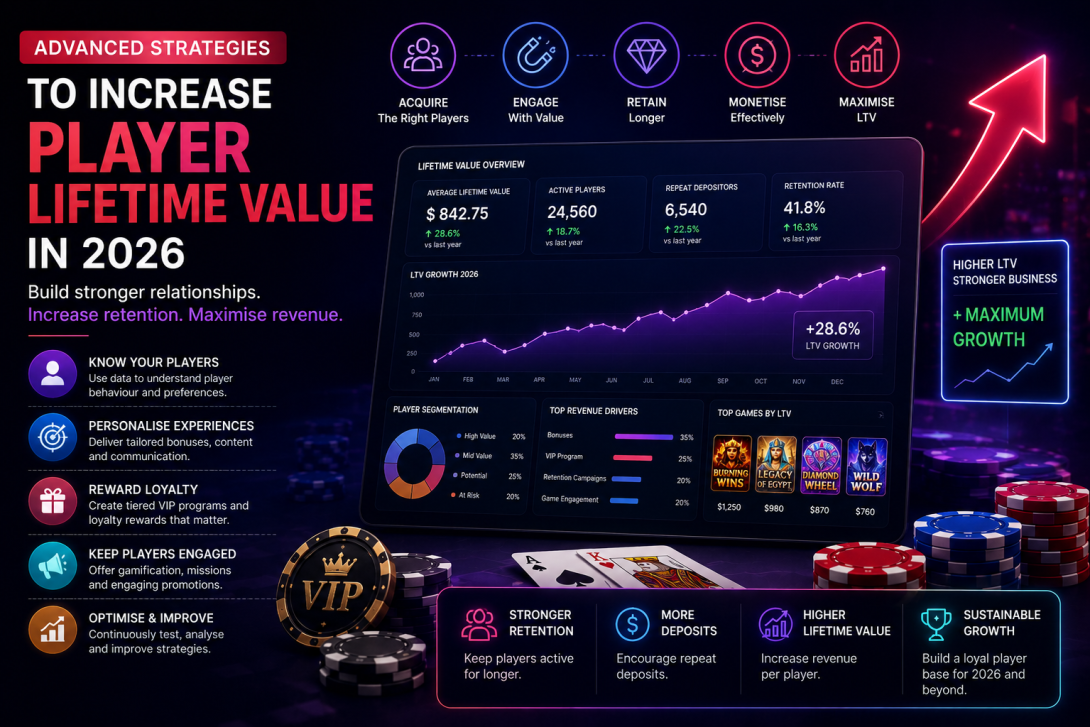
Player lifetime value is no longer improved by sending more bonuses to more people. In 2026, the strongest operators increase value by understanding each player earlier, reducing friction, improving product relevance and building trust over time.
The goal is not to push players towards heavier gambling. It is to create a safer, smoother and more relevant experience that encourages suitable customers to remain active for longer. Rising acquisition costs and higher expectations for personalisation make this approach increasingly important for profitable growth.
What Is Player Lifetime Value?
Player lifetime value, often shortened to player LTV, estimates the commercial value a player generates during their relationship with an iGaming brand.
A simple starting formula is:
Player LTV = average monthly contribution × average active lifespan
Contribution should reflect real value after relevant variable costs. Deposits should not be treated as revenue. A more useful model considers net gaming revenue, bonus costs, payment charges, game provider fees, affiliate costs, fraud losses and support costs.
This gives operators a clearer view of profitable value, rather than headline activity.
How Can Operators Increase Player Lifetime Value?
To increase player lifetime value in 2026, operators should:
- predict likely value and churn earlier;
- personalise journeys using real-time behaviour;
- optimise bonuses for incremental value;
- remove payment, verification and navigation friction;
- create relevant loyalty and gamification journeys;
- improve game and product discovery;
- intervene before valuable players disengage;
- use responsible gambling controls as a core product feature; and
- measure contribution margin, not deposits or wagering alone.
The best results come when these strategies work together through one connected platform.
1. Build a Contribution-Based LTV Model
Many operators still calculate LTV using average revenue per player multiplied by retention time. That can be useful for a quick estimate, but it can hide the true cost of maintaining the relationship.
A more advanced model should calculate value at player, cohort and market level. A cohort is simply a group of players who share a common feature, such as registration month, acquisition source or first product used.
Include the following costs where relevant:
- bonuses and free bets;
- payment processing;
- game provider charges;
- affiliate commission;
- customer support;
- fraud and chargebacks;
- tax and regulatory costs; and
- promotional communication.
This approach may show that a high-deposit player is less profitable than a moderate player who needs fewer incentives, uses lower-cost payment methods and remains active for longer.
Practical Action
Create separate 30-day, 90-day and 180-day contribution LTV views. Compare them by country, affiliate, campaign, product and first deposit method.
This will reveal where profitable player relationships are actually coming from.
2. Predict Value During the Early Player Journey
Waiting three months to identify a valuable player is too slow. By then, the operator may already have delivered an irrelevant experience or missed signs of disengagement.
Early prediction models can use signals such as:
- registration and verification completion;
- first deposit timing;
- payment success or failure;
- first-week session frequency;
- preferred game categories;
- response to the welcome journey;
- use of search and filters;
- customer support contact; and
- changes in normal playing behaviour.
Predictive modelling does not need to be a mystery. It is simply a structured way to estimate a likely future outcome from past and current data.
In 2026, operators are increasingly using predictive analytics to identify high-value players and possible churn before inactivity becomes obvious.
Keep the Model Safe and Useful
Do not use sensitive personal characteristics to decide commercial treatment. Separate commercial value models from responsible gambling risk models, apply clear access controls and keep human review for important decisions.
3. Replace Broad Segments With Player States
Traditional labels such as new, active, lapsed and VIP are often too broad. Two active players may have completely different needs.
A more useful approach is to combine value, intent and current player state. Examples include:
- a new player with strong early engagement;
- a regular player with falling session frequency;
- a high-potential player facing payment friction;
- a loyal slots player exploring live casino;
- a bonus-sensitive player with low contribution;
- a valuable player with an unresolved support issue; and
- a player showing possible signs of harmful play.
These states should update as behaviour changes. This lets the operator respond to what is happening now, rather than relying on a label assigned weeks earlier.
4. Use Next-Best-Action Personalisation
Next-best-action personalisation means choosing the most suitable message, offer or product step for a player at a particular moment.
The correct action is not always a bonus. It may be:
- a reminder that verification is incomplete;
- a faster route to a favourite game;
- an explanation of withdrawal timing;
- a relevant loyalty milestone;
- a service message after a failed payment;
- a recommendation based on genuine game preferences;
- an invitation to set a deposit or session limit; or
- no message at all.
Real-time personalisation is more effective when the platform combines player activity, payments, customer relationship management and support data.
Playage Gaming, for example, presents player management, targeted campaigns, automated bonus journeys and churn detection within its platform tools.
5. Optimise Bonus Spend for Incremental Value
Bonus redemption is not proof of success. A player may claim an offer even when they would have returned without it.
The real question is: Did the incentive create additional profitable activity?
To answer this, use a control group. This is a small, comparable group that does not receive the promotion.
Compare both groups after the campaign using:
- incremental net gaming revenue;
- contribution after bonus cost;
- retention after 30 and 90 days;
- number of additional active days;
- withdrawal and complaint rates; and
- responsible gambling risk indicators.
This prevents teams from rewarding activity that would have happened anyway.
Improve Bonus Decision-Making
Set a maximum expected bonus cost for each player state. Use smaller or non-cash rewards when they can achieve the same objective.
Stop repeated offers when a player is only active during promotions or when incentives produce no lasting value.
Reward systems in 2026 are becoming more selective, with offers increasingly shaped by player value, session patterns and behaviour rather than broad distribution.
6. Remove Friction From Payments and Verification
A sophisticated loyalty programme cannot compensate for a failed deposit, confusing verification request or slow withdrawal.
Payment and verification data should be part of the LTV strategy because these moments strongly affect trust. Review:
- deposit success by payment method and device;
- time taken to complete verification;
- withdrawal processing time;
- payment-related support contacts;
- rejected transaction reasons;
- unexpected fees; and
- abandonment during the cashier journey.
Local payment methods, clear verification instructions and reliable withdrawals can improve confidence and reduce preventable churn.
The ability to support a wide range of payment preferences is also important when operating across several markets.
7. Design Loyalty Around Progress, Not Just Spend
A strong loyalty programme gives players a reason to return without making every interaction dependent on deposit size.
Useful mechanics include:
- progress levels;
- opt-in missions;
- collection features;
- personalised challenges;
- milestone rewards;
- early access to suitable content;
- service benefits; and
- recognition for long-term membership.
The experience should be easy to understand. Players need to know how progress works, what they can earn and when rewards expire.
Gamification has become a core retention tool because visible goals, missions and progression can create continuity between sessions. However, these features should include responsible gambling controls and should not encourage players to chase losses.
8. Improve Content Discovery
More games do not automatically create more value. Players need to find suitable content quickly.
Use personalisation to improve:
- homepage ordering;
- game recommendations;
- search results;
- recently played lists;
- favourites;
- provider filters;
- category pages; and
- new game discovery.
Recommendations should consider actual preferences, device type, market rules and session context. They should not simply promote the games with the highest commercial margin.
Cross-product recommendations can also help when they are relevant. For example, a sportsbook player who has previously used live casino may respond to a live event promotion.
A slots-only player should not receive constant messages about products they have never shown an interest in.
9. Treat Customer Support as a Retention Channel
Support data often contains early signs of churn that marketing systems miss.
A player who contacts support twice about the same withdrawal, account restriction or bonus term may still appear active. However, the relationship is already at risk.
Connect support outcomes to the player profile and track:
- repeated contacts;
- unresolved cases;
- response time;
- customer sentiment;
- payment complaints;
- verification issues; and
- requests for account controls.
High-value service does not always mean a dedicated account manager. Fast, accurate and respectful support can be more valuable than another promotion.
10. Prevent Churn Before Inactivity Begins
Churn is the point at which a player stops engaging with the brand. A useful churn system should identify changes before the player becomes fully inactive.
Possible early signals include:
- fewer sessions;
- shorter visits;
- failed payments;
- reduced product variety;
- abandoned withdrawals;
- fewer searches;
- ignored messages;
- repeated support issues; and
- changes from the player’s normal routine.
The response should match the cause. A technical problem needs service support. Reduced interest may call for better content discovery.
A player showing risk indicators may need safer gambling messaging, limits or a pause from marketing.
Playage Gaming describes its Churn AI tool as a way to identify players who may be preparing to leave, allowing teams to act earlier with more relevant lifecycle management.
11. Make Responsible Gambling Part of Sustainable LTV
Responsible gambling should never be treated as a barrier to commercial performance. A safer experience can strengthen trust, reduce harmful engagement and support a more sustainable customer relationship.
Operators should combine:
- visible deposit, loss and session controls;
- straightforward cooling-off options;
- clear account history;
- real-time risk monitoring;
- trained human intervention;
- suppression from unsuitable campaigns; and
- transparent information about how player data is used.
Current industry thinking places real-time monitoring, personalised controls and proactive intervention directly within onboarding, gameplay and retention journeys.
A player identified as at risk should not be targeted with bonuses, VIP upgrades or reactivation pressure. Commercial models must always sit behind player protection rules.
12. Check Whether the Platform Can Support the Strategy
Advanced LTV optimisation depends on connected data and fast execution. If player, payment, bonus, support and game activity sit in separate systems, teams will struggle to build a consistent view.
Operators should assess whether their platform can support:
- unified player profiles;
- live segmentation;
- automated journeys;
- churn alerts;
- responsible gambling controls;
- flexible reward rules;
- accurate reporting;
- controlled testing; and
- market-specific configuration.
A broader guide on how operators can stay competitive in the evolving iGaming market explains why data, mobile performance, payments and scalable technology matter for long-term growth.
When the existing technology cannot support these requirements, an upgrade may be more practical than adding another disconnected tool.
Operators considering that step can use this online casino platform migration guide to review planning, data transfer, testing and post-launch monitoring.
13. Measure the Right Outcomes
A successful LTV programme should improve profit and experience without weakening player protection.
Commercial Measures
Track:
- 30-day, 90-day and 180-day contribution LTV;
- retention by player state;
- incremental revenue from campaigns;
- bonus cost per additional active day;
- payment success;
- product adoption; and
- support cost per active player.
Experience Measures
Track:
- verification completion time;
- withdrawal processing time;
- complaint rate;
- support resolution time;
- mobile journey completion; and
- player satisfaction.
Player Protection Measures
Track:
- marketing suppression accuracy;
- limit-setting uptake;
- risk escalation rates;
- intervention outcomes; and
- self-exclusion trends.
Never judge success from a single number. Higher short-term revenue combined with more complaints, risky behaviour or bonus cost is not a genuine improvement.
A Practical 90-Day LTV Plan
Days 1 to 30: Fix the Measurement
Agree on one contribution-based LTV definition. Audit data quality, map the player journey and identify the largest points of friction.
Days 31 to 60: Build Priority Player States
Create a small number of useful states based on value, intent, churn risk and player protection. Connect them to clear actions.
Days 61 to 90: Test and Scale
Launch controlled tests for onboarding, payments, content discovery, loyalty and churn prevention.
Scale only the treatments that create incremental value and pass player protection checks.
Frequently Asked Questions
What Is a Good Player Lifetime Value in iGaming?
There is no universal figure. A good LTV depends on the market, product, tax structure, acquisition source, bonus cost and operating model.
Operators should compare contribution LTV across similar cohorts rather than rely on a general industry benchmark.
How Can an Online Casino Increase Player LTV?
An online casino can increase LTV by retaining suitable players for longer, improving product relevance, reducing payment and service friction, controlling bonus costs and strengthening trust through responsible gambling measures.
Does Personalisation Increase Player Lifetime Value?
Personalisation can improve LTV when it makes the experience more relevant and removes unnecessary communication.
It should be based on clear consent, reliable data and player protection rules.
Which Metrics Should Be Used With Player LTV?
Useful supporting metrics include retention, churn, contribution margin, bonus cost, payment success, active days, product adoption, support contacts and responsible gambling indicators.
Can AI Improve Casino Player Retention?
Yes. Artificial intelligence can help identify churn signals, predict likely value and select relevant actions.
It still needs accurate data, clear rules, regular testing and human oversight.
Final Thoughts
Increasing player lifetime value in 2026 is not about extracting more from every session. It is about creating a better relationship between the player and the platform.
Operators that combine accurate measurement, early prediction, relevant personalisation, smoother payments, stronger support and responsible gambling controls can build more sustainable growth.
The technology matters, but the strategy must begin with player needs, commercial discipline and trust.
Playage Gaming brings player management, customer relationship management, payments, retention tools and churn detection into one connected iGaming platform, giving operators the foundation needed to manage the full player lifecycle more effectively.