

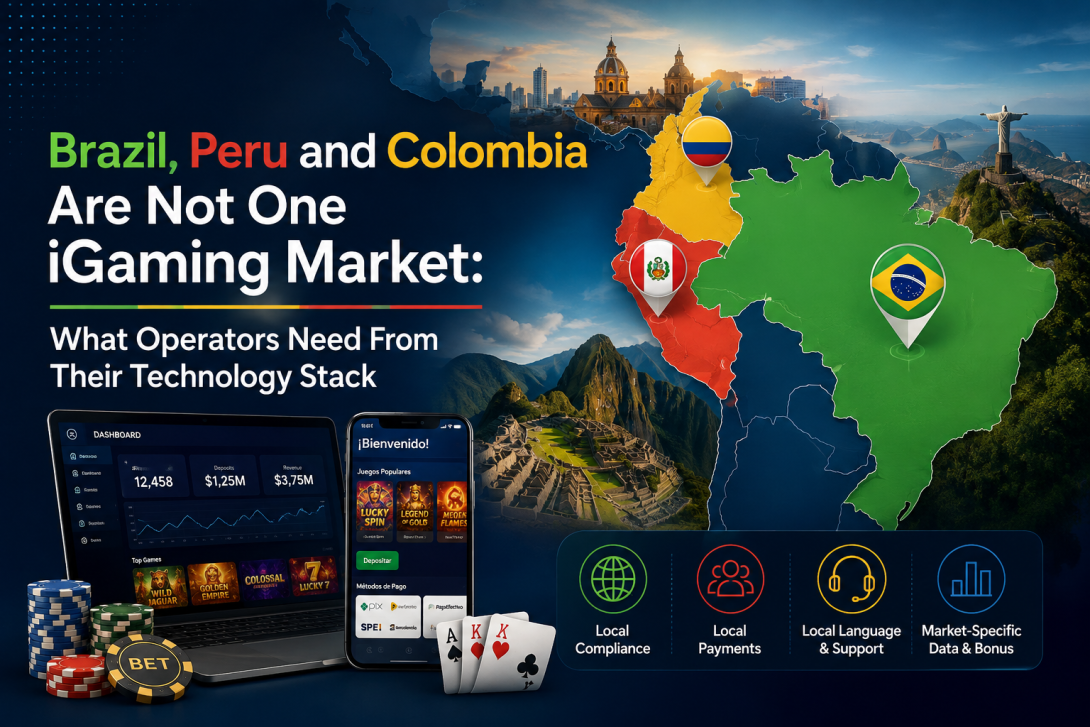
“Latin America” is often treated as a single line in an expansion plan. From a technology perspective, that can be misleading. Brazil, Peru and Colombia each illustrate a different regulatory and operational environment for online betting and gaming. An operator that intends to serve more than one of these markets should therefore evaluate whether its platform can support separate regulatory configurations, data flows, payment setups, player controls and content policies without creating three disconnected businesses.
The purpose of this comparison is not to provide legal advice. It is to show why regulation becomes a technology requirement. As of August 2026, the three markets have distinct authorities and frameworks, and those differences affect how an operator should plan its stack.
Brazil: federal authorization, .bet.br and an active regulatory programme
Brazil's federally regulated fixed-odds betting framework is overseen by the Secretaria de Prêmios e Apostas (SPA) within the Ministry of Finance. The SPA states that since 1 January 2025 only companies authorized by the SPA may operate nationally under the federal framework, and federally authorized betting sites use the .bet.br extension.
The Ministry's legislation index shows why operators should expect ongoing compliance work rather than a one-time launch exercise. The framework includes rules and updates touching authorization, technical systems, payments, anti-money-laundering controls, responsible gambling, marketing, monitoring and reporting.
For technology buyers, Brazil therefore raises practical questions: Can the platform support the required domain and brand structure? Can player restrictions and responsible-gambling controls be configured? Can the operator produce the data and reports expected by the regulator? Are payment flows and PSP relationships compatible with the legal model? Can changes be made quickly when rules evolve?
Peru: authorized platforms, registered components and certification
Peru regulates remote games and remote sports betting under Law No. 31557, as amended, and the regulation approved by Supreme Decree No. 005-2023-MINCETUR. The MINCETUR remote-gaming portal maintains information on authorization holders, technological platforms, game programs, live-casino modalities, certification laboratories and connected service providers.
MINCETUR also provides a formal process for the authorization and renewal of technological platforms. In 2026 the authority reminded authorization holders of requirements around integral platform audits by authorized certification laboratories, reinforcing the point that the platform itself is part of the regulated operating environment.
For an operator, this changes vendor due diligence. It is not enough to ask whether a provider can technically deliver casino and sportsbook functions. The operator needs to understand which components have been or can be certified, how integrations are documented, who is responsible for submissions and changes, and how future versions are managed.
Colombia: concession model and detailed internet-gaming requirements
Colombia has regulated internet-operated games through Coljuegos for years. The authority's operator authorization guidance lists documentation and conditions including certification of compliance with technical requirements by an authorized laboratory.
Coljuegos has also been updating the technical architecture for internet-operated games, emphasizing data management, transaction traceability and technology security. Its technical-requirements programme is a reminder that regulated platform architecture is not static.
For technology procurement, Colombia highlights the importance of certified systems, structured data, reporting, security and the operator's ability to demonstrate that its platform configuration matches the authorized model.
What these three markets have in common
The legal details differ, but the operational lesson is similar: regulation reaches into technology. A serious multi-market platform strategy should assume that each country may require its own combination of configuration, documentation, integrations, monitoring and reporting.
That creates six areas operators should test before selecting a platform.
1. Market-specific configuration
Country rules should not be hard-coded into one global setup. Operators need the ability to control domains, currencies, payment availability, game visibility, limits, bonuses, terms and player journeys by market.
2. Data and reporting
Regulators may require structured operational data, transaction records, player information or periodic reporting. The platform should produce reliable audit trails and allow the operator to separate markets cleanly rather than reconstructing records from several tools.
3. Certification and version control
When platforms, games, integrations or security controls are subject to certification, product releases need governance. Operators should know whether a software change triggers testing, who maintains evidence, and how certified components are distinguished from development versions.
4. Player protection and responsible gambling
Player-protection requirements can include self-exclusion, account controls, restrictions on certain participants, limits, messaging, marketing rules and intervention processes. These cannot be treated as static website pages; they often require system behaviour.
5. Payments and financial controls
Payment regulations and local payment habits both affect implementation. The stack should allow permitted methods to be configured by market, provide transaction monitoring and maintain a clear record of deposits, withdrawals, failures, reversals and manual decisions.
6. Operational permissions
Regulated businesses need controlled access. Role-based permissions, activity logs and separation of duties help an operator demonstrate who changed what, who approved a transaction and which users can access sensitive player or financial data.
Why a single platform can still make sense
Different regulations do not automatically mean an operator needs a completely different platform in every country. In fact, a well-designed shared platform can reduce operational fragmentation if it supports genuine market-level configuration.
A turnkey casino solution can be useful when the operator wants the core platform, game integrations, payment management, backend, CRM, affiliate tools and CMS to work together. The value is not that regulation disappears. The value is that approved market-specific changes can be implemented on top of one controlled technology base.
The opposite is also true: a platform that only supports one global configuration can become a liability. Teams then compensate with manual spreadsheets, external marketing tools, duplicated wallets, separate reporting databases and country-specific workarounds. That increases both cost and compliance risk.
Questions to ask a platform provider
1. Which regulated LATAM markets have you technically supported, and what exactly did that support include?
2. Which parts of certification are handled by the operator, provider, game supplier and laboratory?
3. Can games, payments, currencies, limits, promotions and content be configured independently by country?
4. How are regulatory data exports and audit trails produced?
5. How do you control software versions and changes in certified environments?
6. Can player-protection rules be configured by jurisdiction?
7. How are role permissions and operational approvals recorded?
8. What happens technically when the regulator changes a requirement?
9. Can casino and sportsbook share one wallet while maintaining market-specific controls?
10. What evidence can you provide during due diligence beyond a sales presentation?
Operators unfamiliar with the overall procurement model may first review a turnkey casino solution guide and then add a separate regulatory-technology checklist for each target country.
The real meaning of “LATAM-ready”
A provider should not be considered LATAM-ready because it offers Spanish, Portuguese or a list of regional payment methods. Those are important, but regulated-market readiness goes deeper. It is the ability to support different operating rules, certified components, data requirements, player controls and local commercial configurations while keeping the business manageable.
Brazil, Peru and Colombia make that distinction visible. They are geographically connected, but they are not one compliance environment. Operators that design their technology strategy around that fact are in a stronger position to expand without rebuilding the business country by country.
Regulatory requirements change. Operators should verify current rules directly with the relevant authority and obtain advice from qualified legal and compliance professionals before entering or changing operations in any jurisdiction.
B2B information notice: This article is for general industry information and does not constitute legal, regulatory, tax or financial advice. Requirements vary by jurisdiction and change over time. Operators should verify current rules with the relevant authority and qualified advisers before launch.