
Wireless Infrastructure Market Overview Analysis By Fortune Business Insights
Market Size & Future Outlook
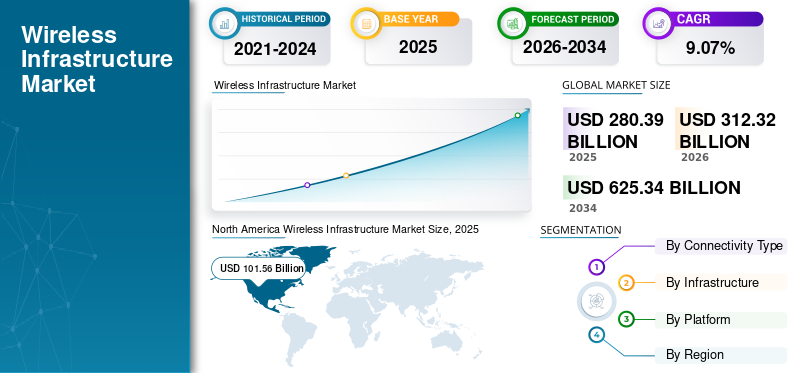
According to Fortune Business Insights: The global wireless infrastructure market size was valued at USD 280.39 billion in 2025 and is projected to grow from USD 312.32 billion in 2026 to USD 625.34 billion by 2034, exhibiting a CAGR of 9.07%. North America dominated the market with a 36.22% share in 2025, valued at USD 101.56 billion.
Market Overview
Wireless infrastructure comprises the radio networks, base stations, small cells, distributed antenna systems (DAS), backhaul, and supporting software that carry mobile and wireless traffic. It spans 2G through 5G and satellite connectivity, and serves commercial networks as well as government and defense users. Network operators, enterprises, and public-sector buyers are the main customers.
Get a Sample Research PDF: https://www.fortunebusinessinsights.com/enquiry/request-sample-pdf/102741
Market Drivers
- High-speed connectivity: Demand continues to rise for fast, reliable mobile connections.
- 5G rollouts: Operators are expanding 5G coverage and capacity.
- IoT growth: The page cites about 1.9 billion connected devices in 2024, per Ericsson.
- Defense and aerospace: Electronics demand from these sectors adds to growth.
Market Restraints
- High design and development costs: Equipment is expensive to engineer and deploy.
- Standardization delays: Slow standards work holds back rollouts.
- Signal obstruction: Physical barriers degrade performance.
- Security and privacy concerns: These affect adoption.
- Wired comparison: Wireless speed and efficiency still trail wired networks.
Market Trends
- Densification: More small cells are deployed.
- OpenRAN and virtualized RAN: Open, software-based radio networks are gaining ground.
- Edge: Multi-tenant edge data centers are emerging.
- Spectrum repurposing: 850 MHz and 1900 MHz bands are moving from 2G and 3G to 5G.
- DAS: Distributed antenna systems are used in large venues.
Segmentation Analysis
By Connectivity: Satellite holds 39.75% in 2026. 5G is the fastest-growing segment, with no share given. 4G and LTE are also covered.
By Infrastructure: Macro cells hold the largest share, at 21.37% in 2026.
By Platform: Commercial holds 23.80% in 2026. Government and defense is also covered, without a 2026 figure.
Regional Analysis
North America leads with USD 101.56 billion in 2025 (36.22%), projected at USD 112.33 billion in 2026. The U.S. is projected at USD 95.96 billion.
Europe holds 27.80%, with USD 77.94 billion in 2025 and USD 87.07 billion projected in 2026. The U.K. is projected at USD 24.54 billion and Germany at USD 22.01 billion.
Asia Pacific holds 23.32%, with USD 65.38 billion in 2025 and USD 73.7 billion projected in 2026. China is projected at USD 28.62 billion, India at USD 16.94 billion, and Japan at USD 13.29 billion.
Connect with Our Expert for any Queries: https://www.fortunebusinessinsights.com/enquiry/speak-to-analyst/102741
Competitive Landscape & Key Developments
Key players named include Huawei, Samsung, Ericsson, Nokia, Cisco, Qualcomm, ZTE, and NEC. Profiled companies also include Capgemini Engineering, Ciena, D-Link, Fujitsu, and NXP Semiconductor. Strategies center on mergers, joint ventures, acquisitions, product launches, and OEM partnerships.
Notable developments include:
- Ericsson and Verizon signing a multi-year 5G deal valued at USD 8.3 billion (July 2021).
- Vodafone selecting Capgemini Engineering for an Open RAN deployment in Europe (June 2021).
- Cisco and Telenor signing the fourth Joint Purpose Agreement (April 2022) and expanding it in a fifth iteration (March 2023).
- NPPGov and TESSCO Technologies announcing a partnership (May 2023).
- Baylin Technologies completing its acquisition of Kaelus AB (May 2026).
- MaxLinear launching its Trinity wireless backhaul platform (May 2026).
- Arium Networks launching after EQT acquired Crown Castle's Small Cell and Venue business (May 2026).
Outlook Summary
The wireless infrastructure market is positioned for steady growth through 2034, led by North America and driven by 5G rollouts, IoT, and defense and aerospace demand. High development costs, standardization delays, and security concerns remain restraints, but Open RAN, small-cell densification, edge computing, and spectrum repurposing are expected to sustain expansion.
Explore Japan’s Market Opportunities - Latest Wireless Infrastructure Market Insights