
Vehicle Software Lifecycle Management Market Overview Analysis By Fortune Business Insights
Market Size & Growth Outlook
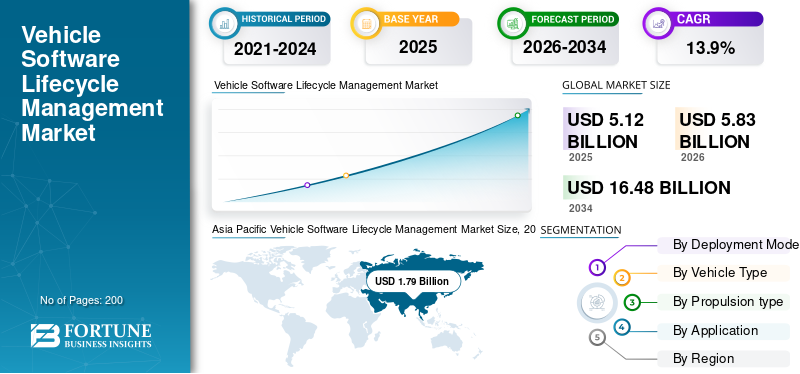
According to Fortune Business Insights: The global vehicle software lifecycle management (SLM) market was valued at USD 5.12 billion in 2025 and is projected to grow from USD 5.83 billion in 2026 to USD 16.48 billion by 2034, at a CAGR of 13.9% during the forecast period. Asia Pacific dominated the global market with a 34.96% share in 2025, valued at USD 1.79 billion, followed by Europe as the second-largest region and North America in third position.
Vehicle software lifecycle management encompasses the solutions and services that govern software from development and testing through deployment, over-the-air (OTA) updates, maintenance, and eventual retirement. These platforms enable automakers and suppliers to streamline software integration, ensure cybersecurity compliance, support regulatory requirements, and maintain continuous vehicle performance across increasingly complex software-defined vehicle architectures. The growing deployment of connected, electric, and autonomous vehicles — each requiring extensive embedded software management — is fundamentally reshaping the automotive software development landscape and driving accelerating demand for lifecycle management platforms.
Get a Sample Research PDF: https://www.fortunebusinessinsights.com/enquiry/request-sample-pdf/117741
Market Trends
The defining trend shaping the market is the growing integration of artificial intelligence (AI), machine learning, and DevOps methodologies into automotive software development processes. Automotive companies are increasingly adopting AI-driven analytics for predictive maintenance, automated testing, defect detection, and software optimization. DevOps practices are simultaneously enabling continuous integration and continuous deployment (CI/CD) pipelines, helping automakers accelerate software release cycles while improving system reliability. Cloud-native development platforms and digital twin technologies are gaining traction for real-time simulation and validation of vehicle software systems — supporting faster product updates, enhanced cybersecurity monitoring, and improved software quality management. As software-defined vehicles become mainstream, manufacturers are prioritizing intelligent and automated lifecycle management frameworks to remain competitive.
Market Drivers
Rising Adoption of Connected and Software-Defined Vehicles: The growing deployment of connected, electric, and software-defined vehicles is the primary market growth driver. Automakers are integrating advanced software platforms to support infotainment, autonomous driving, battery management, and vehicle connectivity features, significantly increasing software complexity and the need for efficient lifecycle management solutions. OTA software updates have become essential for delivering real-time enhancements, security patches, and feature upgrades without requiring physical dealership servicing, further accelerating platform adoption. The increasing collaboration between OEMs and software providers is expected to strengthen market demand globally over the forecast period.
Regulatory Cybersecurity Compliance: Tightening vehicle cybersecurity regulations — including international standards such as ISO/SAE 21434 and regional mandates across Europe, North America, and Asia — are compelling automakers to invest in lifecycle management platforms with integrated security monitoring, vulnerability management, and compliance reporting capabilities. Ensuring software integrity across vehicle fleets through structured lifecycle processes is increasingly a regulatory requirement rather than an optional operational enhancement.
Market Restraints & Challenges
High Integration Complexity and Development Costs: The primary restraint is the substantial complexity of integrating software management platforms into existing automotive architectures. Modern vehicles contain numerous Electronic Control Units (ECUs), sensors, and connected systems requiring seamless interoperability. Small and mid-sized automotive manufacturers often struggle with the significant costs associated with software development infrastructure, cybersecurity frameworks, cloud deployment, and continuous testing environments. A shortage of skilled software engineers and cybersecurity professionals further limits efficient implementation and slows adoption.
Rising Cybersecurity Risks: Connected vehicles continuously exchange large volumes of sensitive data through cloud platforms, wireless networks, and OTA update systems, making them vulnerable to hacking, malware, and unauthorized access. As vehicle software environments grow more complex, cyberattacks targeting infotainment systems, autonomous driving functions, and vehicle control systems are becoming increasingly sophisticated. Varying cybersecurity regulations across regions also create compliance complexity for global automakers and software platform providers, adding operational burden and development cost.
Segmentation Analysis
By Deployment Mode: On-premises solutions dominate the market, reflecting the automotive industry's strong focus on data security, intellectual property protection, and direct infrastructure control. Major OEMs and Tier-1 suppliers prefer on-premises deployment for managing sensitive vehicle software, cybersecurity operations, and complex integration with existing enterprise and manufacturing platforms. The cloud-based segment is projected to grow at a CAGR of 12.6% through 2034, driven by rising demand for scalable software development, remote OTA update management, AI-driven analytics, and cross-team collaboration capabilities.
By Vehicle Type: The SUV segment leads the market, reflecting strong global consumer demand for connected, premium, and feature-rich utility vehicles. SUVs increasingly integrate ADAS, infotainment platforms, telematics, and OTA software capabilities, requiring higher software management investment. The hatchback and sedan segment is expected to grow at a CAGR of 11.2%, supported by the growing adoption of connected features and OTA updates in compact urban passenger vehicles.
By Propulsion Type: The ICE segment dominates due to the large global fleet of internal combustion engine vehicles and their ongoing integration of advanced infotainment, telematics, driver assistance, and connected vehicle platforms. The BEV segment is the fastest-growing propulsion category at a CAGR of 14.5% through 2034, driven by rising electric vehicle adoption globally and the inherently software-intensive nature of battery management, OTA updates, and autonomous driving features in EVs.
By Application: The OTA software updates segment leads the market, driven by the growing need for remote software deployment, performance optimization, and cybersecurity enhancements in connected vehicles without requiring dealership visits. This capability reduces maintenance costs, improves customer convenience, and supports continuous vehicle feature expansion. The autonomous driving software management segment is the fastest-growing application, projected at a CAGR of 15.3%, as the development of AI-driven autonomous systems creates strong demand for continuous software monitoring, validation, and lifecycle management.
Regional Outlook
Asia Pacific leads the global market with a 34.96% share in 2025 (USD 1.79 billion), driven by strong automotive production, rapid EV adoption, and increasing deployment of connected vehicle technologies across China, Japan, South Korea, and India. Government smart mobility initiatives, large semiconductor and electronics manufacturing ecosystems, and heavy OEM investment in software-defined vehicle platforms sustain the region's dominant position. China is the region's largest contributor, estimated at USD 0.96 billion in 2026, while Japan is projected at USD 0.26 billion.
Europe holds the second-largest share and is projected to grow at a CAGR of 14.2% through 2034, supported by a strong premium automotive manufacturing base, strict regulatory mandates on vehicle safety and cybersecurity, and rising EV and autonomous vehicle production. Germany leads the region at an estimated USD 0.43 billion in 2026, driven by premium OEM investment in software-defined vehicle architectures. The UK follows at USD 0.25 billion.
North America represents the third-largest market, with the U.S. estimated at USD 1.46 billion in 2026 — the largest single-country contributor globally — fueled by advanced autonomous vehicle development, AI-driven automotive software innovation, and expanding cloud-based lifecycle management deployments by major OEMs and technology firms.
Middle East & Africa is experiencing gradual growth, with the UAE estimated at USD 0.11 billion in 2026, supported by smart city projects, growing EV adoption, and government-led connected mobility investments. Latin America is growing steadily, with Brazil estimated at USD 0.08 billion in 2026, driven by rising automotive digitalization, fleet management adoption, and growing connected vehicle demand.
Connect with Our Expert for any Queries: https://www.fortunebusinessinsights.com/enquiry/speak-to-analyst/117741
Competitive Landscape
The global vehicle SLM market is highly competitive, with leading players including Siemens AG, Robert Bosch GmbH, Elektrobit Automotive GmbH, Vector Informatik GmbH, IBM Corporation, Microsoft Corporation, PTC Inc., Wind River Systems, BlackBerry QNX, KPIT Technologies, Tata Elxsi, HARMAN International, Capgemini, Intellias, and Synopsys competing through cloud-based platforms, OTA capabilities, AI-driven tools, and cybersecurity solutions.
Key recent developments include Bosch and Qualcomm's April 2026 expanded collaboration on ADAS and cockpit computing for software-defined vehicles, with Bosch surpassing 10 million cockpit computer deliveries; Siemens' January 2026 launch of PAVE360 Automotive, a cloud-based digital twin platform for SDV development in partnership with AMD and Microsoft; Elektrobit and Mobileye's February 2026 collaboration integrating EB corbos Linux for Safety into Mobileye's Level 4 autonomous driving platform; Wind River's partnership with Hyundai Mobis in September 2025 to launch Mobis Development Studio for SDV creation; and Vector Informatik and Synopsys' March 2025 strategic collaboration for digital twin and software factory integration in automotive lifecycle development.