
Vegan Food Market Overview Analysis By Fortune Business Insights Analysis
Market Size & Growth Outlook
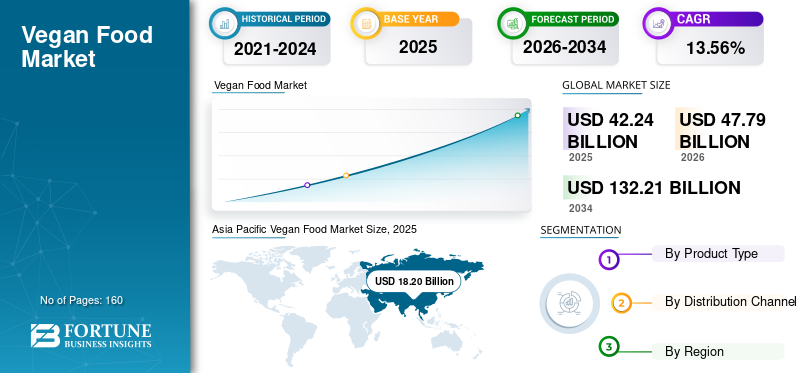
According to Fortune Business Insights: The global vegan food market was valued at USD 42.24 billion in 2025 and is projected to grow from USD 47.79 billion in 2026 to USD 132.21 billion by 2034, exhibiting a CAGR of 13.56% during the forecast period. Asia Pacific dominated the market with a 43.10% share in 2025. The U.S. market is projected to reach an estimated USD 26.90 billion by 2032, driven by increased awareness of veganism and rising adoption of vegan diets among consumers.
Rising consumer demand for meat substitutes and alternative dairy products is expected to boost product adoption. A vegan diet eliminates animal products in favor of plant-based foods, which are rich in antioxidants, fiber, plant compounds, and vitamins A, C, and E. Vegetarians and vegans consume significantly more legumes, fruits, vegetables, tomatoes, allium vegetables, and fiber, which helps protect the body against certain health risks, including cancer. These benefits are attracting new consumers toward the diet.
The COVID-19 pandemic significantly affected consumer dietary behavior. In the early stages, consumers stockpiled food products, including both meat-based and meat-free items, which strained production and supply. Companies gradually ramped up production to meet growing demand for vegan food.
Get a Sample Research PDF: https://www.fortunebusinessinsights.com/enquiry/request-sample-pdf/106421
Market Trends
Increasing Health Consciousness among Consumers: As consumers lead more sedentary lifestyles, health complications such as obesity and cardiovascular disease are growing. Adopting a vegan diet helps reduce weight, improves blood flow, and lowers the chance of cardiovascular disease. A study published in the JAMA Internal Medicine journal states that people who adopt a vegan lifestyle have a higher life expectancy than those on a meat-based diet. Because vegan diets are rich in fiber, they also help improve metabolism, and demand is rising steadily among health-conscious consumers.
Food chains, fine dining restaurants, and manufacturers such as Amy's Kitchen are launching new products and recipes to match this demand, including dishes built around pumpkin, avocado, and other healthy ingredients aimed at consumers who want new, tasty, and healthy food experiences.
Growth Factors
Growing Adoption of Innovative Food Packaging: Vegan food consumers tend to be environmentally conscious, so demand for sustainable packaging on meat-free products is rising rapidly. Product labeling is also becoming important. Oatly, for example, provides carbon labeling on its packaging, and No Evil Foods, a U.S.-based company, is investing in new sustainable packaging materials for its products.
Rising Demand for Animal Cruelty-Free Products: Consumers are increasingly aware of animal cruelty and are adopting diets aimed at reducing it and at preventing the environmental impact of meat consumption. As per reports published in a science journal, dairy and meat products generate around 60% of the greenhouse gas emissions from agriculture. The pandemic further propelled demand because of consumer concerns about zoonotic infections, and as per data from Google AdWords, searches for vegan food products grew 47%.
Restraining Factors
High Cost of Vegan Food Products and Associated Nutritional Concerns: Many manufacturers have launched plant-based alternatives, but their prices are comparatively higher than animal-based products. The taste and texture of plant-based products can also differ significantly from animal-based ones, making them less appealing and slowing adoption among some consumers.
Vegan diets are also associated with certain nutrient deficiencies. In some instances, low protein content can contribute to health disorders such as anemia, hormonal imbalance, and vitamin B12 deficiency. Consumers therefore need advice from healthcare professionals who can provide a plan based on the vegan food pyramid to ensure a balanced, healthy diet.
Segmentation Analysis
By Product Type: Alternative dairy products are expected to account for a 49.38% share in 2026. Demand for alternative dairy is rising more rapidly than for meat substitutes. Vegan milk products are made from oats, almonds, soy, and similar ingredients and suit consumers who are lactose intolerant or weight conscious. As health becomes a significant factor in purchasing behavior, demand for these products is rising. Vegan meat is available in shelf-stable, frozen, and refrigerated forms. Growing consumer concern about the spread of the pandemic in meat manufacturing facilities pushed many consumers toward plant-based alternatives seen as healthier and safer.
By Distribution Channel: Supermarkets and hypermarkets account for the majority of sales, at 70.06% globally in 2026. Major supermarket chains are launching a variety of plant-based products and promoting them with prominent display signage. Plant-based products occupy dedicated shelf space that draws consumer attention, which has contributed to sales growth. E-commerce portals have also become a major channel since the pandemic, as they allow consumers to buy from home, and sales through these channels are increasing gradually. Convenience stores and other channels round out distribution.
Regional Insights
Asia Pacific captured 43.10% of the global market in 2025, generating USD 18.2 billion, and is projected to reach USD 20.73 billion in 2026. As younger generations become more conscious of climate and its link to meat consumption, demand is rising steadily. Cultural variations across India, China, and Japan significantly affect adoption: although India has many vegetarians, adoption of an animal-free diet remains low. Growing awareness is propelling the market. The China market is valued at USD 16.86 billion by 2026, while Japan is valued at USD 0.88 billion and India at USD 0.85 billion.
North America contributed approximately USD 12.76 billion in 2025 (30.22% share) and is expected to reach USD 14.43 billion in 2026. It is one of the largest consumers of vegan food products, alongside Europe. Beyond Meat is partnering with restaurant chains such as Panda Express to expand distribution. According to Plant Protein's sources, around 6% of U.S. consumers have adopted a vegan lifestyle, with millennials accounting for about 40% of those consumers. The U.S. market is valued at USD 12.43 billion by 2026.
Europe stood at USD 8.76 billion in 2025 (20.73% of global demand) and is projected to grow to USD 9.82 billion in 2026. Major chains such as Domino's and Starbucks have launched new vegan products in the region, and rising climate awareness is increasing adoption. Some consumers are adopting a flexitarian diet, which also supports growth. Supermarkets reserve specific shelf space for vegan products. The U.K. market is valued at USD 1.92 billion by 2026 and Germany at USD 1.83 billion.
Latin America recorded USD 2.16 billion in 2025 (5.11% share) and is projected to reach USD 2.42 billion in 2026.
Middle East & Africa generated USD 0.35 billion in 2025 (0.84% share) and is projected to reach USD 0.4 billion in 2026. Both South America and the Middle East & Africa are in the early stages of development, with startups such as Future Farms expanding capabilities and health a significant factor behind demand.
Key Industry Players
The competitive landscape is highly fragmented, with startups evolving alongside established companies. Danone S.A. holds a high market share and is expanding its plant-based portfolio by acquiring established players. In 2021, it acquired significant plant food manufacturers, including Follow Your Heart. Other important players include Conagra, Inc. and The Hain Celestial Group, Inc.
Other companies profiled include Axiom Foods, Inc. (U.S.), DAIYA Foods Inc. (Canada), Alpro (Belgium), Kellogg Company (U.S.), Amy's Kitchen (U.S.), Impossible Foods Inc. (U.S.), Beyond Meat (U.S.), Archer Daniels Midland Company (U.S.), and Tofutti Brands, Inc. (U.S.). Companies are investing in production and technology to develop new variants and launch them in the market.
Connect with Our Expert for any Queries: https://www.fortunebusinessinsights.com/enquiry/speak-to-analyst/106421
Key Industry Developments
April 2023: The Bel Group and biotech start-up Climax Foods Inc. announced a partnership to create plant-based cheese, producing plant-based portions of Kiri, Laughing Cow, Babybel, Boursin, and Nurishh.
June 2022: Starbucks and Imagine Meats agreed that Starbucks will sell Imagine Meats' vegan products in India, including vegan hummus kebab wraps, vegan sausage croissant rolls, and vegan croissant buns across cities such as Delhi, Mumbai, and Bangalore.
February 2022: Planet Based Foods Global Inc. partnered with Vejii Holdings Ltd., an online vegan marketplace, to sell its products digitally, including burgers, breakfast sausage patties, and crumbles.
May 2021: Target launched its Good & Gather Plant-Based sub-brand and aimed to introduce 30 new plant-based products. In the same month, Nestlé launched Wunda, a pea-based milk alternative, in France, the Netherlands, and Portugal.
What Everyone Should Know About Japan’s Market Vegan Food Market Insights