
Synthetic Biology Market Overview Analysis By Fortune Business Insights Analysis
Market Summary
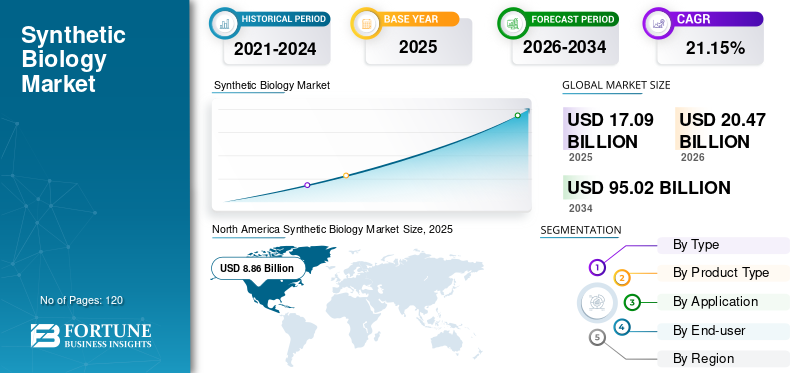
According to Fortune Business Insights: The global synthetic biology market was valued at USD 17.09 billion in 2025 and is projected to grow from USD 20.47 billion in 2026 to USD 95.02 billion by 2034, exhibiting a CAGR of 21.15% during the forecast period. Synthetic biology redesigns organisms or biological systems through genetic engineering to create new organisms, devices, or systems, and the market spans DNA synthesis, peptide and protein synthesis, and cell mimics. North America led the market with a 51.88% share in 2025.
Key Market Trends
Applications are broadening to include personalized therapies, advanced diagnostics, and engineered cell treatments such as CAR-T cells. AI and machine learning are being used to predict gene circuit behavior, model proteins, and identify drug candidates. Sustainable production is also gaining ground, with engineered microbes making pharmaceuticals and vaccines at lower environmental cost, and bio-based materials emerging as replacements for plastics.
Get a Sample Research PDF: https://www.fortunebusinessinsights.com/enquiry/request-sample-pdf/107168
Key Market Drivers
Technological advances in DNA sequencing and editing, such as CRISPR-Cas9, are a core driver, alongside progress in software, automation, AI, and machine learning. New product launches support growth, as with Bio-Rad's four new anti-idiotypic antibodies in June 2024. The rising prevalence of genetic disorders, growing R&D investment, and demand for sustainable solutions add further momentum.
Market Restraints
Safety and containment concerns, including potential side effects, weigh on adoption, and changes in biosafety rules and regulations create uncertainty for developers. Broader challenges include biosafety risks, data misuse, and bioterrorism concerns, along with high R&D and commercial-scale production costs. Scaling from lab to industrial production also remains difficult, with yield, contamination, and downstream processing issues.
Market Opportunities
New tools such as gene editing open fresh avenues for product development. Faster vaccine development, including RNA vaccines, is another opportunity, as shown by Codagenix's work using machine learning.
Segmentation Analysis
By type, services held a 62.00% share in 2026 and show the highest CAGR, while products, including instruments, reagents, and consumables, are the second-largest segment. By product type, peptide and protein synthesis held a 53.92% share in 2026, with DNA synthesis, covering oligonucleotide and gene synthesis, second-largest, and cell mimics expected to grow at the highest CAGR. By application, therapeutics hold the largest share with the highest CAGR, followed by research and development, while diagnostics held a 51.71% share in 2026. By end user, pharmaceutical and biotechnology companies held a 44.53% share in 2026 and show the highest CAGR, followed by CROs and CDMOs and other users such as academic institutions.
Regional Outlook
North America led the market with a 51.88% share in 2025 (USD 8.86 billion, projected at USD 10.57 billion in 2026), with the U.S. projected at USD 9.94 billion in 2026.
Europe held a 24.06% share (USD 4.11 billion in 2025, USD 4.96 billion projected for 2026) and is seeing moderate growth, with the U.K. at USD 1.17 billion and Germany at USD 1.15 billion in 2026.
Asia Pacific accounted for a 14.17% share (USD 2.42 billion in 2025, USD 2.96 billion projected for 2026) and is projected to grow at the highest regional CAGR, with China at USD 0.76 billion, Japan at USD 0.68 billion, and India at USD 0.43 billion in 2026.
Latin America held a 6.59% share (USD 1.13 billion in 2025, USD 1.33 billion projected for 2026), while the Middle East & Africa held a 3.30% share (USD 0.56 billion in 2025, USD 0.65 billion projected for 2026).
Connect with Our Expert for any Queries: https://www.fortunebusinessinsights.com/enquiry/speak-to-analyst/107168
Competitive Landscape
The market is partially consolidated, with Roche and Illumina holding significant shares. Key players include F. Hoffmann-La Roche, Illumina, Thermo Fisher Scientific, Bio-Rad, Oxford Nanopore Technologies, LabCorp, Agilent, Myriad Genetics, QIAGEN, Quest Diagnostics, and Danaher.
In April 2024, Telesis Bio launched the Gibson SOLA platform for DNA and mRNA, and in August 2024, IDT announced gene synthesis upgrades and launched rapid genes.
In September 2024, Cambrex's Snapdragon Chemistry developed liquid-phase peptide synthesis technology.
In December 2023, Illumina and HaploX collaborated on locally manufactured sequencing instruments in China, Senti Biosciences received FDA clearance for SENTI-202 for AML, and the Allen Institute, Chan Zuckerberg Initiative, and University of Washington launched the Seattle Hub for Synthetic Biology.
In October 2023, Evonetix installed a DNA synthesis platform at Imperial College London. The proposed U.S. Biosecure Act could also limit collaboration with certain Chinese biotech firms.
Curious About Japan’s Market? Explore the Latest Synthetic Biology Market Insights