
Surgical Microscopes Market Overview Analysis By Fortune Business Insights Analysis
Market Size & Future Outlook
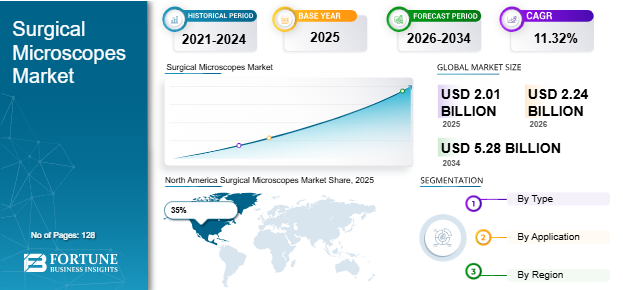
According to Fortune Business Insights: The global surgical microscopes market was valued at USD 2.01 billion in 2025 and is projected to grow from USD 2.24 billion in 2026 to USD 5.28 billion by 2034, exhibiting a CAGR of 11.32% during the forecast period. North America dominated the market with approximately a 35% share in 2025, supported by advanced surgical infrastructure and high adoption of precision imaging technology. The report covers a study period of 2021–2034, with 2025 as the base year.
Market Overview
Surgical microscopes are advanced optical and digital imaging systems that provide magnified, high-resolution visualization during delicate surgical procedures, enabling surgeons to operate with greater precision across neurosurgery, ophthalmology, ENT, dentistry, and reconstructive surgery. As surgical practice continues to shift toward minimally invasive and microsurgical techniques, these devices have become indispensable tools in both hospital operating theaters and specialized outpatient surgical settings, supporting improved clinical outcomes and reduced procedural risk.
Get a Sample Research PDF: https://www.fortunebusinessinsights.com/enquiry/request-sample-pdf/106942
Market Drivers
The primary growth driver is the rising global demand for precision and minimally invasive surgery, fueled by aging populations and the increasing prevalence of chronic diseases that require surgical intervention. As life expectancy rises and the burden of age-related conditions — including cataracts, spinal disorders, and various cancers — continues to climb, demand for surgical procedures requiring high-precision visualization tools is expanding correspondingly. Surgeons and healthcare institutions are increasingly prioritizing microsurgical capability as a standard of care across multiple specialties, directly sustaining robust equipment demand.
Market Restraints
The primary restraint is the high acquisition and ongoing maintenance cost associated with advanced surgical microscope systems, compounded by the need for regular calibration and specialized technical staff to operate and service the equipment. These cost and expertise requirements place significant financial and operational burden on healthcare facilities, particularly smaller hospitals and clinics. Procurement delays within public healthcare systems — often tied to lengthy budgeting and approval cycles — further constrain the pace of market adoption in several regions.
Market Opportunities
The expansion of specialty surgical centers presents a significant growth opportunity, including ambulatory surgical centers, ophthalmic clinics, dental practices, and dedicated neurosurgical institutes that increasingly require application-specific imaging equipment. Rising demand for compact, modular, and application-tailored microscopes — designed to fit the space and procedural needs of outpatient and specialty settings — is opening new addressable segments beyond traditional hospital operating rooms. Additionally, the ongoing expansion of healthcare infrastructure across emerging markets is creating substantial new demand as these regions build out advanced surgical capacity.
Market Challenges
A key challenge facing the market is the rapid pace of technological obsolescence, which raises long-term replacement costs for healthcare providers and introduces compatibility concerns as facilities try to integrate newer digital systems with existing surgical infrastructure. Additionally, the shift toward sophisticated digital interfaces — including 3D visualization and AI-assisted imaging — requires meaningful investment in user training to ensure surgical staff can fully leverage these advanced capabilities, adding to the overall cost and complexity of adoption.
Segmentation Analysis
By Type: Ceiling-mounted microscopes hold the largest share at approximately 40%, favored for their stability, superior maneuverability in the operating room, and suitability for complex, lengthy procedures. On-caster (mobile) systems account for approximately 28% of the market, valued for their flexibility across multiple operating rooms. Wall-mounted systems hold roughly 18% share, while tabletop models — typically used in smaller clinical and outpatient settings — account for approximately 14%.
By Application: Ophthalmology leads the application segment at approximately 25%, driven by the high volume of cataract and retinal procedures performed globally. Neurosurgery follows at approximately 22%, reflecting the critical need for precision visualization in brain and spinal procedures. ENT applications hold around 15% share, dentistry approximately 12%, plastic and reconstructive surgery approximately 11%, and oncology approximately 10%, with other applications comprising the remaining share.
By End User: The market is segmented into hospitals, clinics, and other healthcare facilities. Hospitals remain the primary end-user segment given their role as the principal site for complex and high-volume surgical procedures, while specialty clinics are expanding their share as outpatient surgical capacity grows globally.
Regional Analysis
North America leads the global market with approximately a 35% share in 2025, underpinned by a well-established surgical infrastructure, high per-capita healthcare spending, and early adoption of advanced digital and AI-integrated microscope technology across leading hospital systems.
Asia Pacific holds the second-largest share at approximately 30%, driven by rapidly expanding healthcare infrastructure, rising surgical volumes, and growing investment in advanced medical technology across major economies. China represents roughly 10% of the global market and Japan approximately 6%, reflecting substantial regional demand tied to large patient populations and expanding hospital networks.
Europe accounts for approximately 28% of the global market, supported by strong adoption of precision surgical technology and well-established reimbursement frameworks across major economies. Germany holds approximately a 9% global share and the U.K. approximately 7%, reflecting the region's mature surgical technology infrastructure.
Rest of the World, including Latin America and the Middle East & Africa, accounts for approximately 7% of the global market, with growth expected to accelerate gradually as healthcare infrastructure investment expands across these regions.
Market Trends
A defining trend reshaping the market is the ongoing shift toward digital surgical microscopes equipped with high-definition cameras, 3D visualization capabilities, and heads-up displays that allow surgeons to view magnified images without looking through traditional eyepieces. The integration of AI-powered and image-guided features — including fluorescence imaging for enhanced tissue differentiation — is further elevating surgical precision and diagnostic capability during procedures. Manufacturers are also increasingly prioritizing modular designs built for interoperability with robotic surgical systems and surgical navigation platforms, reflecting the broader trend toward integrated, technology-enabled operating room ecosystems.
Competitive Landscape & Key Developments
The market is led by Carl Zeiss Meditec, which holds approximately a 28% share, followed by Leica Microsystems (Danaher) at approximately 24%. Other key players include Haag-Streit (Möller-Wedel), Takagi Seiko, Alcon, Olympus, Seiler Instrument, and Arri Medical. Companies are focused on technological differentiation and expanding application-specific product portfolios to maintain competitive positioning.
Notable recent developments between 2023 and 2025 include the introduction of AI-enabled visualization modules by leading manufacturers, the launch of compact ceiling-mounted models designed for hybrid operating rooms, expanded adoption of digital heads-up displays in neurosurgical applications, the rollout of energy-efficient LED illumination systems to improve surgical visibility while reducing power consumption, and growing manufacturer partnerships with academic hospitals to co-develop next-generation surgical visualization technology.
Connect with Our Expert for any Queries: https://www.fortunebusinessinsights.com/enquiry/speak-to-analyst/106942
Outlook Summary
The global surgical microscopes market is positioned for strong, sustained growth through 2034, driven by rising surgical volumes tied to aging populations and chronic disease burden, the expansion of specialty surgical centers, and accelerating integration of digital, AI, and robotics-compatible imaging technology. While high equipment costs and rapid technological obsolescence remain structural challenges, continued innovation in compact, modular, and application-specific designs is expected to broaden market accessibility and sustain robust demand across both established and emerging healthcare markets.
Explore Japan’s Market Opportunities - Latest Surgical Microscopes Market Insights