
Space Situational Awareness Market Overview Analysis By Fortune Business Insights
Market Summary
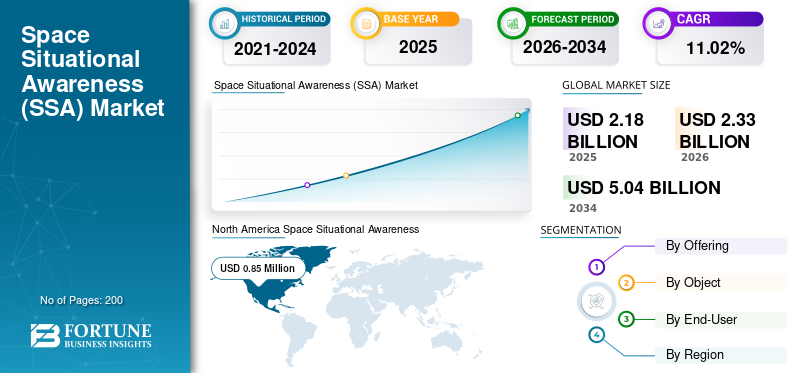
According to Fortune Business Insights: The global space situational awareness (SSA) market was valued at USD 2.18 billion in 2025 and is projected to grow from USD 2.33 billion in 2026 to USD 5.04 billion by 2034, registering a CAGR of 11.02% during the forecast period. Space situational awareness encompasses the capabilities and systems used to detect, track, identify, and predict the behavior of all objects in Earth orbit — including active satellites, non-functional spacecraft, rocket bodies, and debris fragments — to ensure the safety and sustainability of space operations. The U.S. Space Command tracks over 28,000 space objects, of which only 3,373 are active satellites, illustrating the scale of the debris and congestion challenge driving SSA investment globally. North America dominated the market with a 38.82% share in 2025, valued at USD 0.85 billion.
Get a Sample Research PDF: https://www.fortunebusinessinsights.com/enquiry/request-sample-pdf/105446
Key Market Drivers
Surging satellite launches and growing space activities worldwide are the primary market driver. The number of small satellites launched annually has grown exponentially — rising from 322 in 2018 and 385 in 2019 to 1,029 in 2020 — and this growth trajectory has continued through the LEO constellation buildout era. As satellites multiply across commercial, military, and government missions, accurate tracking and prediction of space object positions becomes a non-negotiable operational requirement for satellite operators worldwide. The growing use of space for national security, communications, weather observation, scientific research, and commercial services is generating proportional demand for SSA capabilities to protect these increasingly valuable orbital assets.
Rising international partnerships for SSA cooperation are a defining market trend. With 80 countries now active in the space domain, the congestion challenge cannot be addressed unilaterally. In October 2020, India expanded collaboration with the U.S. to improve its SSA capabilities. In December 2020, the Indian Space Research Organisation set up a dedicated Space Situational Awareness Centre in Bengaluru and launched Project NETRA — Network for Space Object Tracking and Analysis. In April 2022, India and the U.S. signed a bilateral SSA contract to add enhanced capabilities to their defense systems and space monitoring operations. These partnerships are creating structural demand for interoperable SSA platforms and services across governments and national space agencies.
The adoption of radio frequency data for space domain awareness is an important emerging market trend. Traditional SSA primarily relies on radar and electro-optical sensors, each with practical limitations — radars are expensive, and electro-optical output is weather-dependent. RF data from objects in space enables real-time geolocation, interference detection, anomaly identification, payload performance assessment, and ownership tracking, adding a critical new analytical dimension. Kratos Defense & Security Solutions — a leading RF spectral services provider — operates over 20 radio frequency monitoring sites worldwide, reflecting the commercial momentum behind RF-based SSA capabilities.
Market Restraints and Challenges
Stringent norms implemented by space regulatory authorities are the primary market restraint. The space industry is governed by five United Nations Treaties on outer space — including the Outer Space Treaty, Liability Convention, and Registration Convention — alongside national regulations requiring all space objects to be registered and tracked. Non-government entities require state authorization and supervision to conduct space activities, adding procedural burden and cost. Swarm Technologies' SpaceBees picosatellites failed to receive FCC spectrum licensing due to DoD concerns that the satellites could not be consistently tracked — an illustrative example of how regulatory gatekeeping can constrain market entry and delay commercial SSA initiatives. These barriers particularly affect smaller companies and emerging market players with limited regulatory resources.
Segmentation Analysis
By offering, the services segment is expected to dominate the market throughout the forecast period, driven by rising space exploration activity and growing demand for space debris modeling and monitoring. The services segment is classified into space weather services, near-earth object detection services, and space surveillance and tracking services — with the space surveillance and tracking sub-segment expected to grow at the highest CAGR, directly linked to the acceleration in global satellite launches. The software segment is anticipated to show significant growth, reflecting investment in advanced software capabilities including intelligent space awareness platforms. Lockheed Martin developed iSpace — an intelligent space awareness software providing command and control and battle management capabilities — illustrating the growing commercial value of advanced SSA software.
By object, the non-functional spacecraft segment is projected to reach 23.26% of the global market share in 2026, driven by the historical accumulation of decommissioned satellites and test vehicles from six decades of space operations. The fragmentation debris segment is expected to grow significantly, as it already accounts for 40% of the U.S. Space Debris Catalogue. The European Space Agency estimates 34,000 objects greater than 10 cm, 900,000 objects between 1 cm and 10 cm, and 128 million objects between 1 mm and 1 cm in Earth orbit — underscoring the scale of the fragmentation debris tracking challenge.
By end user, the military and government segment is projected to reach 68.87% of market share in 2026, reflecting the dominant role of government investment in SSA infrastructure across the U.S., Europe, China, India, and Russia. The commercial segment is growing at a high CAGR throughout the forecast period, driven by rising commercial satellite operator interest in space debris removal, deorbiting of non-functional spacecraft, and data sharing services — creating new revenue streams and commercial SSA service demand independent of government programs.
Regional Outlook
North America leads the market at USD 0.85 billion in 2025, projected at USD 0.90 billion in 2026, anchored by the United States — which maintains the world's largest space surveillance network through the U.S. DoD — with NASA and the U.S. Space Command as the leading institutional drivers. The U.S. market alone is projected at USD 0.82 billion in 2026. Europe reached USD 0.59 billion in 2025 (27.12% share), projected at USD 0.63 billion in 2026, supported by Russia's second-largest global space surveillance network alongside ESA-led programs and growing national investment from the U.K., Germany, and France. The U.K. market is projected at USD 0.17 billion and Germany at USD 0.06 billion in 2026. Asia Pacific contributed USD 0.48 billion in 2025 (21.90% share), projected at USD 0.52 billion in 2026, driven by China's growing optical sensor network through APOSOS and APSCO, India's expanding NETRA program, and Japan's defense space investments. China is projected at USD 0.24 billion, India at USD 0.09 billion, and Japan at USD 0.07 billion in 2026. The Rest of the World contributed 12.16% at USD 0.27 billion in 2025, projected at USD 0.29 billion in 2026, growing through bilateral SSA partnerships such as the South African National Space Agency's collaboration with Germany's DLR to host a space debris tracking station.
Connect with Our Expert for any Queries: https://www.fortunebusinessinsights.com/enquiry/speak-to-analyst/105446
Competitive Landscape
The global SSA market features companies primarily focused on software and services for space object tracking, debris modeling, and domain awareness. Key players include Lockheed Martin Corporation (U.S.), L3Harris Technologies Inc. (U.S.) — the identified market leader — Vision Engineering Solutions LLC (U.S.), Analytical Graphics Inc. (U.S.), Kratos Defense & Security Solutions Inc. (U.S.), ExoAnalytic Solutions (U.S.), SpaceNav (U.S.), NorthStar Earth & Space Inc. (Canada), GlobVision Inc. (Canada), and Etamax Space GmbH (Germany). Companies are pursuing partnerships, agreements, and new product development to sustain and expand their positions. In October 2023, EnduroSat announced development of European SSA systems for commercial missions, targeting deployment of ESPA microsatellites in low orbit. In August 2022, India-based startup Digantara Research & Technologies announced plans to construct a space situational awareness observatory focused on tracking satellites and debris across all Earth orbits and offering space traffic management solutions.
What’s Driving Japan’s Market? Discover the Latest - Space Situational Awareness Market Insights