
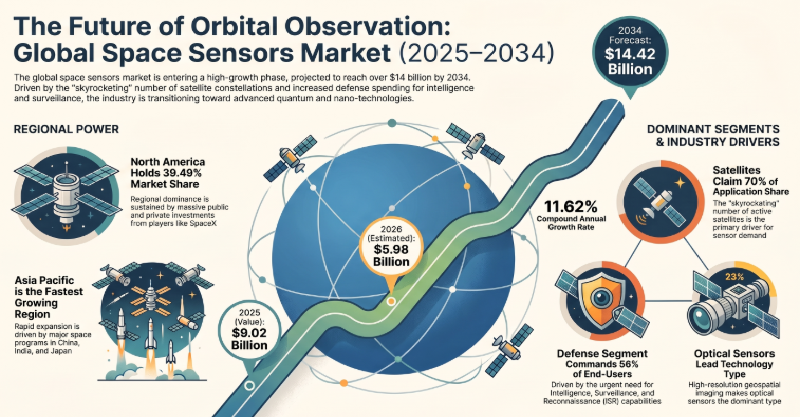
Space Sensors Market Overview Analysis By Fortune Business Insights Analysis
Market Size & Growth Outlook
According to Fortune Business Insights: The global space sensors market was valued at USD 9.02 billion in 2025 and is projected to grow from USD 5.98 billion in 2026 to USD 14.42 billion by 2034, exhibiting a CAGR of 11.62% during the forecast period. North America dominated the market with a 39.49% share in 2025.
Space sensors, also known as "spaceborne sensors," are specially designed instruments used in space missions to collect valuable data and observations on spacecraft, Earth, celestial bodies, or the surrounding environment. These sensors span multiple types — including optical sensors, infrared sensors, radars, star detectors, IMU devices, and GPS trackers — and are essential for scientific research, exploration, and monitoring. Space sensors are used across applications ranging from observing Earth's environment to exploring distant planets and galaxies, playing vital roles in space exploration, weather forecasting, environmental monitoring, and communication. In March 2021, ABB installed an optical sensor on GHGSat's Hugo satellite to monitor greenhouse gases including methane — part of the GHGSat constellation launched via SpaceX's rideshare program. The COVID-19 pandemic slightly affected the industry through supply chain disruptions, border closures, and movement restrictions that delayed sensor manufacturing and delivery, postponing ongoing space projects and missions.
Get a Sample Research PDF: https://www.fortunebusinessinsights.com/enquiry/request-sample-pdf/105871
Market Trends
Growing Popularity of Quantum Sensors and Nanotechnology: Major players are focused on developing technologically advanced sensors capable of sustaining space environment conditions while improving reliability and efficiency. Quantum sensors can detect minute environmental changes, identify items underwater or underground, and offer navigational information when GPS is unavailable — while also playing important roles in developing practical quantum computing based on qubits. Unlike quantum computers requiring hundreds of thousands of tightly controlled, environmentally isolated qubits, quantum sensors leverage the fragility of quantum states to extract environmental information. In August 2022, a German collaboration led by Q.ANT, Bosch, TRUMPF, and the German Aerospace Center (DLR) began using quantum technology to indefinitely improve satellite measurement stability — maintaining high-precision attitude control to ensure reliable communication signal transmission, since signals weaken when satellites move out of position. Quantum sensors are additionally essential in gravity sensing and gravitational wave detection, enabling scientists to observe cosmic phenomena including black hole mergers and neutron star collisions.
Market Growth Factors
Expanding Satellite Constellations: A satellite constellation — a swarm of identical or similar artificial satellites serving the same objective under single-entity control — regularly connects to global ground stations, functioning as complementary systems that rotate in comparable orbital planes to ensure continuous global coverage. IoT, telecommunications, navigation, weather monitoring, and Earth observation sectors are all benefiting from existing and new satellite constellations. According to the U.S. Government Accountability Office, active satellite numbers grew from 1,400 in 2015 to 5,500 by spring 2022, directly bolstering space sensor demand.
Increasing Government Investments for Defense and Security Applications: The growing importance of space-based assets in defense and security drives sensor demand for monitoring, intelligence gathering, and early warning systems. Satellites equipped with high-resolution optical sensors, synthetic aperture radar, or other advanced imaging technologies provide critical intelligence data for threat monitoring, military activity assessment, and strategic information gathering. In April 2023, the U.S. Space Force invested in ground and space-based sensors, surveillance systems, and commercial space tracking data to improve space domain awareness, with its fiscal year 2024 budget plan including USD 0.58 billion for space-tracking activities such as optical telescope and surveillance satellite development. Governments are also investing in satellite sensors that detect and track ballistic missile launches, providing early warning systems essential for national defense.
Restraining Factors
Malfunctioning and High Costs of Space Sensors: Spacecraft sensor failure can directly affect mission success, as sensor data accuracy and reliability are essential for informed decision-making. Sensor failure may result in insufficient data collection, reduced measurement accuracy, and compromised decision-making processes — particularly critical for research missions exploring celestial bodies or monitoring Earth's climate and natural disasters. Hostile conditions including strong radiation, vacuum, and temperature changes placed upon space-borne sensors may cause degradation, premature wear, or total failure. In 2022, India's Small Satellite Launch Vehicle (SSLV) maiden launch failed to reach orbit due to a rocket kick-stage malfunction — ISRO reported the vehicle terminal module (VTM) failed, placing the satellite in an elliptical 76 x 356 km orbit instead of the planned 356 km circular orbit, rendering the satellite unusable after the sensor error went undetected and uncorrected.
Segmentation Analysis
By Type: Optical sensors dominate the market with a 23.08% share in 2026, providing high-resolution images and precise measurements of object size, shape, and orientation in space — with major applications in geospatial imaging driving segment leadership. IMU sensors are projected to hold significant market share, crucial for measuring and tracking spacecraft orientation, position, and speed, with increased space missions driving notable demand.
By Platform: The satellite segment dominated the market with a 70.09% share in 2026 and is expected to be the fastest-growing segment, driven by increasing scheduled satellite launches by major public and private operators across numerous applications. The launch vehicle segment is predicted to grow significantly, driven by increasing small satellite deployment for Earth observation, communications, and scientific research applications.
By End-User: Defense dominated the market with a 56.02% share in 2026, as satellites remain the primary focus of military space activities — widely used to support Intelligence, Surveillance, and Reconnaissance (ISR) operations and arms control compliance verification. The commercial segment is anticipated to grow at the highest CAGR, attributed to rising space tourism, telecommunications, and data transmission activities by government and private space agencies.
Regional Outlook
North America holds the largest space sensors market share, valued at USD 39.49 billion in 2025. Growth is driven by rising investment activities from government and private players including SpaceX and Blue Origin, with growing demand for space-based applications escalating market growth and increasing demand for advanced technological sensors.
Europe is expected to experience significant growth, driven by growing demand for technologically advanced satellites. In October 2020, the European Space Agency signed a contract to develop the world's first iodized electric propulsion system, representing an important development driving regional market growth.
Asia Pacific is anticipated to be the fastest-growing region, attributed to the growing space sector, with China, Japan, and India as leading technological economies investing heavily in space exploration programs and missions.
Middle East & Africa is expected to rise moderately, driven by increasing focus from the UAE and Saudi Arabia on expanding their space sectors and launching ambitious space programs.
Latin America is anticipated to grow significantly with increasing space launch service contracts across Argentina, Colombia, and Brazil. In September 2022, Voyager Space signed memorandums of understanding with the Colombian Space Agency, the El Salvador Aerospace Institute, the Mexican Space Agency, the Guatemalan Space Science and Technology Association, and Costa Rican startup Orbital Space Technologies — with Nanoracks and Voyager signing individual MoUs with each agency to open space access and promote commercial spaceflight opportunities across the region.
Connect with Our Expert for any Queries: https://www.fortunebusinessinsights.com/enquiry/speak-to-analyst/105871
Competitive Landscape
The global market is consolidated with important players including ABB Ltd. (Switzerland), Airbus S.A.S (Netherlands), Ametek Inc. (U.S.), L3Harris Technologies Inc. (U.S.), Safran S.A. (France), Honeywell International Inc. (U.S.), InnaLabs Ltd. (Ireland), Raytheon Technologies Corporation (U.S.), TE Connectivity (Switzerland), and Teledyne Technologies Inc. (U.S.). Prominent companies focus on acquisitions, mergers, product innovations, and technological advancements to sustain market competition, with significant R&D investment observed across civil, commercial, and military end-user segments.
Key recent developments include Lockheed Martin's January 2024 contract win to build 18 space vehicles as part of the Tranche 2 Tracking Layer constellation for the Space Development Agency — providing 16 wide field-of-view missile warning/tracking space vehicles with infrared sensors and two space vehicles with missile defense infrared sensors capable of generating fire control-quality tracks; the U.S. Space Force's November 2023 authorization for Millennium Space Systems to begin producing six satellites for medium Earth orbit deployment to detect and track ballistic and hypersonic missiles, representing a new location for infrared missile detection satellites previously deployed in geostationary orbit; the University of Hawaii Institute for Astronomy's June 2023 receipt of USD 4 million from NASA to develop highly sensitive sensors for exoplanet research; U.S. Earth observation experts' May 2023 refocused development of space-based sensors for sophisticated electro-optical satellite payloads including hyperspectral sensors to monitor Earth's environmental evolution; and NASA's February 2023 development of two weather instruments — COWVR (Compact Ocean Wind Vector Radiometer) and TEMPEST (Temporal Experiment of Storm and Tropical Systems) — testing small, inexpensive sensor feasibility that exceeded expectations in providing useful tropical cyclone forecast information.
Uncover Japan’s Market Trends - Explore the Latest - Space Sensors Market Insights