
Small Wind Turbine Market Overview Analysis By Fortune Business Insights Analysis
Market Summary
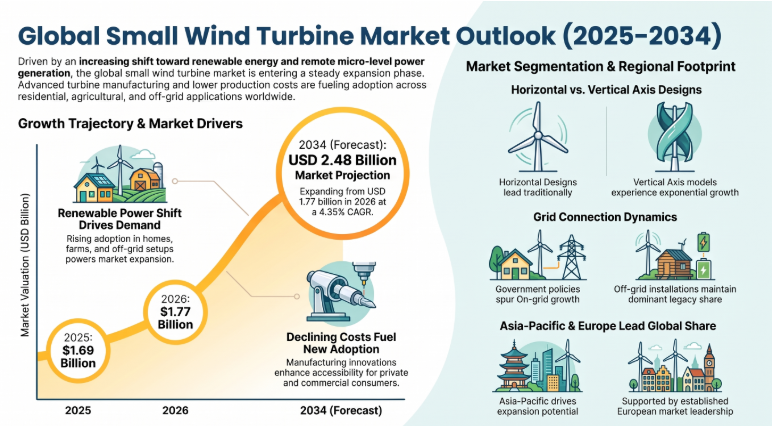
According to Fortune Business Insights: The global small wind turbine market was valued at USD 1.69 billion in 2025 and is projected to grow from USD 1.77 billion in 2026 to USD 2.48 billion by 2034, exhibiting a CAGR of 4.35% during the forecast period. Small wind turbines convert wind into electricity at the micro level for homes, farms, and businesses. They can bring electricity to households without access, lower costs on islands and in remote locations that rely on oil-fired generation, and let residents and small businesses generate their own power. Europe is described as the global leader, with Asia Pacific also named as a dominant region.
Key Market Trends
Falling manufacturing costs and technology advances are expected to increase adoption of vertical axis wind turbines (VAWTs). Off-grid systems are also being modernized with new technologies, improving their appeal for remote and private installations.
Get a Sample Research PDF: https://www.fortunebusinessinsights.com/enquiry/request-sample-pdf/105681
Key Market Drivers
A growing focus on renewable resources as a primary power source is the main driver. Rising demand for off-grid applications also supports growth, as small turbines suit private spaces and enable more efficient energy use where grid connections are costly or unavailable.
Market Restraints
The COVID-19 pandemic reduced demand, restricted production, and delayed projects, and the source treats it as a key restraint, though it reflects an earlier period. North American growth has also slowed to a modest rate amid concerns about market saturation.
Market Opportunities
Remote and island electrification offers a clear opportunity, since small turbines can replace costly oil-fired generation. Distributed residential and farm systems and lower-cost vertical axis designs add further room for growth.
Segmentation Analysis
By type, horizontal axis wind turbines (HAWTs) lead the market by a large margin, reflecting a design used for about two centuries, while vertical axis wind turbines (VAWTs) are expected to grow exponentially on affordable pricing and environmental benefits. By installation type, on-grid systems are predicted to lead in 2025 thanks to government efforts to improve grid connectivity for small wind, while off-grid systems are expected to grow at a moderate rate. The source does not give percentage shares for either segmentation.
Regional Outlook
Asia Pacific is described as dominant, with China having encouraged small wind power since the early 1980s and the region seen as having strong potential for off-grid and residential systems.
Europe is described as the global leader, with Germany and the U.K. holding the largest shares in the region.
North America is the second-largest region by volume and revenue, though concerns about market saturation have slowed growth to a modest rate. South America and the Middle East & Africa fall within the report's scope.
Connect with Our Expert for any Queries: https://www.fortunebusinessinsights.com/enquiry/speak-to-analyst/105681
Competitive Landscape
Key players include Northern Power Systems Inc., Bergey Wind Power Co., SD Wind Energy, Xzeres Wind Corp., Ryse Energy, Fortis Wind Energy, Kliux Energies, City Windmills Holdings PLC, Aeolos Wind Energy Co. Ltd., Qingdao Windwings Wind Turbine Co. Ltd., and Greenergy Technology Co.
In November 2025, Skystream Energy relaunched its Skystream 3.7 Pro with upgraded components, electronics, and control software.
In June 2025, SkyWind Energy GmbH received ACP 101-1 certification for its SkyWind NG micro turbine. In April 2025, Freen OÜ introduced the Freen-H15, a 15-kW horizontal-axis turbine, and in March 2025, Kodair Wind Designs received ACP 101-1 (2021) certification for its KW30, after certifying its KW20 the previous month.
Earlier developments include Matric Limited's January 2021 production of the Intergrid inverter, an interconnection-code-compliant inverter for distributed wind, and the April 2020 launch of the AeroMINE, a device that can draw wind energy from a larger area than its blades alone.
What Everyone Should Know About Japan’s Market Small Wind Turbine Market Insights