
Slip Additives Market Overview Analysis By Fortune Business Insights
Market Size & Growth Outlook
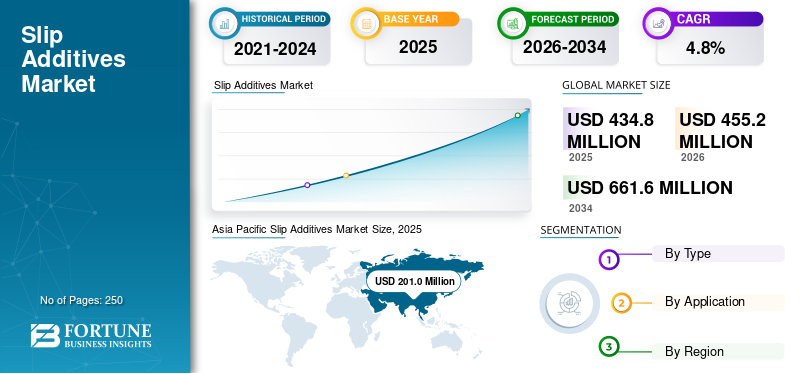
According to Fortune Business Insights: The global slip additives market was valued at USD 434.8 million in 2025 and is projected to grow from USD 455.2 million in 2026 to USD 661.6 million by 2034, at a CAGR of 4.8% during the forecast period. Asia Pacific dominated the global market with a 46.23% share in 2025, valued at USD 201.0 million, followed by Europe at USD 101.8 million and North America at USD 88.2 million.
Slip additives are specialty chemical substances incorporated into polyolefin films, plastic compounds, masterbatches, coatings, and inks to reduce friction between film layers, between films and processing equipment, and across molded or coated plastic surfaces. By lowering the coefficient of friction, these additives improve film unwinding, bag opening, roll handling, machinability, scratch resistance, and surface smoothness — enabling smoother winding, cutting, sealing, filling, and converting operations across high-speed packaging lines. Fatty amides such as erucamide, oleamide, stearamide, and behenamide are the most widely used slip additive chemistries, with wax-based and silicone-based systems increasingly relevant in higher-performance and specialty applications.
Get a Sample Research PDF: https://www.fortunebusinessinsights.com/enquiry/request-sample-pdf/117610
Market Trends
The defining trend shaping the slip additives market is the accelerating shift toward bio-based and low-migration additive formulations. Packaging converters and brand owners are prioritizing materials that combine reliable surface performance with food-contact safety, regulatory compliance, and sustainability targets. Bio-based additives derived from renewable oleochemical feedstocks are gaining traction as manufacturers reduce reliance on conventional petrochemical-derived slip agents. In parallel, low-migration additives are increasingly preferred in food packaging, pharmaceutical films, hygiene films, and premium flexible packaging, where additive transfer, odor, and surface contamination present quality and regulatory risks. This convergence of sustainability and compliance requirements is reshaping product development priorities across the competitive landscape.
Market Drivers
Rising Plastic Film Production for Flexible Packaging: The continued expansion of flexible packaging across food and beverage, personal care, pharmaceuticals, household products, e-commerce, and industrial applications is the primary growth driver. As polyethylene and polypropylene film production volumes increase — particularly in emerging economies — manufacturers are placing greater emphasis on film processability, surface smoothness, and packaging line efficiency, driving consistent demand for slip additives. These additives also reduce blocking issues during storage and transportation, which is critical in high-speed packaging environments.
Broadening Application Scope: Slip additives are increasingly used beyond packaging films in molded plastics, caps and closures, automotive components, agricultural films, industrial liners, consumer goods, masterbatches, sheets, and technical polymer applications. This expansion enables additive producers to develop customized formulations for specific polymers, processing conditions, and performance requirements, creating new revenue streams outside conventional film-based demand.
Market Restraints
Regulatory scrutiny over additive migration is the primary restraint. Slip additives migrate to the surface of plastic films to deliver friction-reducing performance, but excessive or uncontrolled migration raises concerns related to food safety, odor and taste transfer, packaging contamination, print adhesion, lamination performance, and sealing efficiency. Stricter compliance expectations from regulatory bodies and packaging buyers — particularly for food and pharmaceutical packaging — are limiting the adoption of conventional slip additive formulations in highly regulated, quality-sensitive segments and challenging manufacturers to develop safer, more controlled alternatives.
Segmentation Analysis
By Type: Fatty amides held the largest market share in 2025, underpinned by their extensive use in polyethylene and polypropylene films, where they reliably reduce friction, minimize blocking, and support smooth converting operations. Their cost-effectiveness and compatibility with high-volume packaging film production reinforce their market leadership. The waxes segment is projected to grow at a CAGR of 4.2% through 2034, driven by their role as cost-effective lubricants and processing aids in value-driven industrial formulations. The silicone-based segment is the fastest growing, projected at a CAGR of 5.4% through 2034, reflecting strong demand for durable, low-migration, permanent slip performance in specialty films, automotive plastics, consumer goods, and engineering plastic applications.
By Application: Packaging films dominated in 2025, driven by high additive consumption across food, personal care, pharmaceutical, household, and industrial flexible packaging. Their essential role in reducing friction, preventing blocking, and enabling smooth sealing and converting operations ensures continued segment leadership throughout the forecast period. Plastic compounding and processing is expected to grow at a CAGR of 4.9% through 2034, as processors incorporate slip additives into masterbatches, molded plastics, sheets, profiles, and compounded polymer formulations to improve throughput and surface finish. The others segment, covering specialty consumer products, technical polymers, industrial components, liners, and engineered plastics, is projected to grow at 4.5% CAGR as manufacturers explore new applications beyond traditional film-based demand.
Regional Outlook
Asia Pacific leads the global market at USD 201.0 million in 2025, sustained by robust plastic film production, expanding flexible packaging consumption, and large-scale polymer processing industries across China, India, Japan, South Korea, and Southeast Asia. China is the region's largest contributor, accounting for approximately USD 88.3 million (19.4% of global demand) in 2026, driven by its extensive polyethylene and polypropylene film manufacturing base and strong downstream demand from food, consumer goods, and e-commerce sectors. India is projected to reach USD 34.1 million in 2026 (7.5% of global demand), supported by rapid flexible packaging expansion, rising packaged food consumption, and strong FMCG and pharmaceutical packaging activity.
Europe reached USD 101.8 million in 2025, growing at a CAGR of 4.2% through 2034. High regulatory scrutiny, strong sustainability commitments, and circular-economy mandates are pushing European converters toward low-migration, bio-based, and recyclable-packaging-compatible additive solutions. Germany leads the region at an estimated USD 26.8 million in 2026 (5.9% of global demand), supported by its strong packaging, automotive plastics, and polymer processing industries. The UK is projected at USD 12.9 million in 2026, driven by flexible packaging, food-contact films, and recyclable packaging transition initiatives.
North America reached USD 88.2 million in 2025, growing at a CAGR of 4.4% through 2034. The region represents a mature yet technologically advanced market, with the U.S. — projected at USD 82.5 million in 2026 (18.1% of global revenues) — driven by its large flexible packaging industry, food and beverage packaging demand, and growing use of high-performance and low-migration slip additives in healthcare and specialty applications.
Latin America reached USD 26.0 million in 2025 and is projected to grow at a CAGR of 4.8% through 2034, supported by rising flexible packaging demand in Brazil and Mexico. Brazil is projected at USD 12.0 million in 2026 (2.6% of global demand), driven by food, agriculture, personal care, and household packaging growth.
Middle East & Africa stood at USD 17.7 million in 2025 and is projected to grow at the fastest regional CAGR of 5.0% through 2034, supported by expanding petrochemical-based polymer processing capacity and rising flexible packaging demand across food, retail, hygiene, and industrial applications.
Connect with Our Expert for any Queries: https://www.fortunebusinessinsights.com/enquiry/speak-to-analyst/117610
Competitive Landscape
The global slip additives market is moderately consolidated, with competition shaped by product performance, polymer compatibility, regulatory compliance, and formulation expertise. Key players include Cargill (U.S.), BASF (Germany), Clariant (Switzerland), Evonik (Germany), Dow (U.S.), Momentive (U.S.), BYK (Germany), Kao Chemicals (Japan), KLK OLEO (Malaysia), and Fine Organics (India). Companies are increasingly focusing on low-migration, food-contact-approved, bio-based, and permanent slip solutions to address evolving packaging and polymer-processing requirements.
Notable recent developments include Avient Corporation's April 2026 launch of Hiformer Slip + Antistatic for BOPP films in Latin America, combining slip and antistatic performance in one formulation; Ampacet's May 2025 introduction of SLIP SCAVENGER 1540 for flexible packaging with recycled polyethylene content; Tosaf's February 2024 North American capacity expansion increasing additive and masterbatch production by 40%; and Ampacet's October 2023 launch of PERMSLIP 1409, a permanent slip masterbatch delivering consistent low COF performance and reduced additive transfer during film conversion.