
Sequencing Reagents Market Overview Analysis By Fortune Business Insights
Market Size & Growth Outlook
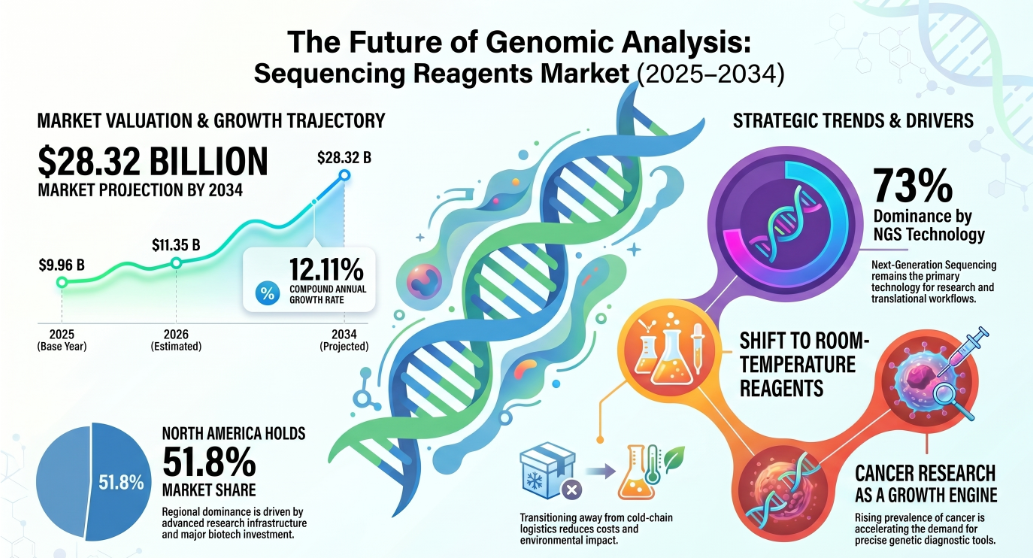
According to Fortune Business Insights: The global sequencing reagents market was valued at USD 9.96 billion in 2025 and is projected to grow from USD 11.35 billion in 2026 to USD 28.32 billion by 2034, reflecting a robust CAGR of 12.11% over the forecast period. North America held the dominant position in 2025, accounting for a 51.80% share of global market revenues.
Sequencing reagents encompass chemicals, enzymes, and sequencing kits used across technologies such as next-generation sequencing (NGS) and Sanger sequencing. Growing demand for personalized medicine, human genome research, and clinical diagnostics — combined with rising investment from key players offering technologically advanced solutions — continues to accelerate market expansion globally.
Get a Sample Research PDF: https://www.fortunebusinessinsights.com/enquiry/request-sample-pdf/115363
Key Market Trends
A rapid shift toward room-temperature sequencing reagents is a prominent trend reshaping the market. These reagents eliminate the need for cold-chain logistics, reducing shipping costs and complexity while increasing accessibility in remote or resource-limited settings. They also enhance shelf life and storage flexibility, supporting faster deployment and turnaround times for sequencing workflows.
A landmark example of this trend came with Illumina's launch of its NovaSeq X Series sequencers in September 2022, which introduced ambient-temperature reagent shipping and eliminated the need for dry ice — saving approximately 500 tons annually. More broadly, the market is witnessing growing integration of AI-powered diagnostics and multi-omics workflows, further expanding the utility of sequencing reagents across research and clinical settings.
Market Dynamics
Drivers: The rising global prevalence of cancer is a key demand driver, spurring adoption of sequencing for oncology research and drug development. As the need for precise genetic profiling and personalized treatment grows, so does the utilization of sequencing reagents. In August 2024, Illumina expanded its oncology testing portfolio for the NovaSeq X Series, including updated tissue and liquid biopsy options to improve lab economics and batch capacity.
Restraints: High reagent costs remain a significant barrier to broader adoption. Complex synthesis routes, stringent quality controls, and advanced manufacturing requirements inflate production costs, limiting uptake among smaller laboratories and in developing markets. For instance, Illumina reagent kits available in India are priced at approximately USD 110.95 per piece — a considerable expense for small-scale labs.
Opportunities: Third-generation sequencing represents a major growth frontier. These advanced workflows enable more comprehensive genome assemblies, structural variation detection, and epigenetic analysis, driving specialized reagent demand. In February 2025, F. Hoffmann-La Roche launched its proprietary sequencing by expansion (SBX) technology — an ultra-fast, high-throughput NGS platform adaptable across a wide range of applications.
Challenges: Supply chain instability poses a significant obstacle. Disruptions in raw material procurement, manufacturing delays, and logistics issues can cause reagent shortages that deter adoption. Maintaining consistent reagent quality across production batches — critical for reliable sequencing results — adds further complexity and limits large-scale adoption.
Segmentation Overview
By Reagents: Sequencing run reagents and consumables led the market with a 42.2% share in 2025, driven by high demand for reliable data outputs and the frequent replacement cycles inherent to sequencing workflows. The library preparation reagents segment is the fastest-growing sub-category, projected at a CAGR of 13.48%.
By Origin: The mixed-origin segment dominated with a 61.0% share in 2025, valued for its versatility and compatibility across various sequencing platforms. QIAGEN's May 2024 launch of the QIAseq Multimodal DNA/RNA Library Kit — supporting whole-genome, whole-transcriptome, and target enrichment applications from a single sample — exemplifies this trend. The synthetic segment is the fastest-growing, forecast at a CAGR of 13.69%.
By Technology: Next-generation sequencing (NGS) accounted for a 73.0% share, driven by its widespread routine adoption across research and translational workflows. Third-generation sequencing is the fastest-growing technology segment, projected at a CAGR of 16.48%.
By Application: Drug discovery and development held the largest application share at 30.6%, fueled by chronic disease prevalence and the demand for personalized therapies. The genetic and rare disease research segment is projected to grow at 11.71% CAGR.
By End User: Pharmaceutical and biotechnology companies dominated with a 48.3% share, driven by high R&D investment and strategic collaborations. Academic and research institutes are expected to grow at a CAGR of 9.23%.
Regional Outlook
North America leads globally, with the U.S. market estimated at approximately USD 4.91 billion in 2025 — around 49.3% of worldwide revenues. Strong genomic research investments and a concentration of major biotech companies and research institutions underpin this dominance.
Europe is the second-largest region, valued at USD 2.57 billion in 2025 and projected to grow at 11.89%. The U.K. (USD 0.56 billion) and Germany (USD 0.52 billion) are the primary contributors, supported by robust research infrastructure and advances in genomics.
Asia Pacific reached USD 1.58 billion in 2025, ranking third globally. China (USD 0.29 billion), India (USD 0.28 billion), and Japan (USD 0.47 billion) are the region's leading markets, with growing investments in genomic research driving expansion.
Latin America recorded USD 0.40 billion in 2025, with digitalization and telemedicine adoption supporting growth. The Middle East & Africa region remains smaller, with the GCC contributing USD 0.12 billion in 2025, though both regions offer moderate growth potential over the forecast period.
Connect with Our Expert for any Queries: https://www.fortunebusinessinsights.com/enquiry/speak-to-analyst/115363
Competitive Landscape
The global sequencing reagents market has a semi-consolidated structure. Illumina and Thermo Fisher Scientific hold the strongest positions due to their broad geographic presence, large installed bases, and diverse product portfolios. Other notable players — including Oxford Nanopore Technologies, QIAGEN, Agilent, and PacBio — are expanding market share by advancing their chemistry and workflow kits.
Key recent developments include QIAGEN's November 2025 acquisition of Parse Biosciences, a provider of scalable single-cell research solutions, and a co-development partnership between Volta Labs and New England Biolabs to expand the NEBNext reagent portfolio. In April 2025, QIAGEN also announced plans to launch three new sample preparation instruments between 2025 and 2026.
Conclusion
The global sequencing reagents market is on a strong upward trajectory, driven by rapid genomics innovation, rising disease burden, and growing demand for personalized medicine. While high reagent costs and supply chain challenges present near-term headwinds, the long-term outlook is highly favorable — with third-generation sequencing, AI integration, and multi-omics workflows offering compelling growth opportunities through 2034.