
Security and Vulnerability Management Market Overview Analysis By Fortune Business Insights
Market Size & Future Outlook
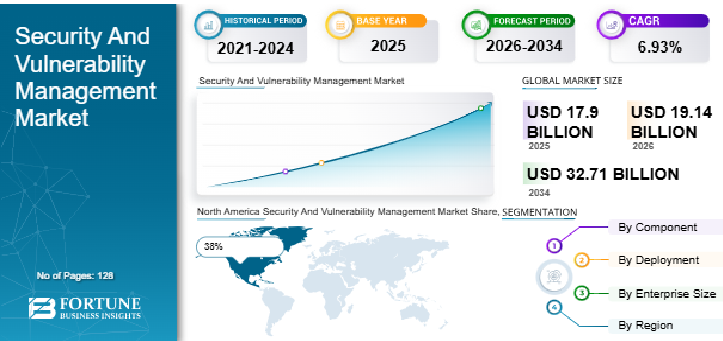
According to Fortune Business Insights: The global security and vulnerability management market size was valued at USD 17.9 billion in 2025 and is projected to grow from USD 19.14 billion in 2026 to USD 32.71 billion by 2034, exhibiting a CAGR of 6.93% during 2026–2034. North America held the largest regional share, at about 38% in 2025. The report covers a historical period of 2021–2024, with 2025 as the base year.
Market Overview
Security and vulnerability management covers the software and services used to identify, prioritize, and remediate weaknesses across IT environments. Offerings include vulnerability scanners, patch management, risk assessment, threat intelligence, security incident and event management (SIEM), and services such as consulting, penetration testing, incident response, and managed security. Buyers span banking and financial services, healthcare, government and defense, IT and telecom, energy, retail, and manufacturing.
Get a Sample Research PDF: https://www.fortunebusinessinsights.com/enquiry/request-sample-pdf/111513
Market Drivers
The rising frequency and sophistication of cyber threats, including ransomware, phishing, zero-day exploits, and misconfigurations, is the primary driver. Organizations need continuous visibility into their exposure and faster remediation.
Market Restraints & Challenges
High implementation and operational complexity is the main restraint, especially for smaller organizations with limited resources and skills. The key challenge is keeping pace with a rapidly evolving threat landscape.
Market Opportunities
Growth in managed security services is the main opportunity, as providers help organizations address talent shortages.
Market Trends
- Automation and AI: Platforms are shifting toward automated, intelligence-driven prioritization using AI and machine learning.
- Cloud-native tools: Agentless scanning and container security are gaining adoption.
- Convergence: Vulnerability management is increasingly combined with SIEM.
- Managed services: Adoption of managed security services is rising.
- Zero trust: Zero-trust models increase demand for continuous visibility.
- Regulation and insurance: Regulatory pressure and cyber insurance requirements influence deployment.
Segmentation Analysis
By Component: The market is divided into software (vulnerability scanners, SIEM, patch management, risk assessment, threat intelligence, and others) and services (professional services, consulting and deployment, penetration testing, vulnerability assessment, incident response, support and maintenance, and managed services). The page's component percentages do not reconcile with each other, so they are not reproduced here.
By Deployment: Cloud holds about 60% and on-premises about 40%.
By Enterprise Size: Large enterprises hold about 65% and SMEs about 35%.
By Type, Target, and Industry: Cloud security is named as the leading type, without a share. Industries covered include BFSI, healthcare, defense and government, IT and telecom, energy, retail, and manufacturing.
Regional Analysis
Regional figures are given as shares of the 2025 global market:
- North America: about 38%.
- Asia Pacific: about 28%, with China at about 11% of the global market and Japan at about 7%.
- Europe: about 26%, with Germany at about 9% of the global market and the U.K. at about 6%.
- Rest of the World: about 8%.
Connect with Our Expert for any Queries: https://www.fortunebusinessinsights.com/enquiry/speak-to-analyst/111513
Competitive Landscape & Key Developments
Microsoft leads with about 16% share, followed by CrowdStrike at about 13%. Other listed companies include Cisco Systems, IBM, Broadcom, Rapid7, AT&T, Qualys, Hewlett Packard Enterprise, and DXC Technology. The FAQ also names Tenable among the top players.
Notable developments include:
- Rapid7 adding runtime validation and data posture features to Exposure Command (March 2026).
- Tenable launching Hexa AI for Tenable One to automate exposure management workflows (May 2026).
- Qualys launching InstaScan for Enterprise TruRisk Management to detect exposures shortly after disclosure (August 2026).
Outlook Summary
The security and vulnerability management market is positioned for steady growth through 2034, driven by escalating cyber threats and the need for continuous exposure visibility. Implementation complexity and skills shortages remain restraints, but AI-driven prioritization, cloud-native tooling, and managed security services are expected to sustain expansion.
Explore Japan’s Market Opportunities - Latest Security And Vulnerability Management Market Insights