
Satellite Data Services Market Overview Analysis By Fortune Business Insights Analysis
Market Size & Future Outlook
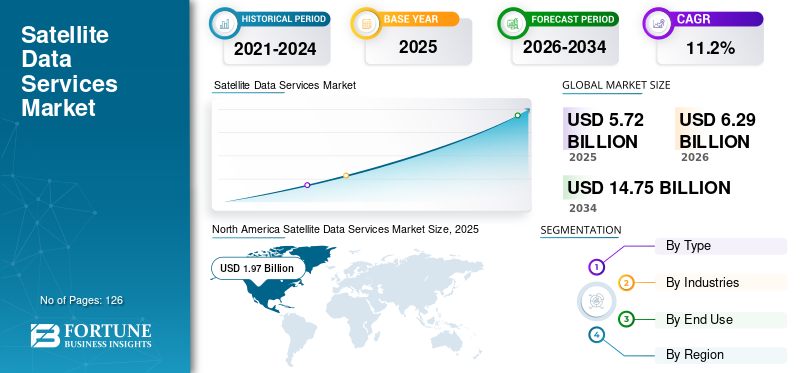
According to Fortune Business Insights: The global satellite data services market was valued at USD 5.72 billion in 2025 and is projected to grow from USD 6.29 billion in 2026 to USD 14.75 billion by 2034, exhibiting a CAGR of 11.2% during the forecast period. North America led the market with a 34.44% share in 2025, valued at USD 1.97 billion. The report covers a study period of 2021–2034, with 2025 as the base year.
Market Overview
Satellite data services provide imagery, radar, radio-frequency, and other data collected from space, along with the analytics and value-added products built on top of it. Customers use this information for defense and intelligence, maritime monitoring, agriculture, energy, environmental tracking, and disaster response. As more Earth observation (EO) satellites launch and analytics tools mature, satellite data is evolving from a specialist input into a routine operational intelligence layer across industries.
Get a Sample Research PDF: https://www.fortunebusinessinsights.com/enquiry/request-sample-pdf/108359
Market Drivers
Growth of the space economy and a rising number of EO satellite launches are shifting customers from one-time imagery purchases toward recurring monitoring and analytics subscriptions. At the same time, satellite data is gaining demand across industries as an operational intelligence layer, serving agriculture, insurance, energy, mining, maritime, logistics, disaster management, and defense.
Market Restraints
High capital requirements for building, launching, operating, and upgrading satellite infrastructure limit entry for smaller firms and lengthen payback periods. Price sensitivity in some sectors is another constraint, as ground surveys, aerial imagery, and open-source satellite data remain viable alternatives.
Market Opportunities
Growing institutional procurement of commercial EO data by government agencies, research institutions, and environmental bodies is a key opportunity, often delivered through long-term contracts that provide providers with predictable, recurring revenue.
Market Challenges
Spectrum congestion from terrestrial networks and the growing number of non-geostationary satellites is raising interference risk. Regulatory fragmentation across national spectrum regimes slows deployment and adds compliance costs, which weighs especially on smaller operators.
Market Trends
Innovation continues across sensors, including optical, SAR, hyperspectral, thermal, and RF, as well as onboard processing, AI, and cloud delivery. The market is shifting toward analytics-ready datasets, API-based access, and near-real-time monitoring. An example is Planet's Tanager-1 hyperspectral satellite, launched in August 2024 for methane and CO₂ detection.
Segmentation Analysis
By Type: The market is divided into satellite data and value-added services. Value-added services hold the leading share, while satellite data is projected to grow at a 10.3% CAGR.
By Industry: Defense and intelligence dominates, with other segments including maritime, environmental, agriculture, and energy and power. Agriculture is the fastest-growing segment, at a 14.1% CAGR.
By End Use: Government and military leads, while commercial is the fastest-growing segment, at an 11.7% CAGR.
Regional Analysis
North America holds the largest share at 34.44% in 2025, valued at USD 1.97 billion and projected at USD 2.14 billion in 2026. The U.S. contributed about USD 1.57 billion in 2025.
Europe is described as the fastest-growing region. The U.K. accounted for about USD 0.40 billion (7.06% of the global market) and France about USD 0.25 billion (4.40%) in 2025.
Asia Pacific is seeing strong adoption growth. China was about USD 0.78 billion (13.63%), India about USD 0.40 billion (7.04%), and Japan about USD 0.29 billion (5.10%) in 2025.
Latin America is growing steadily, with Brazil at about USD 0.11 billion (1.87%) in 2025.
Middle East & Africa is expanding, with the UAE at about USD 0.12 billion (2.03%) in 2025.
Connect with Our Expert for any Queries: https://www.fortunebusinessinsights.com/enquiry/speak-to-analyst/108359
Competitive Landscape & Key Developments
Profiled companies include ICEYE, Planet Labs, Capella Space, Airbus, BlackSky, Vantor (Maxar Technologies), Spire Global, EOS Data Analytics, L3Harris Technologies, and Satellite Imaging Corporation. Competition centers on data quality, analytics capability, and delivery speed.
Notable developments include Planet winning an eight-figure NGA maritime surveillance contract extension and a crisis response monitoring award in June 2026; Airbus and Hisdesat agreeing in January 2026 to commercialize imagery from the future PAZ-2 radar satellites, offering up to 10 cm resolution; ICEYE and Rheinmetall receiving a German Armed Forces SAR data order valued at about USD 1.95 billion in December 2025; NOAA's Commercial Data Program awarding USD 35.5 million for radio occultation data in September 2025; NOAA declaring GOES-19 fully operational as GOES East in April 2025; and BlackSky winning a subscription contract from a new international customer in February 2025.
Outlook Summary
The global satellite data services market is positioned for strong growth through 2034, supported by the expanding space economy, a shift to subscription-based monitoring, and broadening use across commercial and government sectors. While high infrastructure costs, spectrum congestion, and regulatory fragmentation remain challenges, advances in sensors, AI-driven analytics, and API-based delivery are expected to sustain demand, particularly in agriculture and commercial applications.
What Everyone Should Know About Japan’s Market Satellite Data Services Market Insights