
Powersports Market Overview Analysis By Fortune Business Insights
Market Size & Growth Outlook
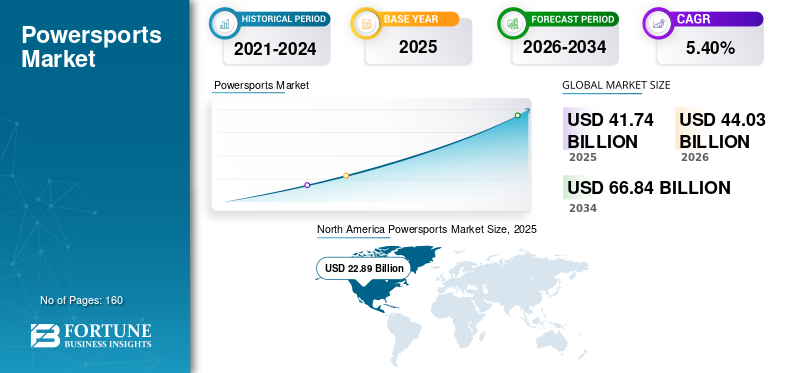
According to Fortune Business Insights: The global powersports market was valued at USD 41.74 billion in 2025 and is projected to grow from USD 44.03 billion in 2026 to USD 66.84 billion by 2034, exhibiting a CAGR of 5.40% during the forecast period. North America dominated the global market with a commanding 54.85% share in 2025, valued at USD 22.89 billion — driven by favorable weather conditions, an extensive network of recreational facilities, strong government support for powersports trail infrastructure, and the presence of leading manufacturers including Polaris, BRP, and Arctic Cat.
Powersports vehicles are high-performance recreational and utility vehicles engineered to operate across extreme conditions — spanning shock, vibration, debris, and diverse environmental hazards. The category encompasses heavyweight motorcycles, recreational off-road vehicles (ROVs) including ATVs, side-by-sides (SxS), and utility terrain vehicles (UTVs), jetskis, and snowmobiles. Growing youth interest in adventure tourism and off-road leisure activities, rising disposable incomes, and expanding recreational infrastructure supported by government and club-level initiatives are collectively sustaining market momentum globally.
Get a Sample Research PDF: https://www.fortunebusinessinsights.com/enquiry/request-sample-pdf/105156
Market Trends
Vehicle Modification Culture and Electrification Reshaping the Market Landscape: The defining trends shaping the global powersports market are the high consumer demand for vehicle modifications and aftermarket accessories, and the accelerating shift toward vehicle electrification. According to the Specialty Equipment Market Association (SEMA), approximately 82% of powersports vehicle owners plan to purchase accessories within three months of vehicle purchase — reflecting deep consumer engagement with product customization and performance enhancement. Powersports vehicles are engineered with customization considerations built in, supporting a robust aftermarket ecosystem across both performance and utility upgrades.
Simultaneously, major OEM manufacturers are prioritizing the introduction of electric variants across ATVs, heavyweight motorcycles, jetskis, and snowmobiles — driven by environmental regulations, growing consumer sustainability awareness, and the industry's commitment to reducing its overall carbon footprint. In April 2023, Polaris launched its electric Ranger XP Kinetic product line — featuring a fully electric powertrain engineered for off-road use under an exclusive 10-year partnership with Zero Motorcycles — and subsequently supplied the model to United Rentals, one of the largest equipment rental companies, to expand its commercial electric UTV fleet.
Market Drivers
Increasing Adoption of ATVs Across Demographics: The primary growth driver is the accelerating global adoption of all-terrain vehicles — driven by their lower age restrictions, relatively affordable pricing, lower vehicle weight, ease of maneuverability, and minimal maintenance requirements compared to other powersport vehicle categories. ATVs are ideally suited for use in tight spaces including national parks, natural forestry, and conservation areas — offering an eco-conscious, low-congestion mobility alternative. Government initiatives in North America and Europe have expanded ATV pathways in recreational parks — exemplified by the federal grant awarded to develop Bush Head Shoals ATV Park in Georgia — directly expanding the addressable recreation infrastructure and supporting demand growth.
Strong Economic Impact of Snowmobiling: The snowmobile segment is a significant market driver, underpinned by its substantial economic contribution to regional tourism and recreation economies. According to data from the International Snowmobile Manufacturers Association (ISMA), approximately USD 36 billion is spent on snowmobiling annually in the U.S. and Canada. Snowmobiling generates approximately USD 350 million in economic impact in Maine alone, while the Quebec Federation of Snowmobile Clubs reported a USD 2 billion economic impact from the snowmobile industry in Quebec — illustrating the category's deep commercial significance in North American and European winter recreation markets.
Market Restraints
Environmental Impact and Safety Concerns Limiting Growth: The primary market restraint is the growing regulatory and public scrutiny of the environmental and safety performance of powersports vehicles. Most powersport vehicles operate on conventional gasoline fuel — with heavyweight motorcycles in particular consuming significant fuel volumes and emitting relatively high emissions — prompting regulatory pressure toward cleaner engine technologies and fuel efficiency standards. Safety concerns are a concurrent restraint: according to the Consumer Product Safety Commission (CPSC), approximately 81,800 people were injured in ATV-related incidents in the U.S. in 2018, with children under 16 involved in 26% of incidents. The prevalence of rollover and collision injuries from off-road use — particularly in the absence of appropriate safety equipment — has led to increased regulatory oversight and public awareness efforts that can suppress demand growth in certain consumer segments.
Segmentation Analysis
By Vehicle Type: ROVs dominate with a projected 63.48% market share in 2026, driven by their multi-seating configurations, enhanced rollover protection systems, versatility across forestry, agriculture, utility, and luxury applications, and broad consumer appeal across both recreational and commercial use cases. ATVs and side-by-sides are the primary growth drivers within the ROV segment. In March 2023, Honda introduced a new product line of multipurpose ATVs and compact SxS vehicles featuring refined bodies suited for multi-terrain use with higher weight endurance and comfort. Snowmobiles are growing steadily — driven by expanding winter tourism, snow recreation popularity, and the introduction of electric models targeting climate-conscious consumers. In March 2023, Taiga Motors introduced long-distance electric snowmobile capabilities offering 80% fast charging in 30 minutes and a full range of 100 km. Heavyweight motorcycles maintain a stable share, while jetskis grow alongside water-based recreational tourism.
By Application: Off-road dominates with a projected 64.75% market share in 2026, reflecting the core utility of powersport vehicles across uneven terrain, steep trails, and crowded forest environments — where compact size, robust chassis, and all-terrain maneuverability make them indispensable for leisure, motorsports, and cargo transport. On-road applications maintain a significant secondary share, particularly for heavyweight motorcycles and road-registered utility vehicles.
By Fuel Type: Gasoline leads with a projected 84.17% market share in 2026, driven by the high reliability, performance, and widely available fueling infrastructure associated with higher-octane gasoline engines across the powersports segment. The electric segment is expected to grow significantly during the forecast period as major players pursue EV model launches, consumer environmental awareness grows, and EV technology advances improve electric powertrain performance and range for off-road conditions. In October 2023, Kayo Electric showcased its EA70 and EA110 electric ATV models — designed for a safer, thrilling off-road experience for ATV enthusiasts — while Tesla announced plans to launch Cyberquad, an all-electric ATV for non-commercial use, in September 2023.
Regional Outlook
North America commands 54.85% of the global market at USD 22.89 billion in 2025, projected to reach USD 24.03 billion in 2026. The U.S. market — projected to reach USD 14.56 billion by 2026 — benefits from strong federal and state support for recreational trail development and powersport activity promotion, extensive recreational facility availability, and a deeply embedded culture of outdoor adventure sports. The COVID-19 pandemic dramatically accelerated demand, with U.S. ATVs and SxS vehicles growing 24% year-over-year during the pandemic period per Solomon Partners data. The ongoing ATV pathway expansion programs and increasing consumer appetite for off-road adventure continue to sustain North America's dominant market position.
Europe is the second-largest region at USD 14.43 billion in 2025 (34.58% share), projected to reach USD 15.33 billion in 2026. Germany leads the region at USD 7.14 billion by 2026, supported by a strong recreational motorsports culture, robust snowmobile tourism across Alpine regions, and active club and provincial organizations promoting off-road leisure activities. The U.K. follows at USD 2.01 billion by 2026. Europe's growing emphasis on EV adoption is also influencing manufacturers to accelerate electric powersport model launches in the region.
Asia Pacific contributed USD 2.17 billion in 2025 (5.21% share), projected to reach USD 2.21 billion in 2026. While high vehicle costs and limited servicing infrastructure constrain broader adoption, rising disposable incomes and increasing consumer awareness of recreational activities are generating growing demand for heavyweight motorcycles and side-by-sides. China is projected to reach USD 1.04 billion by 2026, Japan at USD 0.29 billion, and India at USD 0.17 billion.
Rest of the World accounted for USD 2.24 billion in 2025 (5.36% share), projected to reach USD 2.47 billion in 2026, supported by growing adventure tourism and improving recreational vehicle access across Latin America and the Middle East.
Connect with Our Expert for any Queries: https://www.fortunebusinessinsights.com/enquiry/speak-to-analyst/105156
Competitive Landscape
The global powersports market is led by Polaris Inc. (U.S.), BRP (Canada), Arctic Cat Inc. (U.S.), Honda Motor Co. Ltd. (Japan), Kawasaki Heavy Industries Ltd. (Japan), Yamaha Motor Co. Ltd. (Japan), Harley-Davidson (U.S.), Textron Inc. (U.S.), Suzuki Motor Corporation (Japan), KTM (Austria), CF Moto (China), Taiga Motors (Canada), and KYMCO (Taiwan). Competition centers on new model launches, EV platform development, technology partnerships, and aftermarket ecosystem expansion.
Key recent developments include Polaris' April 2023 launch of the electric Ranger XP Kinetic UTVs and their supply to United Rentals for commercial fleet expansion; Honda's March 2023 launch of new multipurpose ATVs and compact SxS vehicles; Taiga Motors' March 2023 introduction of fast-charging long-distance electric snowmobile capabilities; Kayo Electric's October 2023 showcase of the EA70 and EA110 electric ATV models; and Tesla's September 2023 announcement of the Cyberquad all-electric ATV entry into the powersports market.
What’s Driving Japan’s Market? Discover the Latest - Powersports Market Insights