
Polyimide Film Market Overview Analysis By Fortune Business Insights Analysis
Market Size & Growth Outlook
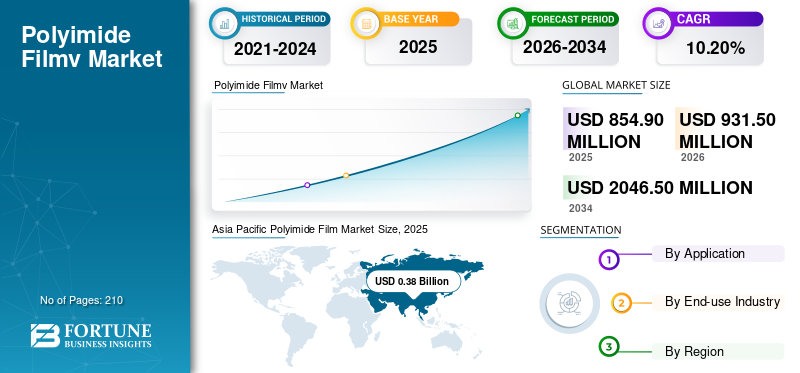
According to Fortune Business Insights: The global polyimide film market was valued at USD 0.85 billion in 2025 and is projected to grow from USD 0.93 billion in 2026 to USD 2.04 billion by 2034, exhibiting a CAGR of 10.20% during the forecast period. Asia Pacific dominated the market with a 45.00% share in 2025, valued at USD 388 million — driven by the region's dominant electronics manufacturing industry, rapid industrialization, and expanding automotive sector across China, Japan, South Korea, and India.
Polyimide (PI) film is a high-performance thin film insulating material synthesized through a two-stage process involving diamines and dianhydrides — producing a polyamic acid that is subsequently imidized using heat or a chemical dehydrating agent. The resulting material exhibits exceptional thermal stability, outstanding electrical insulation properties, superior mechanical strength, and high chemical resistance — making it indispensable across flexible printed circuit boards (FPCBs), semiconductor devices, aerospace components, automotive systems, medical devices, and advanced industrial applications. Its versatility and performance credentials across extreme temperature and environmental conditions position it as a critical enabling material in the global high-performance materials landscape.
Get a Sample Research PDF: https://www.fortunebusinessinsights.com/enquiry/request-sample-pdf/103055
Market Trends
Growing Emphasis on Sustainability Driving Eco-Friendly PI Film Development: The defining trend reshaping the global polyimide film market is the accelerating industry shift toward sustainable and environmentally responsible polyimide materials. Companies are developing eco-friendly alternatives incorporating recyclable polyethylene, minimizing environmental impact while maintaining the high-performance characteristics required by electronics and industrial end-users. Research is actively focused on creating recyclable porous dielectric films with ultralow permittivity from soluble fluorinated polyimide — materials exhibiting exceptional thermal stability, mechanical strength, and recyclable capability suitable for high-frequency communication devices and insulating dielectric applications. The growing adoption of bio-based, greener solvents in the synthesis of high-performance polyimide materials is further advancing sustainable production pathways — aligning the market with global regulatory and corporate sustainability commitments.
Market Drivers
High Thermal Stability and Electrical Insulation Properties Sustaining Indispensable Demand: The primary market driver is the material's exceptional combination of thermal stability and electrical insulation performance — properties that make PI films irreplaceable in demanding electronic, aerospace, and industrial applications. These characteristics make PI films critical in flexible printed circuits, pressure-sensitive tapes, wire and cable insulation, and other electronic products experiencing surging demand as mobile and complex electronic devices become smaller, lighter, and more functionally sophisticated. Asia Pacific's market grew from USD 340.85 million in 2023 to USD 355.26 million in 2024, reflecting consistent region-wide demand expansion.
PI films perform reliably across extreme temperatures and varying weather conditions — enabling their use as insulation in renewable energy applications including solar, wind, and hydro power systems. Their role extends further into healthcare — including medical tubes, circuits, and insulation for medical devices and circuit boards — where expanding healthcare infrastructure and demand for high-performance medical equipment are reinforcing additional growth drivers. In May 2022, DuPont announced expansion of its Kapton polyimide film production in the U.S. to meet growing global demand across automotive, consumer electronics, telecom, specialized industrial, and defense segments — illustrating the material's broad and accelerating multi-sector demand base.
Market Restraints & Challenges
High Manufacturing Costs and Competition from Alternative Materials: The primary restraint is the high cost of PI film manufacturing — arising from the expense of specialized raw materials, complex polymerization and film casting processes, expensive solvents and chemicals, and high-temperature manufacturing operations that substantially increase equipment and energy expenditure. These cost factors limit PI film adoption in price-sensitive applications where alternative insulating materials are commercially viable.
A significant concurrent challenge is competition from lower-cost alternative polymer films — including polyethylene terephthalate (PET), polycarbonates, PTFE, and liquid crystal polymers (LCP). PET films, in particular, offer effective dimensional stability, moisture resistance, and flexibility at considerably lower prices — making them attractive substitutes in applications where PI's high-performance thermal and chemical resistance is not mission-critical.
Regulatory compliance presents an additional constraint: traditional polyimide production processes involve solvents and chemicals that raise environmental concerns, while strict EU regulations on chemical usage and sustainability challenge manufacturers to adopt cleaner chemistries at additional cost. Industries including healthcare and food packaging impose stringent safety standards regarding potential chemical migration — restricting PI film application in certain regulated sectors.
Market Opportunities
Surging Electronics Sector Demand Creating Lucrative Growth Avenues: The most compelling market opportunity is the accelerating global demand for PI films from the electronics industry — driven by the expanding need for thinner, more flexible, and highly reliable insulating materials as electronic devices become progressively smaller and more functionally complex. PI films are ideal for electrical insulation in smartphones, tablets, and wearables — providing outstanding thermal stability essential for preventing short circuits in thermally demanding electronic environments. Their critical role in flexible printed circuits (FPCs), circuit insulating tapes, and semiconductor device packaging — encompassing wafer carriers, chip trays, gate insulators, and intermetallic layers — is being directly amplified by the rapid growth of the IoT market and the proliferation of compact, power-dense connected devices globally.
Segmentation Analysis
By Application: Flexible printed circuits dominate with a 45.99% projected market share in 2026 — reflecting PI films' irreplaceable role as the insulating base film and coverlay in FPCs used across smartphones, cameras, medical equipment, and complex consumer electronics where circuit space efficiency and thermal performance are paramount. Specialty fabricated products represent an emerging high-growth application segment — driven by expanding adoption across consumer electronics in precision-engineered film formats. Pressure-sensitive tapes are growing steadily for electrical insulation and protection applications in electronics assembly. Wires and cables maintain consistent demand for high-temperature wire insulation across industrial, automotive, and aerospace systems.
By End-use Industry: Electronics dominates with a projected 52.53% market share in 2026, reflecting PI films' pervasive role across the full electronics value chain — from FPCBs and semiconductor packaging to dielectric substrates, cable insulation, and flexible solar cell applications. The segment's continued growth is underpinned by the explosive adoption of smartphones, tablets, wearable devices, and IoT systems. Aerospace is a significant secondary end-use — leveraging PI films' thermal resistance and lightweight properties in spacecraft, satellite components, and aircraft thermal protection systems. Automotive is projected to grow at a CAGR of 6.9% through the forecast period — driven by the rapid expansion of electric vehicle production requiring high-performance insulation for electric motors, battery systems, and power electronics where conventional insulating materials are inadequate.
Regional Outlook
Asia Pacific leads the global market at USD 388 million in 2025 (45.00% share), projected to reach USD 425.3 million in 2026. China — home to the world's largest electronics manufacturing sector — is projected to reach USD 0.16 billion by 2026, while India is estimated at USD 86.41 million in 2025 and Japan at USD 61.36 million in 2026. The growing demand from automotive sectors and electronics industries spanning displays, mobile devices, and consumer electronics are recognized as two of the most important regional market drivers for PI films across Asia Pacific.
North America reached USD 183 million in 2025 (21.00% share), projected to reach USD 199.6 million in 2026. The U.S. market — projected to reach USD 0.18 billion in 2026 — benefits from the presence of top automotive and aerospace manufacturers, well-established infrastructure, and high disposable incomes. DuPont's May 2022 Kapton polyimide film production expansion in the U.S. directly underscores the region's growing manufacturing base and strong multi-sector demand.
Europe generated USD 162.5 million in 2025 (19.00% share), projected to reach USD 176.6 million in 2026. Established electronics, medical, and automotive industries drive consistent PI film demand — with EV production growth across Germany and France providing a near-term growth catalyst. Germany is projected at USD 0.05 billion and France at USD 0.03 billion in 2026, while the U.K. market is estimated at USD 33.21 million in 2025.
Middle East & Africa contributed 7.00% of the global market in 2025 (USD 63.4 million), projected to reach USD 67.9 million in 2026 — the fourth-largest regional market. Rising consumer electronics demand across Saudi Arabia (estimated USD 20.76 million in 2025) and growing electronics and automotive sector investment are sustaining regional market development.
Latin America reached USD 58 million in 2025 (6.80% share), projected to reach USD 62.1 million in 2026, with positive economic trends increasing purchasing power and attracting global investor interest across electronics and automotive sectors.
Connect with Our Expert for any Queries: https://www.fortunebusinessinsights.com/enquiry/speak-to-analyst/103055
Competitive Landscape
The global polyimide film market is led by DuPont (U.S.), 3M (U.S.), Arkema (France), Kolon Industries Inc. (South Korea), Kaneka Corporation (Japan), PI Advanced Material Co. Ltd. (South Korea), Taimide Tech. Inc. (Taiwan), Ube Industries Ltd. (Japan), PPI Adhesive Products (Ireland), and Thermo Fisher (U.S.). Prominent players focus on production capacity expansion, product portfolio broadening, and strategic acquisitions to maintain competitive positions.
Key recent developments include Arkema's December 2023 finalization of its acquisition of Glenwood Private Equity's 54% stake in PI Advanced Materials (PIAM) — based on a USD 827.91 million enterprise value — to enhance Arkema's high-performance technologies portfolio for advanced electronics and electric mobility; DuPont's May 2022 announcement of Kapton polyimide film production expansion in the U.S. targeting automotive, consumer electronics, telecom, industrial, and defense demand; and Kaneka Corporation's March 2019 development of colorless polyimide films for flexible electroluminescent (EL) displays intended for next-generation electronic devices.
What Everyone Should Know About Japan’s Market - Polyimide Film Market Insights