
Pharmaceutical Contract Manufacturing Market Overview Analysis By Fortune Business Insights Analysis
Market Size & Future Outlook
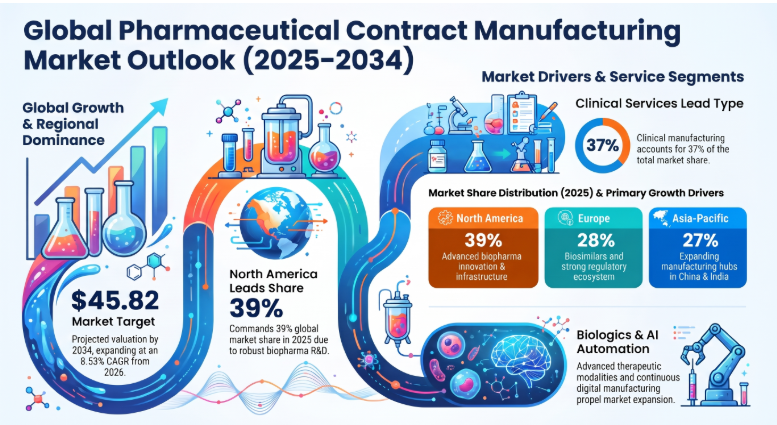
According to Fortune Business Insights: The global pharmaceutical contract manufacturing market was valued at USD 21.93 billion in 2025 and is projected to grow from USD 23.80 billion in 2026 to USD 45.82 billion by 2034, exhibiting a CAGR of 8.53% during the forecast period. North America dominated the market with a 39% share in 2025, followed by Europe at 28% and Asia Pacific at 27%.
Market Overview
Pharmaceutical contract manufacturing involves outsourcing drug discovery support, development, and production to specialized third-party organizations. These providers offer capabilities ranging from active pharmaceutical ingredient (API) manufacturing and formulation development to biologics production, packaging, and analytical testing. By outsourcing, pharmaceutical and biotechnology companies gain access to specialized facilities and expertise, reduce capital investment, and accelerate the path from development to commercialization.
Get a Sample Research PDF: https://www.fortunebusinessinsights.com/enquiry/request-sample-pdf/116354
Market Drivers
Rising outsourcing by pharmaceutical and biotechnology companies, aimed at cutting costs and speeding commercialization, is the primary driver. Growth in biologics, biosimilars, cell and gene therapies, and personalized medicine is increasing the need for specialized manufacturing capacity. Demand for sterile injectable and biologics capabilities, which are costly and technically complex to build in-house, further supports the use of contract partners.
Market Restraints
Strict regulatory and quality requirements, including good manufacturing practice (GMP), sterility assurance, and extensive documentation, raise compliance burdens. High capital and workforce costs for advanced facilities can also weigh heavily on smaller manufacturers.
Market Opportunities
Biologics and personalized medicine manufacturing offer strong growth potential. Integrated, full-service outsourcing models that span discovery through commercial production are attracting customers seeking a single partner. Investment in automation, digital manufacturing, and continuous processing can improve efficiency and quality, creating competitive advantages.
Market Challenges
Rising production costs and the need for cleanrooms and specialized equipment pressure margins. Supply chain complexity, raw material shortages, and geopolitical trade uncertainty add risk. Workforce shortages, intellectual property protection, and maintaining consistent quality across multiple sites remain ongoing concerns.
Market Trends
Biologics and advanced therapy manufacturing are expanding rapidly. Automation, AI, robotics, and continuous manufacturing are being adopted to improve productivity and quality control. Demand for end-to-end service models is growing, and sustainable manufacturing practices are receiving greater attention.
Segmentation Analysis
By Type: Clinical manufacturing services lead with about 37% of the market, followed by drug discovery at about 34% and pre-clinical at about 29%.
By Customer Type: Large pharmaceutical companies account for about 54% of the market, while small pharma and biotech companies account for about 46%.
By Services: The market covers API manufacturing, formulation development, biologics manufacturing, packaging, and analytical testing.
By Therapeutic Area: Oncology is the dominant area, with infectious diseases, cardiovascular, neurology, and respiratory also covered.
Regional Analysis
North America leads with a 39% share in 2025. The United States is a major market, with strength in biologics, sterile injectables, and advanced therapy outsourcing.
Europe holds 28%, with Germany representing about 31% and the U.K. about 24% of the regional market.
Asia Pacific accounts for 27%, with China representing about 43% and Japan about 21% of the regional market.
Rest of the World, covering Latin America, the Middle East, and Africa, holds 6%.
Connect with Our Expert for any Queries: https://www.fortunebusinessinsights.com/enquiry/speak-to-analyst/116354
Competitive Landscape & Key Developments
Key players include WuXi STA, Piramal Pharma Solutions, Syngene International, Samsung Biologics, Jubilant Pharmova, Celltrion, Ajinomoto Bio-Pharma Services, Almac Group, Rubicon Research, Aurigene Pharmaceutical Services, Eurofarma, Unither Pharmaceuticals, Fujifilm Diosynth Biotechnologies, Patheon, and Pfizer. Samsung Biologics leads with a 16% share, followed by Patheon at 13%.
Notable developments include Piramal Pharma Solutions increasing sterile injectable manufacturing capacity in 2023; Samsung Biologics expanding large-scale biologics facilities in 2024; Fujifilm Diosynth Biotechnologies expanding cell therapy production infrastructure in 2024; WuXi STA introducing integrated continuous manufacturing technologies in 2025; and Patheon launching AI-supported pharmaceutical quality control systems in 2025.
Outlook Summary
The pharmaceutical contract manufacturing market is positioned for strong growth through 2034, driven by rising outsourcing, the expansion of biologics and advanced therapies, and demand for specialized sterile capacity. While regulatory burden, capital intensity, and supply chain risks remain challenges, investment in automation, continuous manufacturing, and integrated service models is expected to sustain demand across all major regions.
Explore Japan’s Market Opportunities - Latest Pharmaceutical Contract Manufacturing Market Insights