
Nootropic Ingredients Market Overview Analysis By Fortune Business Insights
Market Summary
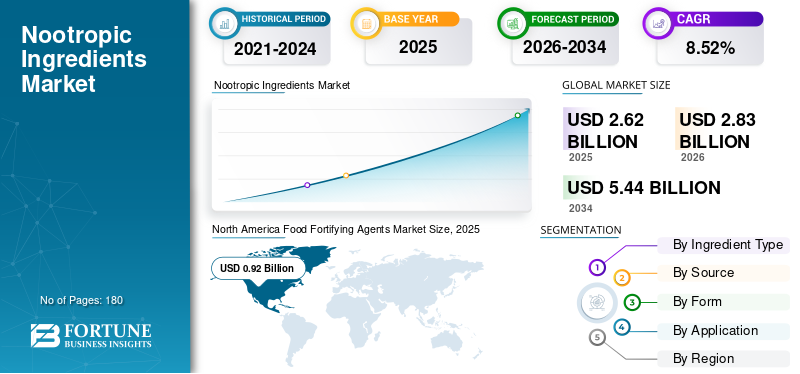
According to Fortune Business Insights: The global nootropic ingredients market was valued at USD 2.62 billion in 2025 and is projected to grow from USD 2.83 billion in 2026 to USD 5.44 billion by 2034, at a CAGR of 8.52% during the forecast period. The market includes plant extracts, synthetic compounds, amino acids, fatty acids, vitamins, minerals, and specialty nutrients that support cognitive performance, focus, memory, alertness, stress resilience, and healthy aging. These ingredients are primarily deployed in dietary supplements, functional beverages, and fortified foods. Growth is accelerating as consumers increasingly seek non-prescription solutions for stress management, sleep-quality support, and age-related cognitive maintenance, driven further by innovations in botanical extracts, adaptogen blends, omega-3 ingredients, and convenient ready-to-use product formats. North America led the global market with USD 0.92 billion in 2025.
Get a Sample Research PDF: https://www.fortunebusinessinsights.com/enquiry/request-sample-pdf/118027
Key Market Drivers
Rising cognitive workload and preventive brain-health priorities are the primary market drivers. Professionals, students, gamers, athletes, and older adults are incorporating nootropic ingredients into daily wellness routines to improve focus, memory, alertness, calm energy, stress response, and mental stamina — without relying on stimulants or prescriptions. Functional beverage and supplement brands are using nootropics to differentiate products across wellness categories, while clinical studies continue to validate the cognitive benefits of hybrid blends that mix botanicals, adaptogens, amino acids, and fatty acids to support both short-term productivity and long-term brain function. The convergence of mental health awareness, demanding work environments, and the mainstreaming of biohacking is significantly broadening the consumer base for nootropic ingredients globally.
The dominant market trend is a structural shift toward clean-label botanicals, microencapsulation, and hybrid cognitive claims reshaping product development. Consumers now prefer familiar botanicals — ashwagandha, bacopa, lion's mane, ginkgo, rhodiola, saffron, and green tea extracts — over strong synthetic stimulants. Brands are also blending nootropics with adaptogens, electrolytes, probiotics, collagen, protein, and sleep-support nutrients to offer more complete wellness products. Advances in microencapsulation, beadlets, and premix systems are making it easier to incorporate nootropic ingredients into gummies, shots, stick packs, and ready-to-drink products while addressing taste, stability, and bioavailability challenges.
Market Restraints and Challenges
Evidence gaps, regulatory claim limits, and formulation challenges are the primary restraints on market growth. Many nootropic ingredients show promise based on traditional use or early-stage studies, but brands still require robust clinical evidence to support cognitive and health claims around memory, focus, stress, or mental energy. Regulatory frameworks differ significantly across the U.S., Europe, and Asia Pacific, complicating global product positioning and requiring dedicated compliance investment for each region. Formulation presents practical challenges as well — many nootropic ingredients carry bitter taste, poor water solubility, odor issues, or stability concerns in beverages and gummies, leading to higher reformulation, testing, and documentation costs. These barriers make it particularly difficult for mainstream food and beverage companies to enter the space without significant R&D commitment.
Market Opportunities
Adaptogen blends, personalized nutrition formats, and beverage-compatible delivery systems create the most significant near-term growth pathways. As consumers prefer multi-benefit products, brands can develop formulas targeting specific cognitive needs — focus, productivity, calm energy, gaming stamina, exam performance, sports cognition, stress management, sleep support, and healthy aging — rather than relying on single-ingredient capsules. Suppliers offering ready-to-use blends backed by regulatory documentation, sensory solutions, and clinical substantiation are well positioned to capture premium partnerships with major nutraceutical manufacturers, particularly in North America and Europe.
Segmentation Analysis
By source, the plant-derived segment held the largest market share in 2025, driven by strong consumer demand for natural, clean-label, and traditionally validated ingredients. Ashwagandha, bacopa, ginkgo biloba, lion's mane, rhodiola, green tea extract, turmeric, and saffron are widely used in cognitive supplements, stress-support blends, functional drinks, and gummies. The synthetic/chemically synthesized segment holds the second-largest share and is expected to grow at a CAGR of 8.58%, offering consistent dosages, reliable potency, and superior formulation control through ingredients such as synthetic caffeine, choline compounds, amino acid derivatives, and specific B-vitamin forms targeting focus, alertness, and mental energy.
By ingredient type, botanical and herbal extracts led the market in 2025, as consumer preference for familiar plant-based ingredients enables brands to build differentiated blends across productivity, study support, gaming, active lifestyle, and healthy aging platforms. Lipids and fatty acids represent the second-largest segment, growing at a CAGR of 8.77%, strongly linked to long-term brain health, neuronal membrane support, and aging populations through omega-3 DHA, EPA, phosphatidylserine, and medium-chain triglycerides in cognitive supplements, senior nutrition, children's brain-development formulations, and premium nootropic blends.
By application, the dietary supplements segment led in 2025, as capsules, tablets, gummies, powders, softgels, and sachets remain the most common and effective delivery format for combining botanicals, amino acids, lipids, vitamins, minerals, caffeine, choline, and adaptogens in clinically relevant amounts. The functional beverages segment is growing at a CAGR of 8.59%, converting cognitive support into on-the-go consumption occasions through RTD beverages, shots, powdered drink mixes, and sparkling drinks using L-theanine, caffeine, green tea extract, lion's mane, ashwagandha, B vitamins, electrolytes, and adaptogens to position products around focus, calm energy, and mental wellness. Sports, active, and gaming nutrition is a fast-growing application as esports and competitive gaming drive demand for reaction-time, mental endurance, and sustained attention products.
By form, powder led the market in 2025, offering an optimal combination of shelf stability, formulation flexibility, lower shipping costs, and compatibility with supplements, stick packs, capsules, tablets, gummies, and drink mixes at scale. The encapsulated/beadlet/microencapsulated segment held the second-largest share and is expected to register the fastest CAGR of 9.24%, as encapsulation technologies solve key formulation challenges by protecting active compounds, improving shelf life, masking unpleasant taste, and enabling controlled or delayed release — making them especially valuable in gummies, functional beverages, and premium cognitive formulations.
Regional Outlook
North America is the leading global market at USD 0.92 billion in 2025, driven by productivity-focused consumers, sports nutrition users, gamers, students, and aging adults seeking memory and focus support. The U.S. market alone reached USD 0.77 billion in 2025, with dietary supplements as the core application and rapid expansion in functional beverages, shots, gummies, and RTD energy-focus products. Europe reached USD 0.78 billion in 2025, shaped by demand for stress resilience, mental wellbeing, healthy aging, and clean-label cognitive support across Germany (USD 0.16 billion, 6.23% of global revenues) and the U.K. (USD 0.13 billion, 3.89%). Regulatory scrutiny around cognitive health claims is stricter in Europe than in North America, influencing product formulation and positioning. Asia Pacific reached USD 0.64 billion in 2025 and is one of the fastest-growing regions, with China (USD 0.19 billion, 7.14%), Japan (USD 0.12 billion, 4.40%), and India (USD 0.08 billion, 3.38%) each serving distinct market profiles spanning functional drinks, dietary supplements, beauty-wellness crossovers, and e-commerce-driven demand. South America reached USD 0.17 billion in 2025, driven by dietary supplements, functional beverages, sports nutrition, and plant-derived ingredients including guarana, yerba mate, ashwagandha, and bacopa. The Middle East and Africa reached USD 0.12 billion in 2025, led by the UAE and Saudi Arabia, where premium nootropic supplements and functional drinks are popular among wellness-focused expatriates and fitness-oriented consumers, with halal compliance a key market requirement.
Connect with Our Expert for any Queries: https://www.fortunebusinessinsights.com/enquiry/speak-to-analyst/118027
Competitive Landscape
The global nootropic ingredients market is fragmented, with companies competing on ingredient credibility, clinical validation, formulation compatibility, and consumer trust. Key players profiled include dsm-firmenich (Switzerland), International Flavors & Fragrances Inc. (U.S.), Glanbia Nutritionals (U.S.), Kerry Group plc (Ireland), Sabinsa Corporation (U.S.), Kyowa Hakko Bio Co. Ltd. (Japan), Nektium Pharma S.L. (Spain), Indena S.p.A. (Italy), Nutriventia (India), and AIDP Inc. (U.S.). In May 2026, Sepic launched Sepibright, a new cognitive health ingredient supporting healthy aging. In October 2024, Monteloeder (SUANNUTRA) launched MINDREVIVE, a botanical compound designed to improve short-term memory and cognitive performance in adults, in the U.S. market. In February 2023, Thorne HealthTech acquired PreCon Health Inc. for USD 5 million to support the development of brain health formulas targeting traumatic brain injury protection and recovery — illustrating the growing investment in clinically substantiated, premium-tier nootropic ingredient platforms.