
Non-Alcoholic Beverages Market Overview Analysis By Fortune Business Insights Analysis
Market Size & Growth Outlook
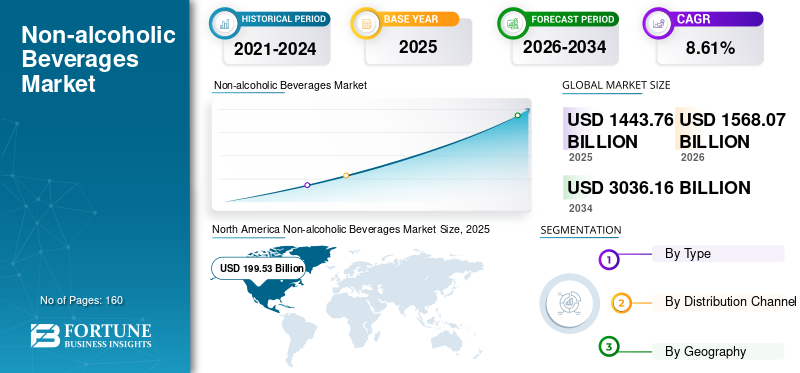
According to Fortune Business Insights: The global non-alcoholic beverages market was valued at USD 1,443.76 billion in 2025 and is projected to grow from USD 1,568.07 billion in 2026 to USD 3,036.16 billion by 2034, exhibiting a CAGR of 8.61% during the forecast period. North America is credited with a 21.71% market share in 2025. The U.S. market alone is projected to reach USD 246.90 billion by 2032, driven by shifting consumer preferences toward healthier drink options.
Non-alcoholic beverages account for more than 50% of the global beverage market, and their share has been growing for several years. The market is supported by the rising popularity of refreshment drinks, relaxed trade duties and tariff barriers in overseas markets that have encouraged manufacturers to strengthen production capacity worldwide, and emerging markets where shifting consumer demand and innovative products create multiple growth opportunities.
Get a Sample Research PDF: https://www.fortunebusinessinsights.com/enquiry/request-sample-pdf/101927
Market Trends
Nutritious Beverages: Consumers, especially millennials, are becoming more experimental and willing to try healthier alternatives to traditional soft drinks. This is pushing manufacturers to reformulate products and launch nutrient-enriched drinks that reflect the evolving tastes of millennials and their children. According to Key National Health and Nutrition Organizations (2019), adequate intake of healthy beverages in early childhood is an important factor in meeting the nutritional needs of young children and supporting healthy development. New nutritious beverages are expected to aid market expansion during the forecast period.
Growth Factors
Innovative Beverages Supporting Hydration: Non-alcoholic beverages offer more than basic refreshment. They are used for mood enhancement, as fortified drinks, and to satisfy sweet indulgences during hectic daily schedules, and regular intake helps keep the body hydrated. Convenience drinks such as canned carbonated soft drinks and ready-to-drink (RTD) coffee and tea have become mainstream, offering grab-and-go convenience. According to the Food Export Association (2019), sales of RTD tea and coffee grew by approximately 24% over the preceding four years. Rising dependence on soft drinks and other innovative products is expected to support market growth.
E-Commerce Platforms: Virtual shopping trends are expected to have a large impact on the beverage sector as consumers rely more on the internet. According to the Global E-commerce Foundation (2018), approximately 30% of global grocery revenue was achieved through e-commerce, a share expected to rise. Soft drink manufacturers are therefore developing new online stores to support the market.
Restraining Factors
Natural Resource Availability and Price: The industry relies heavily on natural resources such as energy and water, which creates social and environmental externalities. Indirect greenhouse gas emissions, reduced water availability, and pollution can disrupt the availability of those resources and hamper production. Manufacturers have recognized the risks and opportunities tied to sustainability and, together with other industry players, formed the Beverage Industry Environmental Roundtable (BIER), a technical coalition of leading companies such as The Coca-Cola Company and PepsiCo that promotes sustainability in the beverage sector.
Segmentation Analysis
By Type: Carbonated soft drinks (CSDs) hold the largest share on easy availability and low price. Consumers buy new and flavored CSDs as thirst quenchers for their refreshing properties, and developing markets such as India and China contribute major shares to this segment as consumers' economic conditions improve. RTD drinks, juices, and sports drinks are expected to grow faster as consumers worldwide shift toward healthier drinks. The market covers CSDs, RTD coffee and tea, bottled water, fruit beverages, and others including sports and functional drinks.
By Distribution Channel: Supermarkets and hypermarkets lead on wider product availability. Retailers use technology and equipment on the floor to offer quality beverages and an easy shopping experience. According to the Food Industry Association (2018), about 43% of total grocery sales in 2017 went through supermarkets and hypermarkets, which represents a major share of non-alcoholic beverage sales every year. Supermarkets are also focusing on new regulatory requirements, such as refrigerant leak rules overseen by the EPA, to avoid penalties and maintain product quality. The other channels are the food services sector, convenience stores, specialty stores, and online retail.
Regional Insights
The source describes Asia Pacific as the dominant region and expects it to remain so over the forecast period, thanks to steady improvement in disposable income and living standards. Growing westernization and modernization have raised spending on beverages. According to the International Wines and Spirits Record (IWSR), non-alcoholic brands will show significant growth in such markets as consumers look for ways to reduce their alcohol intake. The same report credits North America with the largest single-region share at 21.71% in 2025.
North America and Europe are expected to grow at a significant CAGR because of increased demand for RTD beverages and sports drinks. Alcohol consumption in these regions is declining, and consumers are focusing on "better-for-you" products that promote healthy soft drinks.
The Middle East & Africa and South America account for a lower share because of sub-optimal product penetration in underdeveloped markets in those regions. Country coverage in the report spans the U.S., Mexico, and Canada in North America; the U.K., Germany, France, Italy, Spain, and Russia in Europe; Japan, China, India, and Australia in Asia Pacific; Brazil and Argentina in South America; and South Africa and the UAE in the Middle East & Africa.
Connect with Our Expert for any Queries: https://www.fortunebusinessinsights.com/enquiry/speak-to-analyst/101927
Key Industry Players
The market is highly consolidated, with a handful of companies holding significant positions. These companies are focused on meeting evolving consumer preferences and ongoing trends. The Coca-Cola Company, the world's major beverage brand, is adding to its VitaminWater range, fermented drinks, probiotic drinks, and RTD beverages. In March 2019, it launched a carbonated Jaljeera drink in India to cater to demand for energy drinks in the country. The dominance of the key players, with their strong production and distribution capabilities, helps them stay ahead.
Top companies include PepsiCo, Inc. (U.S.), The Coca-Cola Company (U.S.), Nestlé S.A. (Switzerland), The Kraft Heinz Company (U.S.), Dr. Pepper Snapple Group, Inc. (U.S.), Reed's, Inc. (U.S.), Appalachian Brewing Co. (U.S.), Arca Continental SAB de CV (Mexico), ITO EN Ltd (Japan), and Monster Beverage Corp (U.S.).
Key Industry Developments
April 2025: Keurig Dr Pepper announced its Q1 2025 results and reaffirmed its guidance for the year, continuing to focus on strong financial performance and strategic growth initiatives.
March 2025: PepsiCo announced net revenue of nearly USD 92 billion in 2024, driven by a complementary beverage and convenient foods portfolio that includes Lay's, Doritos, Gatorade, and Pepsi-Cola.
February 2025: Coca-Cola added over 250,000 net new outlets and nearly 600,000 new coolers globally in 2024, aiming to increase consumer recruitment and drive long-term balanced revenue growth.
August 2024: Nestlé's Health Science segment reported a 2.4% decrease in reported sales to CHF 3.2 billion. Europe delivered high single-digit growth, while other regions saw slightly negative growth.
July 2024: Nestlé reported half-year 2024 organic growth of 2.1%, with real internal growth of 0.1% for the first half and 2.2% for the second quarter.
What Everyone Should Know About Japan’s Market Non alcoholic Beverages Market Insights